The Unkei attribution problem: the small core and the large penumbra
- Title
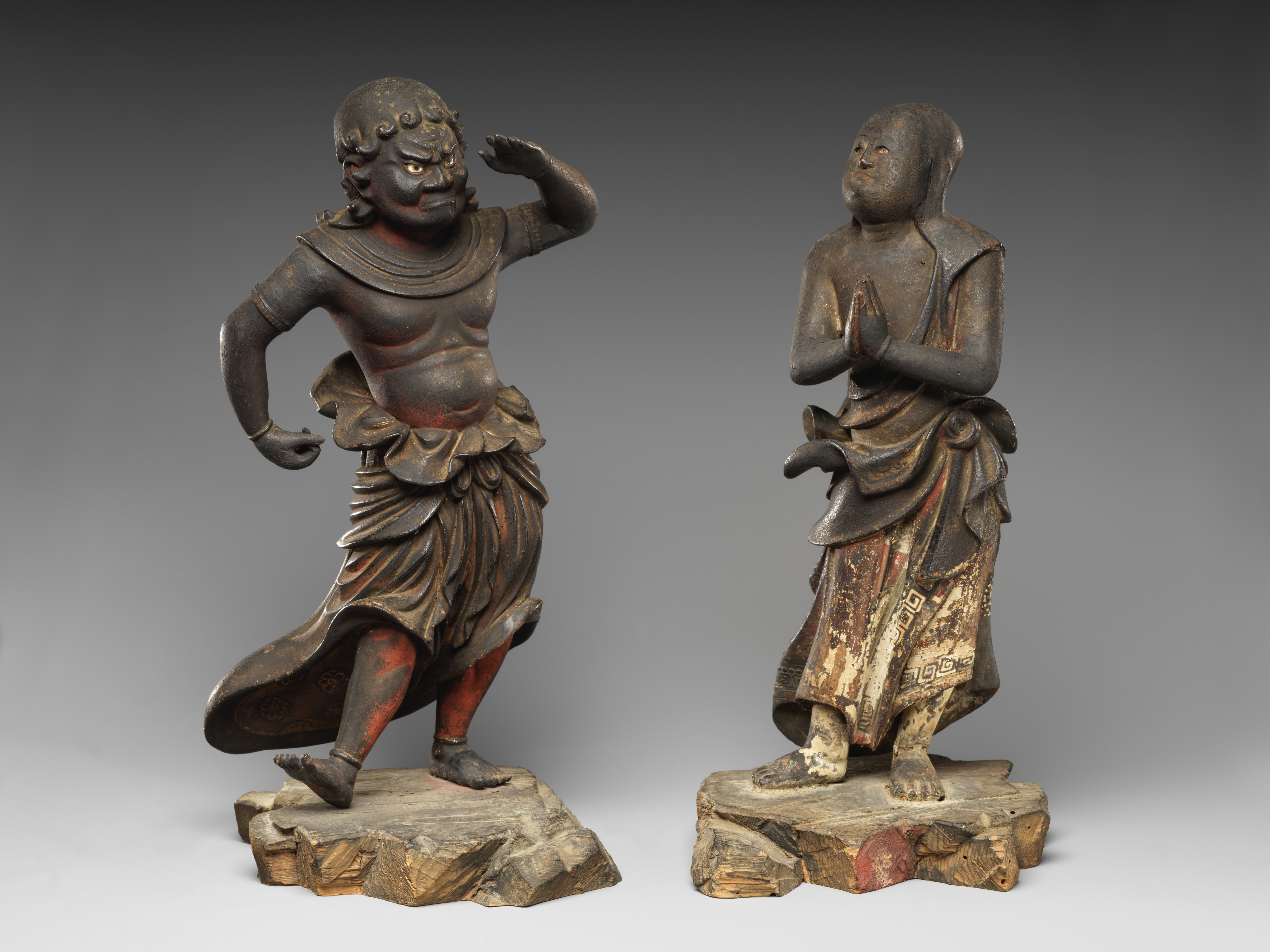
- The Boy Attendants Kongara Dōji and Seitaka Dōji — The Metropolitan Museum of Art (acc. 2018.17.1, .2)
- Period
- Nanbokuchō period (1336–1392), c. 1350
- Region
- Japan
- Medium
- Lacquered wood with traces of paint, inlaid glass eyes; joined-block construction (yosegi-zukuri)
- Collection
- The Metropolitan Museum of Art — Open Access
- Accession
-
2018.17.1, .2 - Rights
- Public domain (CC0-equivalent Open Access). The Metropolitan Museum of Art, Purchase, Mary Livingston Griggs and Mary Griggs Burke Foundation Fund and Brooke Russell Astor Bequest, 2018 (acc. 2018.17.1, .2). Public-domain status re-confirmed live via the Met Collection API on 2026-05-16.
Each about 34.3 cm. Fudō Myōō's two boy acolytes, carved a century and a half after Unkei in the manner his workshop standardised. Artist recorded by the Met as 'Unidentified': no signature, no recovered deposit, no documented hand — the ordinary state of the corpus the Unkei attributions are read against.
Only a small core of works can be tied to Unkei by documents sealed in the wood: the Enjō-ji Dainichi (1175–76), the Ganjōju-in and Jōraku-ji groups (1186–89), the Tōdai-ji Niō (1203, with Kaikei), the Kōfuku-ji Hokuendō Miroku (1212). Everything else is attributed by style. The 1212 inscription that names Unga “in charge of” a figure now credited to Unkei alone is where the method shows its seams. Met’s unsigned Nanbokuchō acolyte pair (acc. 2018.17.1, .2) is read here as the penumbra itself.
What this is and what it is not
The two small figures in front of the reader were not carved by Unkei. They are Kongara Dōji and Seitaka Dōji, the boy acolytes who stand at the feet of Fudō Myōō, Japanese, catalogued by the Metropolitan Museum to the Nanbokuchō period and dated about 1350 (acc. 2018.17.1, .2; objectID 757344). That is a century and a half after Unkei’s death. The Met records the artist as “Unidentified.” There is no signature, no recovered cavity deposit, no document that names a hand. The public-domain status was re-confirmed live through the Met Collection API on 2026-05-16.
This article is not about these figures as objects. It is about what the absence on them is the absence of, and how the field decides what an “Unkei” is when almost nothing carries his name. The pair is the vehicle: an honest specimen of the ordinary condition of Kamakura and Nanbokuchō Buddhist sculpture, in which the work survives and the maker does not. Most of the corpus looks like this. The interesting fact is that one sculptor’s name is nonetheless attached, with confidence, to a body of work many times the size of the handful of pieces that can actually be tied to him. How that attachment is made, where it holds, and where it stops holding, is the subject.
The core: a handful of figures with documents inside them
Start with what is secure, because it is surprisingly little. The works that can be tied to Unkei on documentary rather than visual grounds form a short list, and every entry on it is anchored by writing on a pedestal or sealed inside the figure, not by the look of the carving.
The earliest is the seated Dainichi Nyorai at Enjō-ji in Nara. An inscription on the pedestal records that the work was begun in 1175 and finished the following year, and names the maker as the “true apprentice of Kōkei, Unkei.” This is the first object that can be assigned to him with any certainty, and it is assigned by a sentence carved into the base, not by connoisseurship. A decade later come two sets of figures in the eastern provinces, made for warrior patrons rather than the Nara temples: the Ganjōju-in group in Shizuoka, carved in 1186 for Hōjō Tokimasa, and the Jōraku-ji group in Kanagawa, 1189. Neither set was recognised as Unkei’s until inscribed wooden tablets were recovered from inside the statues: four tablets from the Ganjōju-in Fudō and Bishamonten figures, and tablets in each of the Jōraku-ji images naming Unkei as the maker with ten shōbusshi (minor sculptors) assisting. The attribution of these provincial works followed the discovery of the tablets; it did not precede it.
Then the two great Nara commissions. The Tōdai-ji Nandaimon Niō of 1203, the pair of guardian giants in the great south gate, was a collaboration with Kaikei and other masters, documented in the temple records, with the joined-block giants finished in roughly seventy-two days by a large team. (bodhi reads the Niō commission itself in its own study; the point here is only that the documentary record fixes the project and the participating masters, not the chisel-by-chisel division.) Last is the Kōfuku-ji Hokuendō Miroku of 1212, the Maitreya Buddha for the rebuilt Northern Octagonal Hall, with the flanking Yogācāra patriarch portraits Mujaku and Seshin. This commission is the documentary high-water mark of the whole problem, and the next two sections are about why.
That is close to the entire secure list. A few further pieces (late figures at the Tōdai-ji Daibutsuden, a small number of provincial images) extend it modestly. Everything else attributed to Unkei, and that is most of what is called “an Unkei,” rests on style.
How the method actually works: the document, not the chisel
The decisive evidentiary instrument is not the carving. It is zōnai nōnyū (像内納入), the Kamakura practice of sealing written and physical material into the hollow of a joined-block image: dedicatory petitions, dated colophons, sponsor and devotee name-lists, sūtra texts, sometimes relics, and, for the attribution question, inscribed tablets and pedestal records that name makers and assign roles. A signature carved on a peg under a foot, or a tablet placed in the cavity before the figure was closed and lacquered, is what moves a work from the penumbra into the core. The Ganjōju-in and Jōraku-ji cases are the textbook demonstration: figures that art history could not place by eye were placed, decisively, by tablets that had been sealed inside them for seven centuries.
This produces the central asymmetry of the field. The Kamakura period is unusually well documented for Japanese sculpture, because busshi began to sign and to deposit with new frequency, so historians know more about individuals and workshops than in any earlier era. And yet the documented core of even the most famous busshi is a short list, because deposits are lost, cavities are never opened, pedestals are recut, fires take temples whole. The Ganjōju-in and Jōraku-ji groups also carry a second lesson the literature is careful about: their style, rough and massive in the body and complicated in the drapery, differs from the Enjō-ji Dainichi and the Hokuendō Miroku. If those eastern works had not been tablet-secured, a connoisseur reasoning from the documented Nara pieces alone might have argued them out of Unkei’s hand on stylistic grounds. The documents corrected the eye. That is the order of authority the method runs on, and it is worth holding onto when reading any unsigned figure, including the two in front of us.
The seam: the 1212 inscription names someone else
The Hokuendō commission is where the method’s authority and its limits sit in the same object. An inscription inside the base of the central Miroku records the names of the sculptors placed “in charge” of the surrounding figures of the programme. For the Seshin (Vasubandhu) portrait, that named sculptor is Unga, described as Unkei’s “fifth son,” not Unkei. The name of the sculptor assigned to the Mujaku (Asaṅga) is damaged and illegible. These two patriarch portraits are among the most celebrated objects in Japanese art, and they are credited, in almost every general account, to Unkei alone.
Set the two statements side by side without smoothing them. The primary document, the 1212 inscription, the same class of evidence that authenticated Enjō-ji, Ganjōju-in and Jōraku-ji, assigns Seshin to Unga. The standard attribution assigns it to Unkei. Both cannot be literally true in the sense “carved by.” The reconciliation the field uses is that a master is the one who dictates style and output, that a directing busshi designed, supervised and finished what his named sub-masters roughed out, and that workshop production is properly credited to the master-in-charge. That reconciliation is defensible and is probably right at the level of artistic responsibility. But it is a convention about what authorship means, not a reading of the document, and the convention is doing the work that the inscription, read literally, does not do. Notice the structural awkwardness, stated plainly by the practitioner literature: were the inscription’s named sculptor not the relatively obscure Unga but no one of note, no one would hesitate to read it as written; it is partly the unthinkability of conceding Japan’s most famous portraits to a lesser name that keeps the convention firmly in place. bodhi does not adjudicate the Seshin figure here. The Hokuendō pair has its own single-work study, and the consensus that both patriarch portraits are substantially Unkei’s late personal work rests on the unified facial handling across the two. The point for the method is narrower and sharper: at the one place where the documentary instrument speaks against the famous name, the field overrides the instrument with a convention. That is the seam, and an honest account of “an Unkei” has to show it rather than paint over it.
The penumbra: attributing by style, and the modern test case
Outside the core, attribution is connoisseurship: facial structure, the carving of hair, drapery logic, the handling of weight and torsion, set against the documented pieces. Done well, by scholars like Samuel C. Morse and the lineage of Japanese specialists from Kobayashi onward, this is disciplined comparative work, not guesswork; the Mary Griggs Burke Center’s “Invention and Revival” lectures on the Kei school are built on exactly this method. But it is style reasoning, and its conclusions are weaker than a tablet, and the field generally marks them as “attributed to” or “workshop of” rather than flatly “by.”
The clearest modern demonstration is the Shinnyo-en Dainichi Nyorai, a 66.1 cm gilded cypress seated Dainichi sold at Christie’s New York in March 2008 for US$14.37 million, at the time the highest auction price ever paid for a Japanese or Buddhist art object. The figure carries no signed attribution. The Unkei (or Unkei-workshop) case was built on the late-twelfth-century style (facial expression, drapery design, the technique of the carved hair) and reinforced by X-ray imaging that revealed objects sealed inside the body, the deposit reasserting itself as evidence even when its texts cannot be read in situ. Scholarship has framed the figure as attributed to Unkei’s workshop (the 2008 Orientations treatment is explicit about the workshop hedge), not as a documented Unkei. The $14 million did not buy a signature. It bought the strongest possible style-and-deposit argument, honestly labelled as an attribution. That is the upper bound of what the penumbra can support, and the museum-versus-market gap is instructive: the market will pay for a confident attribution, but the careful catalogue still writes “attributed to” and “workshop of.”
The common misreading runs the other way and should be named. The popular register treats “an Unkei” as a fact about the chisel, Unkei carved this, when for most of the corpus the defensible claim is this belongs to the body of work the field assigns to Unkei and his workshop on stylistic grounds. The first is biography; the second is classification. Conflating them is how a directing master’s name comes to stand, in the general account, for the hands of a workshop whose other members, Unga among them, the documents actually name.
Reading the two boys honestly
Which returns us to the figures in the case. At about 34.3 cm each they sit at chest height in a gallery vitrine, read at arm’s length and from above, the way a collector handles a pair, which is the opposite of how the documented core is met: the Hokuendō Miroku is an over-life-size hall image a visitor looks up at from a Nara temple floor, and its authenticating inscription is sealed where no gallery viewer will ever stand. The two boys are lacquered wood gone dark, with inlaid glass eyes that still catch the case lighting and a little surviving paint. Kongara stands with hands joined; Seitaka holds a staff and wears the scowl the type requires. They are carved in the joined-block, inlaid-eye, realist manner that Unkei’s generation made the Kei standard and that the workshop transmitted forward, a manner so thoroughly diffused that, by about 1350, a competent atelier could produce a clean pair of acolytes entirely inside it. They look like the tradition because they are the tradition, two more generations down.
What the Met has, and states, is the honest version: Japanese, Nanbokuchō, about 1350, artist unidentified. No tablet, no signature, no deposit on the record. By the standard that authenticated Enjō-ji, the pair is mute. It can be placed in a period and in a manner descended from the Kei workshop; it cannot be placed with a hand. The temptation the whole article is about is to let the manner stand in for the missing name: to call anything that looks like the Kei realist mode “Unkei school” and slide from there to “an Unkei.” These figures are well past Unkei’s lifetime and no one would make that slide here, which is exactly why they are useful: they show the slide for what it is when the dates make it impossible. The same restraint the dates force here is the restraint the method requires everywhere, including for figures close enough to Unkei’s lifetime that the slide is tempting.
What the name can and cannot do
Two readings of “an Unkei” are easy to confuse and worth separating. The first: a work is an Unkei because it has Unkei’s manner. The second: a work is an Unkei only if a document (a pedestal inscription, a sealed tablet, a dated colophon) ties it to him, and is otherwise, at most, “attributed to” or “workshop of.” The first treats the name as a style readable in the wood. The second treats it as a claim that needs the archive, the way the Ganjōju-in and Jōraku-ji tablets, and not the carving, settled those works.
bodhi commits to the second. The secure Unkei is the short documented list (Enjō-ji 1176, Ganjōju-in and Jōraku-ji 1186–89, the Tōdai-ji Niō of 1203, the Hokuendō Miroku of 1212), and the honest description of the rest is “attributed,” with the strength of the attribution stated rather than hidden. The residual uncertainty is real and specific in two directions. The core could grow: an unopened cavity or a recovered deposit could pull a penumbra figure in, exactly as tablets once pulled in the eastern works. And the core’s own showpiece is contested from inside: the 1212 inscription names Unga where the convention names Unkei, and the field’s reconciliation is a convention about authorship, not a reading of the text. The roster wording and the Unga clause here are reported from the museum and the practitioner literature and have not been checked against a primary Japanese cultural-property report; that is the load-bearing gap, stated here rather than smoothed over. An “Unkei” is a contested category because the name does two jobs at once — documented authorship and stylistic classification — and reading the corpus well means saying, of any given figure, which job the name is doing.
Related
- The Kei school as a genealogy — the workshop the name sits inside
- Kōfuku-ji Hokuendō Miroku (1212) — the inscribed centre of the problem
- Kōfuku-ji Hokuendō Mujaku — the Seshin/Unga question on one figure
- Tōdai-ji Niō (1203) — the documented Unkei–Kaikei collaboration
- Rokuhara-mitsu-ji Jizō — a documented Unkei-circle figure
- The An’ami standing Amida — Kaikei’s signed counter-case
- Unkei (entity)
- Kaikei (entity)
- Kei school (entity)
Sources
-
[7]2026-05-16Mary Griggs Burke Center for Japanese Art, Columbia University burkecenter.columbia.edu/lectures-symposia/spring-lecture-seri…