Kuhon ōjō: reading the nine grades of rebirth
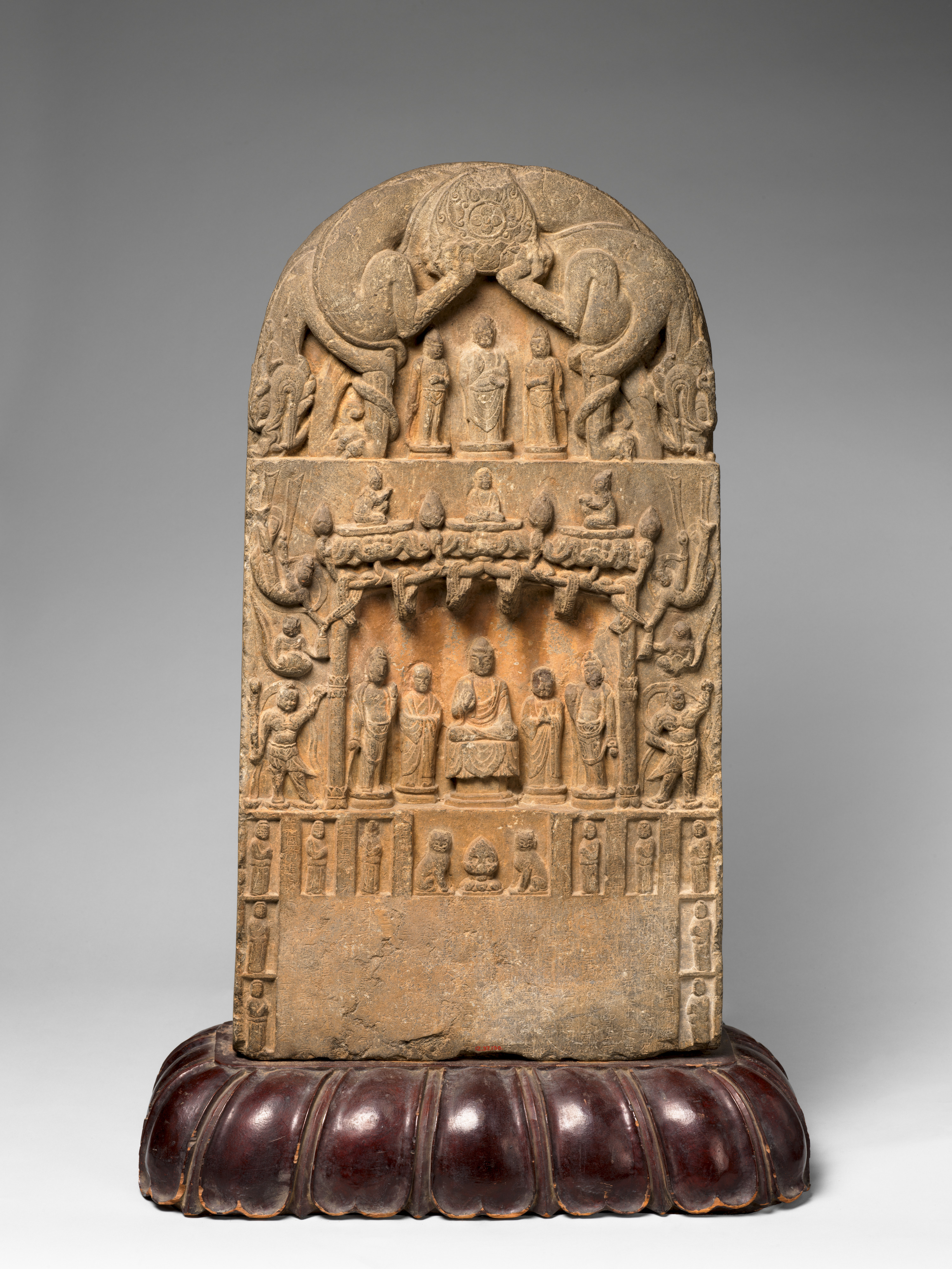
- Title
- Stele with Pure Land Imagery
- Period
- China, Tang dynasty (618–907), dated 758
- Region
- China
- Medium
- Limestone
- Dimensions
- H. 87.9 cm × W. 58.4 cm × D. 28.6 cm (34 5/8 × 23 × 11 1/4 in.)
- Collection
- The Metropolitan Museum of Art
- Accession
-
12.37.130 - Rights
- The Metropolitan Museum of Art (CC0 / Open Access, public domain); Rogers Fund, 1912, acc. 12.37.130.
*Stele with Pure Land Imagery*, China, Tang dynasty, dated 758. Limestone, H. 87.9 cm. The Metropolitan Museum of Art, New York, accession 12.37.130, Rogers Fund, 1912. CC0 (Met Open Access, public domain). Source: metmuseum.org/art/collection/search/61506. Read here as the continental ancestor of the Japanese kuhon raigō, not as a captioned nine-grade sequence.
Kuhon ōjō is the Contemplation Sutra’s 3×3 ranking of rebirth in Amida’s Pure Land: upper/middle/lower grades, each split superior/middle/inferior. A kuhon raigō diagrams a different welcoming party for each, and the kuhon-in is the matching nine-mudrā set.
What the matrix is
Kuhon ōjō (九品往生) is a sorting system. The Kanmuryōjukyō (the Sutra on the Contemplation of Amitāyus, the third of the three Pure Land sutras and the textual spine of every diagram discussed here) closes with three contemplations, the fourteenth, fifteenth, and sixteenth. They sort every being who will be reborn in Amida’s Pure Land into three grades: upper (jōbon 上品), middle (chūbon 中品), lower (gebon 下品). Each grade is then cut again into three: superior birth (jōshō 上生), middle birth (chūshō 中生), inferior birth (geshō 下生). Three times three is nine, and the nine are the kuhon.
The cut is moral and practical, not arbitrary. The upper grade is for beings who generated the three minds (sincerity, deep faith, the aspiration to transfer merit) and who studied the Mahāyāna. The middle grade is for precept-keepers and the filial. The lower grade is for wrongdoers. The inferior birth of the lower grade, gebon geshō, is explicitly reserved for those who committed the five grave offences and the ten evils and are saved only by ten deathbed recitations of the Buddha’s name. The system’s argument is that the Pure Land has a door for everyone, including the murderer, and that the door is graded, not closed.
What makes kuhon an iconographic subject rather than only a doctrinal one is that the sutra attaches a different welcoming scene to each of the nine. The deathbed is the hinge. For each grade the sutra specifies who comes for the dying person, what vehicle carries them, and how long the lotus stays shut once they arrive. A painter who wants to depict kuhon is being handed nine compositions, not one, and the discipline of reading a kuhon image is the discipline of telling which of the nine you are looking at.
The differentiated welcoming party, grade by grade
The sutra’s specifications are precise enough to function as a key. The reading below follows Inagaki’s BDK translation of the Kanmuryōjukyō for the structure; the per-grade detail is the sutra’s own, paraphrased close.
For jōbon jōshō, the top of the top, Amida comes in person, attended by Kannon and Seishi, by countless transformation buddhas, and by a host of monks. The dying person is carried on a diamond platform (kongōdai) and is reborn in the time it takes to snap a finger; the lotus opens at once and the insight called the non-arising of dharmas follows immediately. For jōbon chūshō the platform is purple-gold and the lotus opens after one night. For jōbon geshō the welcome thins. Not Amida and the two great bodhisattvas in their full bodies, but five hundred transformation buddhas who extend their hands, and a golden lotus that takes a day and a night to open and three weeks before the figure inside sees clearly.
The middle grade keeps Amida but strips the retinue. Chūbon jōshō is met by Amida with monks and emits golden light; the practitioner attains the arhat fruit on the spot. Chūbon chūshō rides a seven-jewelled lotus that opens after seven days. Chūbon geshō, the merely filial, with no formal practice, gets no descent at all in the sutra’s account: a good friend appears at the deathbed and explains Amida’s vows, and the rebirth follows as fast as a strong man bends and straightens his arm.
The lower grade is where the welcoming party contracts to almost nothing and the waiting expands enormously. Gebon jōshō is met by a transformation buddha, a transformed Kannon, a transformed Seishi, every figure a phantom emanation rather than the body itself, and the lotus stays shut seven weeks. Gebon chūshō sees only transformation buddhas and bodhisattvas on heavenly flowers; the hellfire that was already rising at the deathbed turns to a cool breeze; the lotus opens after six kalpas. Gebon geshō, the murderer saved by ten recitations, gets no figure at all at the moment of death, only a golden lotus “like the sun,” and waits twelve great kalpas inside the closed flower before Kannon and Seishi arrive to expound the true nature of things. The image-grammar of kuhon is built on this gradient. The higher the grade, the more complete the body that comes and the faster the flower opens; the lower the grade, the more the welcome is a phantom and the longer the calyx stays sealed.
How a kuhon raigō diagrams the gradient
A kuhon raigō-zu (九品来迎図) is a painting that takes those nine scenes and lays them out as a set. The canonical Japanese instance is at Byōdō-in in Uji: the wall and door paintings of the Phoenix Hall, the surviving Heian programme around Jōchō’s seated Amida of 1053, which Byōdō-in itself describes as “Japan’s oldest existing kuhon raigō-zu in the Yamato-e style.” The doors were painted with the descent scenes so that a worshipper moving around the hall passed grade by grade; the panel Byōdō-in singles out by name, the Jōbon chūshō-zu, is described as the second level in the nine, and the programme as a whole illustrates the belief that “Amida Buddha classifies a person’s deeds into nine levels at their death.” The original removable doors have been replaced by reproductions; the surviving panels are conserved off the structure.
The other route by which kuhon reaches a Japanese painting is the Taima mandala. ten Grotenhuis, in Japanese Mandalas, reads the Taima composition as a central Pure Land court framed by three narrative borders: the left border carries the prefatory legend of Queen Vaidehī, the right border the thirteen specific meditations, and the bottom border (the Court of General Meditations, the sanzengi) the nine grades of birth. Her reading of the bottom register is the one to carry into any kuhon image: rank is encoded as distance from Amida and as the state of the lotus. The higher grades sit nearer the central pond with their flowers open; the lower grades are pushed to the margins and shown still enclosed in the calyx. Proximity is grade. A sealed lotus far from the Buddha is not decoration; it is a specific entry in the matrix, almost always one of the three gebon births.
This is where the popular reading goes wrong. The standard online gloss flattens kuhon into “nine levels of paradise,” as if the Pure Land had nine neighbourhoods and your conduct bought you a better address. The sutra does not say that. Every grade arrives in the same Pure Land. What differs is the welcoming party, the speed of the lotus, and the length of the wait before the flower opens onto the Buddha’s teaching. Kuhon ranks the passage, not the destination. The diagram is a diagram of arrival conditions, and bodhi reads it as the sutra writes it: nine doors into one land, not nine lands.
The stele as the diagram’s continental ancestor
No early Japanese kuhon raigō survives in a Western public-domain collection; the Byōdō-in doors are conserved in Uji, the Taima recensions sit in Japanese temple and museum holdings, and the form is, like several Pure Land subjects, effectively absent from the CC0 tracks. What the open collections do hold is the diagram’s ancestor: the Chinese Pure Land stele, the medium in which the Contemplation Sutra’s tableau was first compressed into a single carved field.
The Metropolitan Museum’s Stele with Pure Land Imagery (acc. 12.37.130, dated 758, Tang dynasty, limestone, 87.9 cm high) is one such object, and reading it teaches the grammar that the later Japanese paintings inherit. The stele is organised in horizontal registers under a round-topped arch. At the apex, in the lunette, a small triad. Below it the principal scene: Amitābha enthroned at centre under a tasselled canopy, flanked by standing bodhisattvas and a tight assembly, with three small seated buddhas ranged along a beam above the canopy like a clerestory. The carving is shallow and the assembly is packed. The sculptor has put more figures into the panel than the space comfortably holds, which is itself the Pure Land argument: abundance pressed in as a visual claim.
Stand close to the lower third, where the stone is most worn. A separate, lower register runs along the base: a row of small figures, some seated frontally, set among what read as lotus forms and a shallow basin. This is the iconographic seed of kuhon. The Pure Land paradise tableau of the Tang, the genre the Contemplation Sutra generated in stone and on the Dunhuang walls, characteristically places along its lower edge small beings emerging from or seated within lotus blossoms in a pond: the reborn, shown at the moment the calyx opens. The Met record gives no curatorial narrative for this object and the lower band is too abraded to count discrete figures, so the claim here is deliberately bounded. The stele carries the Pure-Land-rebirth-by-lotus register that the kuhon system later differentiates into nine; it is not a captioned nine-grade sequence. The reading is of the grammar, not of nine labelled scenes. The Japanese kuhon raigō is what happens when that worn lower band is pulled out, enlarged, and split into the sutra’s three-by-three.
The kuhon-in: the matrix as a set of hands
The most compact form the diagram ever takes is not a painting at all. It is a hand. When Amida is shown, sculpted or painted, in one of nine specified mudrā, the figure is the matrix; the grade is read off the fingers. This set is the kuhon-in (九品印).
The construction is regular. Three base gestures carry the three grades: the meditation gesture (jō-in, hands cupped in the lap) for the upper grade, the preaching gesture (seppō-in, hands raised) for the middle, and the welcoming gesture (raigō-in, one hand raised, one lowered) for the lower. Within each base gesture, three finger contacts mark the three births: thumb to index finger for superior birth, thumb to middle finger for middle birth, thumb to ring finger for inferior birth. The grade is the posture of the arms; the birth is which finger the thumb touches. Read the arms, then read the fingers, and the nine resolve.
The canonical sculptural realisation is the Kuhonbutsu, the nine Amida statues of Jōshin-ji in Setagaya, Tokyo. This is a Jōdo-shū temple founded in 1678 by the priest-sculptor Kaseki, who carved the figures with his disciple Kaoku; its three subsidiary halls (jōbon-dō, chūbon-dō, gebon-dō) each enshrine three Amida figures, nine in all, each holding a different mudrā of the kuhon-in. That undertaking, one carver committing to nine distinct manifestations across a working lifetime, is itself a statement about the system: the nine are nine forms of one Buddha, distinguished only by the hands. The same logic governs the smaller Amida figures. The mida no jō-in, thumbs to index fingers, is the upper-grade superior-birth gesture that became the default Amida sculptural hand in Japan precisely because it sits at the top of this grid.
The mudrā set is described consistently across the standard iconographic references (JAANUS, the Jōdo-shū presentational material, and the survey literature), but the underlying finger geometry is transmitted through that reference layer rather than pinned here to a single scholarly page; that gap is flagged honestly in the source notes. The structure itself is not in dispute: nine grades, three base gestures, three finger contacts, one Buddha.
Why the diagram mattered
Kuhon did real work in Japanese devotional history because it solved a problem that pure faith-language leaves open: what about the wicked, and what about the deathbed. The Contemplation Sutra’s answer is the lower grade. By specifying that gebon geshō (the worst case, the five grave offences) is still inside the matrix, reachable by ten recitations, the sutra makes the Pure Land argument total: there is no life so bad that it falls off the diagram. Genshin’s Ōjōyōshū (985) built its deathbed practice on exactly this register, and the kuhon raigō paintings are its visual instrument: a dying person, or those attending one, could look at the relevant grade’s descent and know which welcoming party the sutra promised for a life like this one.
The residual uncertainty is art-historical, not doctrinal. The structure of kuhon is fixed by the sutra and stable across a millennium of images. What is not settled is how literally any given painting follows the sutra’s per-grade specifications versus a workshop’s abbreviated convention. Byōdō-in’s surviving panels are few and their original nine-door sequence is partly reconstructed; the Taima bottom border compresses the nine into a register where individual grades are read by position more than by caption. bodhi’s reading commits to the sutra-literal grammar, proximity, lotus state, completeness of the welcoming body, as the reliable key, while naming the open question: for many surviving kuhon images the exact grade of a given panel is inferred from that grammar, not from an inscription, and the inference is only as good as the grammar holds.
Related
- The Taima mandala, the Heian recension, read
- Byōdō-in’s Jōchō Amida, the central image the kuhon doors surround
- The White Path between two rivers, the other Pure Land diagram
- Amida raigō, the welcoming descent
- Raigō with twenty-five bodhisattvas
- Amida (entity)
- Raigō (entity)
- Kanmuryōjukyō / Contemplation Sutra (entity)