Kannon's thirty-three bodies: reading Lotus Sūtra chapter 25
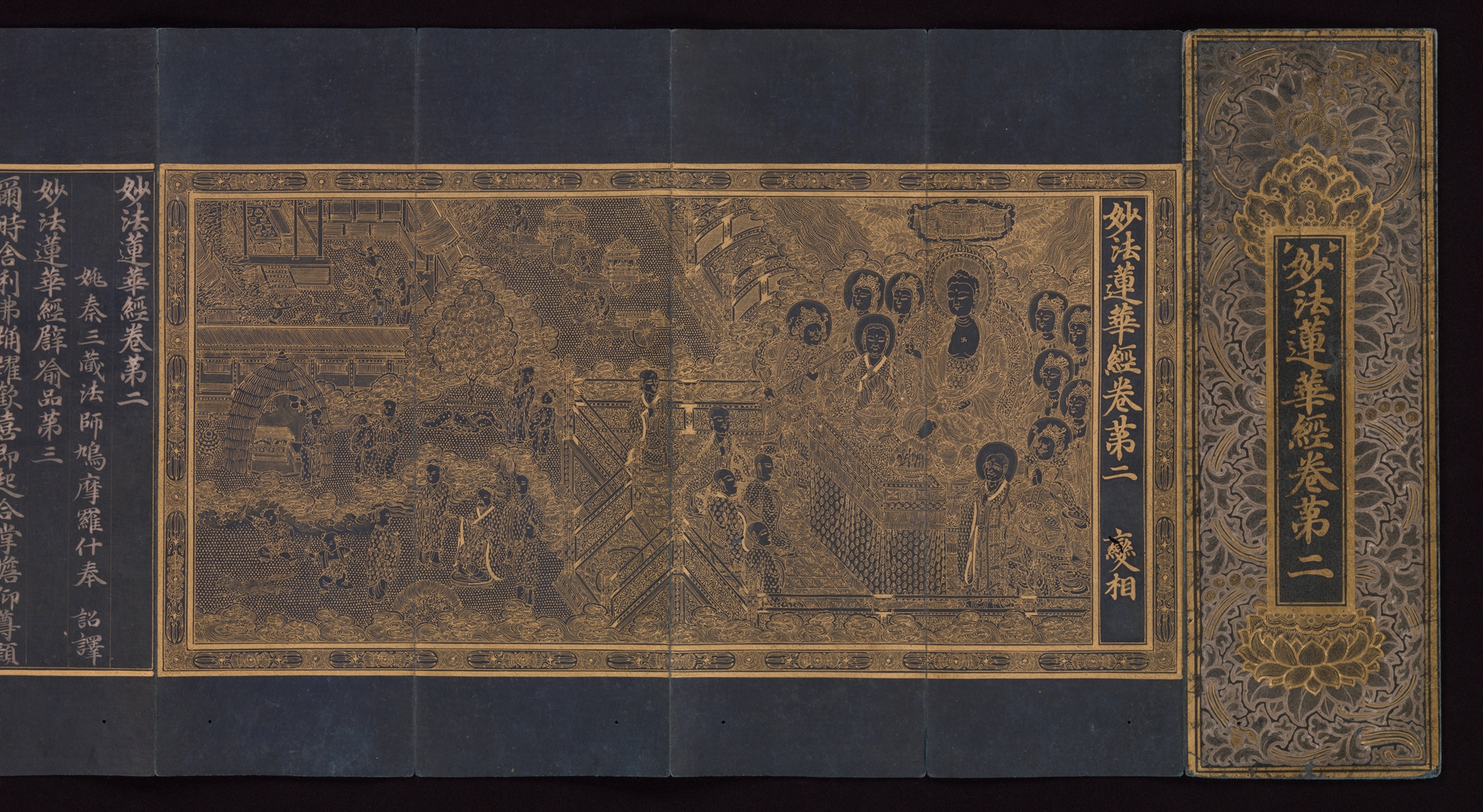
- Title
- Illustrated manuscript of the Lotus Sūtra (Miaofa lianhua jing), Volume 2
- Period
- Goryeo dynasty (918–1392)
- Medium
- Accordion-fold book; gold and silver on indigo-dyed mulberry paper
- Collection
- The Metropolitan Museum of Art, New York
- Accession
-
1994.207 - Rights
- Illustrated manuscript of the Lotus Sūtra (Miaofa lianhua jing), Volume 2. Korea, Goryeo dynasty, ca. 1340. Accordion-fold book; gold and silver on indigo-dyed mulberry paper. The Metropolitan Museum of Art, Purchase, Lila Acheson Wallace Gift, 1994, accession 1994.207. Public domain (Met Open Access).
Met 1994.207, Volume 2 of an illustrated Goryeo Lotus Sūtra, ca. 1340. The gold-on-indigo frontispiece is the surface on which the chapter-25 transformation doctrine was pictured. Public domain (Met Open Access).
Lotus Sūtra chapter 25 has the Buddha enumerate the bodies Avalokiteśvara assumes to teach: buddha, śrāvaka, Brahmā, monk, woman, child, nāga, Vajrapāṇi. Kumārajīva’s Chinese gives thirty-three; the Sanskrit gives sixteen. This is the upāya doctrine of skillful manifestation, read off an illustrated gold-on-indigo Lotus Sūtra, distinct from the later named 33-form devotional gallery.
What chapter 25 actually says
The number thirty-three, in the Kannon literature, belongs to two different things, and almost every popular account collapses them. The first thirty-three is the one read here: the list of bodies the Buddha says Avalokiteśvara takes in order to preach, set out in the twenty-fifth chapter of the Lotus Sūtra. The second thirty-three is the later East Asian devotional gallery of named, pictured Kannon types (White-Robed, Willow-Branch, Fish-Basket, and the rest): a popular iconographic series that crystallised many centuries after the sūtra and is the subject of a separate bodhi reading guide. They are not the same set. They do not even have the same members. The scriptural thirty-three has no White-Robed Kannon in it; it has a nāga, a Brahman’s wife, and a thunderbolt-bearing god.
The chapter is the Guanshiyin pusa pumen pin in Chinese, the Kanzeon Bosatsu Fumon-bon in Japanese: the “Universal Gate” chapter. It is short, it circulates on its own as the Guanyin jing or Kannon-gyō, and its narrative spine is a single exchange. A bodhisattva named Inexhaustible Intent asks the Buddha why Avalokiteśvara is so called and how he moves through the world. The Buddha answers in two registers. First, the rescue register: those who call the name are saved from fire, flood, storm, sword, demons, chains, bandits. Then the register this guide is about: the Buddha enumerates the forms the bodhisattva assumes to teach the Dharma to beings of every condition. The grammatical frame is fixed and repeated without variation. In Tsugunari Kubo and Akira Yuyama’s BDK translation: “To those who are to be saved by the form of a buddha, Bodhisattva Avalokiteśvara teaches the Dharma by changing himself into the form of a buddha. To those who are to be saved by the form of a pratyekabuddha, he teaches the Dharma by changing himself into the form of a pratyekabuddha.”1 The clause repeats, the body changes, the doctrine accumulates by iteration rather than by argument.
The list, in order
The Chinese reckoning that became standard in East Asia counts thirty-three bodies. The order, following Kumārajīva’s Miaofa lianhua jing of 406 CE and the standard English renderings, runs: buddha; pratyekabuddha; śrāvaka (voice-hearer); Brahmā; Śakra (Indra); Īśvara; Maheśvara; a great heavenly general; Vaiśravaṇa; a minor king; an elder or rich householder; a householder; a chief minister or official; a Brahman; a monk (bhikṣu); a nun (bhikṣuṇī); a layman (upāsaka); a laywoman (upāsikā); the wife of an elder; the wife of a householder; the wife of an official; the wife of a Brahman; a boy; a girl; a deva; a nāga; a yakṣa; a gandharva; an asura; a garuḍa; a kiṃnara; a mahoraga; and Vajrapāṇi, the thunderbolt-bearer who closes the list.2 The internal grouping the chapter itself gives is: three holy bodies, six heavenly bodies, five human bodies, the bodies of the four assemblies, four female bodies, the youth and the girl, the eight classes of non-human being, and the diamond-holder.2
It is worth stating plainly what kind of list this is. It is not an iconographic catalogue. None of these thirty-three is a Kannon “form” with fixed attributes a sculptor could carve to a rule. A buddha-body is a buddha; a monk-body is a monk; the Brahman’s wife is a Brahman’s wife. The point of the list is precisely that the bodhisattva is not recognisable in them. He meets the being in the being’s own world, wearing that world’s appearance. The thirty-three are a doctrine of disappearance as much as of appearance.
Thirty-three or sixteen: the translation seam
The roundness of “thirty-three” is a Chinese-language fact, not a feature of the original. The extant Sanskrit Saddharmapuṇḍarīka enumerates sixteen transformation-forms in this passage, not thirty-three; the standard English notes to the chapter flag the correspondences in parentheses against the longer Chinese count.2 The expansion to thirty-three is carried by the Chinese translation tradition that East Asia received, and it is that count, fixed by Kumārajīva’s hugely authoritative 406 version, that the Korean, Chinese, and Japanese pictorial traditions inherited.
There is a second, narrower textual seam in the same chapter, and it bears on dating any illustrated copy. Kumārajīva’s 406 translation rendered chapter 25 in prose. The verse recapitulation now printed at the end of the chapter, the gāthā that re-tells the rescues and the manifestations in metre, was not in Kumārajīva’s text; it entered the Chinese transmission with the Jñānagupta and Dharmagupta revision of 601–602 and was subsequently spliced into the Kumārajīva recension that became canonical.3 The standard East Asian Lotus Sūtra, in other words, is a composite at exactly the chapter this guide reads. An illustrated medieval copy is illustrating the composite, prose-plus-verse chapter 25, not Kumārajīva’s 406 prose alone, a fact worth holding when reading any frontispiece that pictures both the rescues and the manifestations together.
Why “thirty-three bodies” is not “thirty-three Kannon”
This is the distinction that the cluster turns on, so it earns its own section. The scriptural thirty-three is a list of bodies the bodhisattva vacates: provisional appearances adopted and dropped. The later popular thirty-three is a gallery of named Kannon with their own iconography, their own paintings, their own devotional histories: Byakue (White-Robed) Kannon, Yōryū (Willow-Branch) Kannon, Gyoran (Fish-Basket) Kannon, Suigetsu (Water-Moon) Kannon, and so on, conventionally numbered to thirty-three in Chinese and Japanese popular print and pilgrimage culture from roughly the late Ming onward. Chün-fang Yü’s Kuan-yin treats the historical emergence of these named popular forms as a separate development from the canonical sūtra material, driven by indigenous Chinese cult, miracle-tale, and pilgrimage practice rather than by the Lotus text itself.4
The number thirty-three was almost certainly a magnet: the scriptural count gave the later devotional series a sanctioned figure to grow toward. But the membership does not transfer. There is no “Willow-Branch” body in chapter 25; there is no “Brahman’s wife” Kannon in the popular gallery. Conflating them produces the standard pop-Buddhist error, “the Lotus Sūtra describes the thirty-three forms of Kannon you can pray to,” which is wrong twice over: the sūtra describes bodies the bodhisattva becomes and abandons, not forms held as devotional images, and the named gallery is a later, separate, largely Chinese-cult formation. bodhi keeps the two apart on principle; the popular gallery is read in its own guide.4
What an illustrated Lotus Sūtra does with the doctrine
A doctrine of skillful manifestation is hard to picture, because its content is that the manifestations are not stable images. The East Asian illuminated-sūtra tradition solved this not by inventing thirty-three fixed Kannon figures but by pictorialising the narrative of the chapter, the rescues and the preaching scenes, on the frontispiece that precedes the copied text. The hero of this guide is one such object.
Met accession 1994.207 is Volume 2 of an illustrated Lotus Sūtra, Korea, Goryeo dynasty, dated by the museum to about 1340: an accordion-fold book in gold and silver on indigo-dyed mulberry paper, with a painted image panel of roughly 23 by 11 centimetres.5 Volume 2 of a Goryeo Lotus Sūtra does not carry chapter 25; the chapter falls late in the seven- or eight-fascicle division, so this specific book is the form of the object that pictured the doctrine, not the page on which the thirty-three appear. That is the honest reading position, and it is the right one for an iconographic guide: the question is how this kind of book handled the chapter, and the Goryeo gold-on-indigo Lotus is the single most consequential surviving body of illustrated Lotus Sūtra material for exactly that question.
Read the object. An accordion sūtra is not read flat on a wall; it is opened from its stiff embossed cover and the frontispiece is the first painted spread the hand reaches before the copied text begins, so the doctrine is encountered as the threshold to the scripture rather than as a hung picture, at book scale, the painted panel barely the span of two hands. On the indigo ground the entire image is line: gold for the figures and architecture, the darker silver oxidised toward grey, no fill and no modelling, so the painting reads as a luminous diagram rather than a scene with depth. The Buddha sits enthroned at the right under a jeweled canopy, larger than every other figure, ringed by haloed bodhisattvas whose halos are concentric gold rings drawn with compass precision. The left half is busier and smaller in scale: tile-roofed pavilions on a stepped ground, clustered standing figures, small scattered episodes that do not resolve into one continuous space. The figure scale is not uniform within the panel; the seated Buddha is drawn at roughly twice the height of the largest standing attendant, and the left-side narrative figures shrink again below that, a hierarchic sizing that does the reading work a single continuous ground would otherwise do. The gold line itself does not vary in weight across these registers, so the size hierarchy, not the brush, carries the order of importance. This right-heavy, narrative-left composition is not idiosyncratic. The Asian Art Museum’s account of Goryeo sūtra production describes precisely this convention for the early 1300s: “the figure of the Buddha accompanied by his attendants painted in the right half of the frontispiece,” with “key events within the sutra shown on the left half.”6 What the frontispiece offers the chapter-25 doctrine is therefore structural: a preaching assembly that is the recurring scriptural frame (“he teaches the Dharma by changing himself into…”), and a narrative field at the left where the rescues and encounters are staged as small discrete vignettes rather than as a fixed Kannon image. The doctrine is rendered as event, not as portrait — which is faithful to a text whose whole claim is that the bodhisattva has no fixed portrait.
Two physical particulars reward a slow look. The book’s cover, standing at the right edge of the opened object, is not plain: it carries a gold lotus-arabesque embossed into the indigo and a rectangular title cartouche reading 妙法蓮華經卷第二, “Lotus Sūtra, Volume 2,” the gilt decoration heavier and more worn than the interior line, the raised pattern catching where the flat frontispiece does not. And the painted panel is held inside a double border: a plain gold rule, then an inner band of small repeated floral-and-bead units, the kind of patient ruled containment that the eye registers as frame before it registers as ornament. Neither detail is doctrinal. Both are the marks of an object made to a high commissioned standard in a culture that treated sūtra-copying as merit-work; the labour is visible, and it is the labour, not an iconographic programme of Kannon-types, that the chapter-25 doctrine is wrapped in here.
The Goryeo illustrated-sūtra context
The object’s culture is worth one compact paragraph because it explains why a Korean book is the right anchor for an East Asian doctrine. Goryeo Korea produced illuminated Buddhist manuscripts at a level of material extravagance and scribal discipline that made them tribute objects prized in China, Japan, and the Mongol court; gold and silver ground pigment on deep-indigo dyed mulberry paper, in accordion (folding) format, copied as merit by monk-scribes under royal and aristocratic patronage.6 The Lotus Sūtra was among the most-copied texts in this tradition. The thirty-three-body doctrine of chapter 25 thus had, in the Goryeo illuminated Lotus, one of its most lavish material vehicles anywhere in East Asia. The Japanese decorated-sūtra tradition (the Heian and Kamakura gold-and-silver-on-indigo Lotus, and the painted Japanese chapter-25 handscrolls) is a parallel, partly interconnected development of the same impulse. bodhi reads the Japanese painted chapter-25 handscroll separately, on its own anchor object; this guide stays with the doctrine and with the Goryeo book that pictures the form of it.
How to read it against the popular gallery
For a reader holding both this guide and the popular-gallery guide, the operational test is simple and worth carrying. If a Kannon image has a name and fixed attributes (a willow branch, a fish basket, a white robe, a moon disc), it belongs to the later devotional gallery, not to chapter 25. If a painting instead shows the bodhisattva absent or generic and the scene specific (a fire, a shipwreck, an execution halted, a preaching assembly), it is illustrating the Lotus text’s claim that the manifestation takes the world’s form, not Kannon’s. The Goryeo frontispiece is decisively in the second category: there is no fixed thirty-three-Kannon set anywhere on it, because that is not what chapter 25 is about. The chapter’s thirty-three are a theology of adaptive teaching; the gallery’s thirty-three are a catalogue of devotional images. The shared number is the only thing they share, and even that is a translation artefact: the Sanskrit, again, gives sixteen.2
Related
- The popular thirty-three named Kannon — the devotional gallery (separate guide)
- Met 53.7.3 — the Japanese painted chapter-25 handscroll, Sugawara Mitsushige 1257
- Senju Kannon — reading the thousand arms
- Jūichimen Kannon — the eleven-headed form
- Kannon (entity)
- Upāya — skillful means (entity)
- Kannon-gyō / Lotus Sūtra chapter 25 (entity)
Footnotes
-
Tsugunari Kubo and Akira Yuyama (trans.), The Lotus Sutra, BDK English Tripiṭaka (Numata Center / BDK America, 2007), chapter 25, “The Gateway to Every Direction [Manifested by Bodhisattva Avalokiteśvara].” The fixed-clause enumeration (“To those who are to be saved by the form of a buddha … by changing himself into the form of a buddha”) is quoted from the BDK English text as transmitted online; the specific page in the printed BDK volume has not been verified. ↩
-
The thirty-three-body enumeration, the internal grouping (“three holy bodies, six heavenly bodies, five human bodies, the four assemblies, four female bodies, the youth and girl, eight classes of non-human beings, and the diamond-holder”), and the note that “the Sanskrit text gives sixteen” follow the standard English presentation of Kumārajīva’s chapter 25; cross-checked against the Kubo & Yuyama and Watson renderings. Page reference is to “Source elements of the Lotus Sutra, p. 366–373” as cited in the secondary presentation consulted; the primary pagination has not been independently verified. ↩ ↩2 ↩3 ↩4
-
The textual history — Kumārajīva’s Miaofa lianhua jing of 406 CE as the standard East Asian translation, and the verse (gāthā) portion of chapter 25 entering the Chinese transmission with the Jñānagupta–Dharmagupta revision of 601–602 and later being incorporated into the canonical Kumārajīva recension — follows the standard reference summary of Lotus Sūtra translation history. Not tied to a monograph page; not yet checked against Teiser & Stone, Readings of the Lotus Sūtra. ↩
-
Chün-fang Yü, Kuan-yin: The Chinese Transformation of Avalokiteśvara (Columbia University Press, 2001), on the popular named Guanyin/Kannon forms as an indigenous Chinese-cult and pilgrimage development distinct from the canonical Lotus Sūtra material; the reading is consistent with Yü’s lecture treatment of chapter 25 (Avalokiteśvara as the central focus of the chapter and the thirty-three manifestations as a vehicle for the doctrine of upāya). Specific page references in Kuan-yin have not been verified. ↩ ↩2
-
The Metropolitan Museum of Art, accession 1994.207, “Illustrated manuscript of the Lotus Sutra (Miaofa lianhua jing), Volume 2,” Korea, Goryeo dynasty, ca. 1340; “Accordion-fold book; gold and silver on indigo-dyed mulberry paper”; image 22.9 × 11.4 cm; Purchase, Lila Acheson Wallace Gift, 1994. Met Open Access API (objectID 36451) confirms public-domain status (CC0); accessed 2026-05-16. The Met catalog HTML returned HTTP 429; tombstone and physical data are quoted from the Met Open Access API record, which is authoritative for accession, date, culture, and medium. ↩
-
Asian Art Museum, San Francisco (Chong-Moon Lee Center for Asian Art and Culture), “Buddhist Manuscripts (Sutras) of the Goryeo Dynasty (918–1392),” educational resource, accessed 2026-05-16. Quoted: “Sutras of the early 1300s often have the figure of the Buddha accompanied by his attendants painted in the right half of the frontispiece. Key events within the sutra are shown on the left half”; gold and silver ground pigment “to deep indigo–dyed mulberry paper”; accordion-booklet format. No individual author is attributed on the resource. ↩ ↩2
Sources
-
[1]2026-05-16The Metropolitan Museum of Art collectionapi.metmuseum.org/public/collection/v1/objects/36451 -
[5]2026-05-16Asian Art Museum, San Francisco education.asianart.org/resources/buddhist-manuscripts-sutras…