Gyoran Kannon: the fish-basket form and its Chinese legend
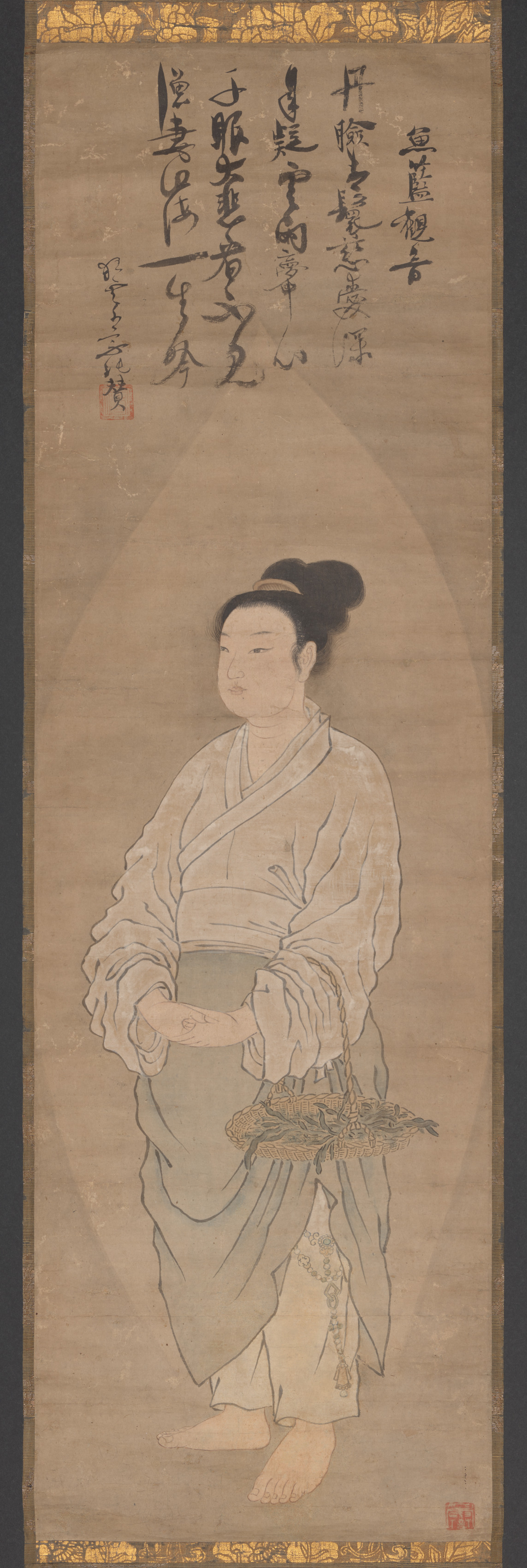
- Title
- Fish Basket Kannon (Gyoran Kannon, 魚籃観音菩薩像) — hanging scroll
- Period
- Muromachi period (1392–1573), 1400s
- Region
- Japan
- Medium
- Hanging scroll; ink and color on paper
- Dimensions
- Painting 118.8 × 36 cm; mounted 197.2 × 37.8 cm
- Collection
- Cleveland Museum of Art — Gift from the Collection of George Gund III
- Accession
-
2015.465 - Rights
- The Cleveland Museum of Art, acc. 2015.465 — Creative Commons Zero (CC0), Open Access Initiative. Attributed to Bokkei Saiyō (Japanese, 1415–1473); calligraphy attributed to Ikkyū Sōjun (Japanese, 1394–1481).
Gyoran Kannon, 15th century, attributed to Bokkei Saiyō with an inscription attributed to Ikkyū Sōjun. Cleveland Museum of Art acc. 2015.465 (CC0). The figure is identified by one attribute alone — the woven basket of fish.
Gyoran Kannon (魚籃観音) is the fish-basket form of Kannon: a Chinese folk invention, the Mr. Ma’s-wife / Yulan Guanyin legend, not a sutra figure. The Cleveland scroll (acc. 2015.465), attributed to Bokkei Saiyō with an inscription by the Daitoku-ji Zen eccentric Ikkyū Sōjun, is a documented 15th-century Japanese reception of that legend, read by one attribute alone: the woven basket of fish.
The scroll in the room
The Cleveland scroll is tall and narrow: a painting 118.8 cm high on a mount that runs to nearly two metres, the proportion of a temple alcove rather than a hand scroll. Hung at its intended height the figure stands at roughly the viewer’s own eye, which is the first surprise. Most museum Kannon look down from a pedestal. This one does not. A barefoot woman in cream robes stands inside an almond-shaped mandorla. In one hand she carries a woven basket; inside it, painted small and almost offhand, are leaves and a few fish. Above her the upper third of the paper goes to columns of cursive Japanese calligraphy and two red seals. The painting is not crowded. The pigment is thin and the contour line economical, and the basket, the one thing that names her, is rendered with less ceremony than the inscription crowding the sky above it.
That distribution is the reading. A viewer who does not know the legend sees a plainly dressed woman with a fish basket and no halo of attributes; a viewer who does sees the whole Chinese story folded into that basket. The scroll withholds. It gives the attribute its one square of paper and spends the rest on a Zen abbot’s brush.
A figure with no sutra
Gyoran Kannon is the Japanese reading of a Chinese figure, and the Chinese figure is a folk invention with no scriptural source. This is the load-bearing fact about the form, and it separates Gyoran from almost every other Kannon a Japanese collection holds. The canonical esoteric forms (Shō, Jūichimen, Senju, Batō, Nyoirin, Fukūkenjaku) each have a dhāraṇī or a sutra passage behind them. Gyoran has a legend.
The legend, as the Oxford reference tradition records it under the title Malang fu (“the wife of Mr. Ma”), runs as follows.1 A beautiful young woman appears in a fishing village, selling fish in the market; the usual telling places her at Golden Sand Beach in the Tang northwest, conventionally dated to around 817 CE. She is pursued by many suitors. She sets a condition: she will marry the man who can memorise the Universal Gateway chapter (the Kannongyō, chapter 25 of the Lotus Sutra) overnight. Several succeed, so she raises the bar to the full Diamond Sutra, then to the entire Lotus Sutra in three days. One man, Ma Lang, the Mr. Ma of the title, accomplishes it. On the wedding day, before the ceremony, the bride sickens and dies. She is buried. Some days later an old monk comes to Ma, has the grave opened, and the coffin is found to hold nothing but bones linked by a golden chain. The monk explains that she was a manifestation of Kuan-yin, come in the body of a fish-seller to lead an unlettered fishing population to the sutras. Then he vanishes into the air.
Chün-fang Yü, in Kuan-yin: The Chinese Transformation of Avalokiteśvara, treats this figure within her account of the feminisation of Kuan-yin in late imperial China, the long process by which an originally male Indian Avalokiteśvara became, in China, a predominantly female figure with folk biographies.2 Yü’s chapter on the feminine forms reads the fish-basket Kuan-yin and the Princess Miao-shan legend as parallel Chinese productions: not iconographic types handed down from India, but stories that Chinese devotional culture generated and then attached to the bodhisattva. The marriage-test plot is the recurring engine. A beautiful woman turns desire toward the sutras and is revealed, too late for marriage, as the bodhisattva. The figure is sometimes called Marriage-seeking Kuan-yin (Malang fu) and sometimes Fish-basket Kuan-yin (Yulan Guanyin); the two names are the same legend told from the husband’s side and from the attribute’s side.
The textual stratum matters for honest dating. The narrative kernel (the fish-seller, the sutra test, the gold-chain bones) circulates from the Song dynasty onward in miracle-tale collections, and the figure is a stable subject of Chinese painting by the Ming. The fully elaborated devotional text, the Precious Scroll of the Fish-Basket Guanyin (a baojuan), is much later: it takes its mature form around the nineteenth century, drawing on the older miracle materials, and survives in living recitation practice in Jiangsu.3 So the legend is old and the canonical scripture for it is, strictly, none, while the long devotional text that fixed its details for popular recitation is recent. The Cleveland scroll sits between those poles. It is a fifteenth-century Japanese painting of a Chinese Song-or-later legend, made centuries before the precious scroll that would later codify it.
What the basket has to carry
Because there is no sutra, there is no canonical implement list. Senju Kannon can be read off a forty-arm programme of named attributes; Nyoirin is read by the jewel and the wheel; Batō by the horse-head crown. Gyoran has one attribute, and it does all the iconographic work the others spread across many. The fish basket is not a symbol added to a figure already identifiable as Kannon. It is the only thing that makes the figure Kannon at all.
This is why the Cleveland painter’s economy is not casual. Strip the basket and the painting is a barefoot woman in plain robes, a market figure and not a bodhisattva. The mandorla and the inscription supply the devotional frame, but the identification is carried entirely by the woven basket and the few fish inside it. The Princeton University Art Museum holds a Chinese version of the same subject, an ink rubbing taken from a stone engraving carved after 1617 (acc. y1958-176), and its catalogue states the convention plainly: Guanyin appears as “a young lady with bare feet carrying a basket with a fish,” the bare feet signalling otherworldliness and the basket serving as “her identifying attribute in this particular manifestation.”4 Two features recur across the surviving corpus and both are present in the Cleveland scroll: bare feet, and the fishwife’s plain dress rather than the jewelled bodhisattva costume. The figure is iconographically poor on purpose. Her whole point in the legend is that she did not look like a bodhisattva until the coffin was opened.
The fish are the sharpest detail and the one most often softened in description. They are not symbolic adornment. They are merchandise. The legend’s bodhisattva is a woman selling fish for money in a market, and Chinese and Japanese painters who knew the story painted the basket as a vendor’s basket, with the catch in it. The Cleveland painter keeps the fish small and unemphatic, consistent with a Zen-circle reading that wants the legend present but not narrated. The basket states the story; the brush declines to illustrate it.
Bokkei’s brush and Ikkyū’s seal
The Cleveland scroll’s value is not only that it is an early Japanese Gyoran. It is that it is a documented one, attached to two named fifteenth-century figures. The Cleveland Museum of Art attributes the painting to Bokkei Saiyō (1415–1473) and the calligraphy to Ikkyū Sōjun (1394–1481).5 The same object, with the same attribution and the note of Ikkyū’s seal, is recorded in the scholarship around the Awakenings: Zen Figure Painting in Medieval Japan exhibition.6
Both names sit at the centre of fifteenth-century Zen painting rather than at its edges. Ikkyū Sōjun was the poet, calligrapher, and deliberately scandalous Rinzai monk who revived the Daitoku-ji line and, late in life, was appointed its abbot in 1474. An inscription in his hand and seal puts the scroll inside the Daitoku-ji literary orbit, which is also where the surviving textual record of Bokkei comes from. Bokkei is identified with the painter the documentary sources call “Hyōbu Bokkei,” named in the writings of the scholar-monk Kisei Reigen (1403–88) as a student of the painter Shūbun, a frequent companion of Ikkyū, and a recorded disciple of Ikkyū who died in Ise in 1473; he is also taken as the earliest of the Soga-lineage painters who served the Asakura clan in Echizen. Two surviving portraits of Ikkyū, dated 1452 and 1453, anchor the identification.
The attribution is honest about its limits, and so is this article. “Attributed to” is the museum’s word, not “by”; fifteenth-century Zen-circle painting is a field where signed, dated autograph works are the exception and workshop-and-circle attributions on documentary and stylistic grounds are the norm. The strongest claim the evidence supports is the one Cleveland makes: a Gyoran painting from the Bokkei circle, carrying an inscription associated with Ikkyū, produced in the Daitoku-ji ambit in the third quarter of the fifteenth century. bodhi follows that reading. The residual uncertainty is the one the field always carries here. Whether the painting hand is Bokkei’s own or a close follower’s, and whether the inscription is Ikkyū’s autograph or an early attribution, are questions a brush specialist with the physical scroll would have to settle, not a catalogue record.
How a Chinese legend became a Japanese form
Gyoran Kannon entered Japan as part of the broader reception of the Chinese transformed Kuan-yin, the same current that brought Byakue (the White-Robed Kannon) and Yōryū (the Willow Kannon) into the Japanese repertoire. None of these three is an esoteric Japanese form with a dhāraṇī; all three are Chinese devotional inventions absorbed into Japanese practice. What is distinctive about Gyoran’s Japanese afterlife is the direction the emphasis took. The Chinese legend is about converting the unlettered to the sutras through desire and death. In Japan the figure was pulled toward the practical concerns of fishing communities, safe passage and good catches, so that the maritime and fecundity associations latent in a fish-selling bodhisattva were, in places, valued above the conversion narrative.7 The Edo-period record bears this out: Gyoran turns up as the honzon of small shrines in fishing and onsen districts, and is folded into the popular set of thirty-three named Kannon, where she is identified by attribute and folk story rather than by scripture.
This Japanese trajectory is exactly why the Cleveland scroll is worth dwelling on. It is early, fifteenth century, before the Edo popularisation, and it comes from the Zen monastic elite rather than a fishing-village shrine. It preserves the Chinese legend at the level of the literati and the abbot, before the figure was domesticated into a folk protector of boats. The thin pigment, the economical contour, the refusal to narrate the story the basket encodes: these are the marks of a Zen-circle reading of a Chinese legend, not of the popular maritime cult the figure would later largely become in Japan.
What the form is, and what it is not
Gyoran Kannon is not one of the esoteric Six (or Seven) Kannon, and reading her as if she were is the common error. She has no canonical mudra, no fixed implement list, no dhāraṇī. She is read by a single attribute and a Chinese story. The popular reference literature names her among the thirty-three Kannon, but that set is itself a late composite (Chinese folk forms, esoteric Japanese forms, and literary forms gathered under a Lotus-derived number long after the Lotus), and her membership in it is by attribute and legend, not by scripture. The honest summary is the one the legend itself proposes: she is the bodhisattva who came in a body that did not look like one, recognised only after the coffin was opened, and she is identified in painting by the one thing she carried into the market. On the Cleveland scroll that is a woven basket with a few small fish, given a single square of quiet paper beneath an abbot’s loud calligraphy. The whole iconography of the form rests on the least ceremonious passage of the painting.
Related
- Byakue Kannon — the White-Robed form, another Chinese transformed Kuan-yin
- Yōryū Kannon — the Willow form, the same Chinese reception current
- Shō Kannon — the canonical esoteric anchor, for contrast with a non-scriptural form
- The thirty-three Kannon — the popular composite set Gyoran is folded into
- Kannon (entity)
- Gyoran Kannon (entity)
- Ikkyū Sōjun (entity)
- Bokkei Saiyō (entity)
Footnotes
-
Oxford Reference, “Malang fu (the wife of Mr. Ma),” A Dictionary of Chinese Buddhism; the entry gives the fish-seller, the escalating sutra-memorisation test (Kannon chapter → Diamond Sutra → full Lotus Sutra), the death before the wedding, and the gold-chain bones revealed when the coffin is reopened. Accessed 2026-05-16 (entry consulted via search-index summary; full HTML returned 403 — text cross-checked against the Princeton y1958-176 catalogue and the Cleveland record). ↩
-
Chün-fang Yü, Kuan-yin: The Chinese Transformation of Avalokiteśvara (Columbia University Press, 2001). Ch. 8, “Princess Miao-shan and the Feminization of Kuan-yin”; Ch. 10, “Feminine Forms of Kuan-yin in Late Imperial China,” is where the Mr. Ma’s-wife / Yü-lan fish-basket Kuan-yin is treated as a Chinese devotional production parallel to Miao-shan. Cited at chapter level; specific page references not verified against the volume. ↩
-
Rostislav Berezkin, “Guidance through seduction: the Precious Scroll of Fish-Basket Guanyin in the recitation practice of Changshu in Jiangsu, China,” Studies in Chinese Religions 9, no. 1 (2023). Cited only for the dating of the mature baojuan text to roughly the nineteenth century, drawing on older miracle materials. Abstract-level citation; full text not consulted. ↩
-
Princeton University Art Museum, acc. y1958-176, “Fish-basket Guanyin (Yulan Guanyin 魚籃觀音),” ink rubbing on paper of a stone engraving carved after 1617, Ming dynasty; catalogue description quoted verbatim (“a young lady with bare feet carrying a basket with a fish”; bare feet as signal of otherworldliness; basket as “her identifying attribute in this particular manifestation”). Accessed 2026-05-16. ↩
-
Cleveland Museum of Art, acc. 2015.465, “Fish Basket Kannon (Gyoran Kannon)” (魚籃観音菩薩像), Japan, Muromachi period (1392–1573), 1400s, hanging scroll, ink and color on paper; painting 118.8 × 36 cm, mounted 197.2 × 37.8 cm; attributed to Bokkei Saiyō (Japanese, 1415–1473), calligraphy attributed to Ikkyū Sōjun (Japanese, 1394–1481); Gift from the Collection of George Gund III. Cleveland Open Access API confirms
share_license_status: CC0. Accessed 2026-05-16. ↩ -
Awakenings: Zen Figure Painting in Medieval Japan (Japan Society, 2007), exhibition record for the Fish-Basket Kannon attributed to Bokkei with an inscription and seal of Ikkyū Sōjun (asianart.com exhibition page no. 10, consulted 2026-05-16). The documentary identification of Bokkei as “Hyōbu Bokkei” — a Shūbun-school painter, companion and disciple of Ikkyū recorded by the scholar-monk Kisei Reigen (1403–88), associated with the Soga lineage in Echizen, died Ise 1473, with two Ikkyū portraits dated 1452/1453 — follows the same exhibition’s catalogue scholarship. Catalogue page references not verified. ↩
-
On the Japanese reception emphasising fishing, maritime safety, and fecundity over the conversion narrative, and on Gyoran as a small-shrine honzon folded into the popular thirty-three: “Gyoran Kannon — the fish-basket bodhisattva,” Japanese Mythology & Folklore (japanesemythology.wordpress.com), consulted 2026-05-16. A tertiary folklore synthesis, used only for the Japanese-reception emphasis and the Edo small-shrine record; the underlying claim (Chinese transformed Kuan-yin reception in Japan) rests on Yü 2001. ↩
Sources
-
The standard scholarly account of Kuan-yin's Chinese transformation and feminization. Ch. 8, 'Princess Miao-shan and the Feminization of Kuan-yin'; Ch. 10, 'Feminine Forms of Kuan-yin in Late Imperial China,' treats the Mr. Ma's-wife / Yü-lan (fish-basket) Kuan-yin. Cited at chapter level; page references not verified.
-
Records the Fish-Basket Kannon attributed to Bokkei with an inscription and seal of Ikkyū Sōjun. Bokkei identified with 'Hyōbu Bokkei,' a Shūbun-school painter and Ikkyū disciple recorded in the writings of the scholar-monk Kisei Reigen (1403–88) and associated with the Soga lineage in Echizen; he died in Ise in 1473. Catalogue page references not verified.
-
[5]2026-05-16Oxford Reference — A Dictionary of Chinese Buddhism oxfordreference.com/display/10.1093/acref/9780190681159.0… -
On the late textual stratum — the nineteenth-century baojuan (precious scroll) of the fish-basket Guanyin and its recitation practice. Cited for the textual-tradition dating only; abstract-level, full text not consulted.