Sugawara Mitsushige's Kannon-gyō handscroll, dated 1257
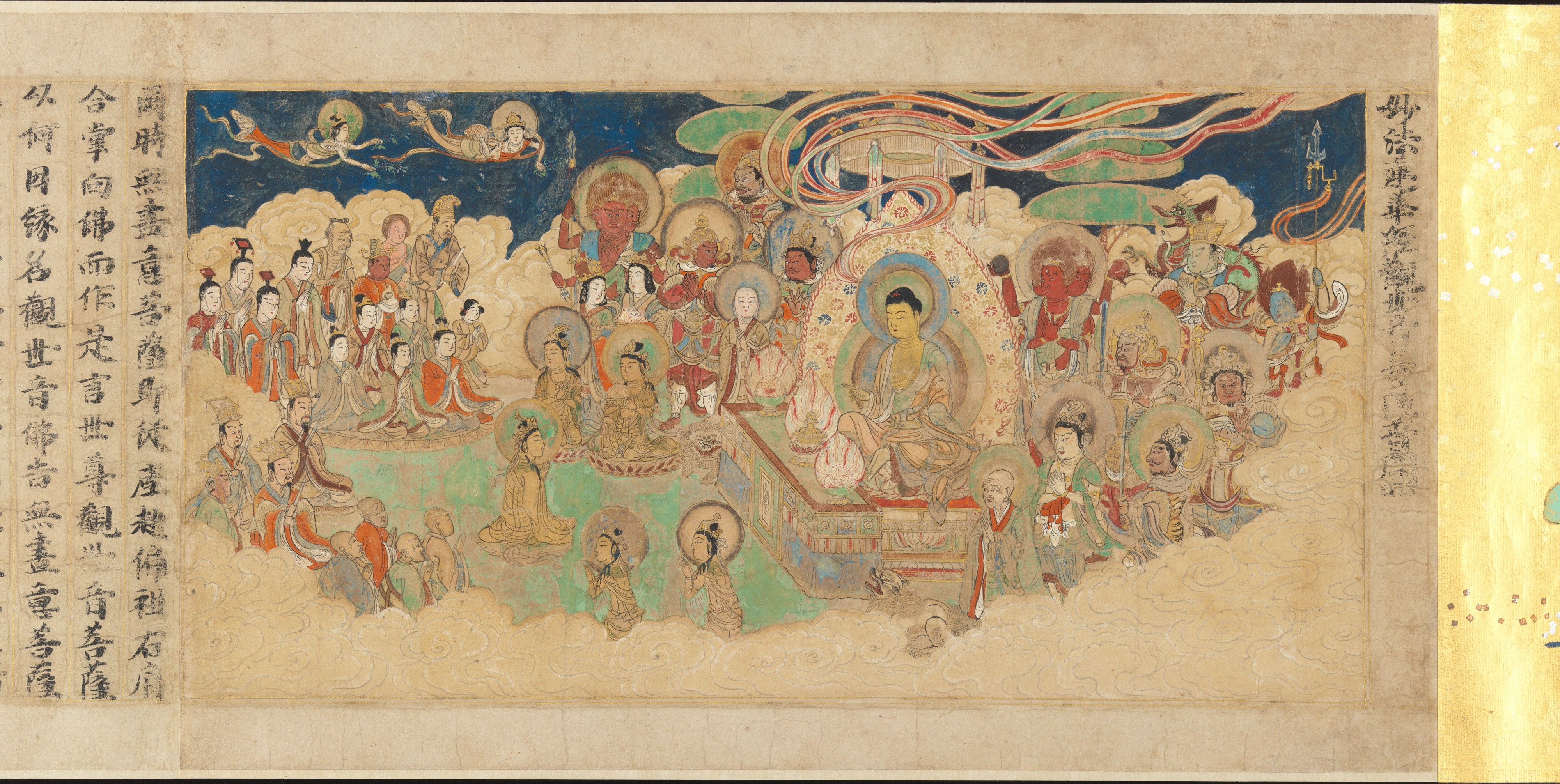
- Title
- "Universal Gateway," Chapter 25 of the Lotus Sutra (観音経 Kannon-gyō)
- Period
- Kamakura period (1185–1333), dated 1257
- Region
- Japan
- Medium
- Handscroll; ink, color, and gold on paper
- Dimensions
- Overall with mounting: 24.6 × 934.9 cm (9 11/16 in. × 30 ft. 8 1/16 in.)
- Collection
- The Metropolitan Museum of Art
- Accession
-
53.7.3 - Rights
- The Metropolitan Museum of Art, Open Access (Public Domain). Purchase, Louisa Eldridge McBurney Gift, 1953.
One segment of the 9.34-metre scroll. The text-then-image alternation continues for the full length: thirty-four painted scenes interspersed with the Chinese characters of Chapter 25 of the Lotus Sutra.
The colophon is where to start. According to the calligrapher’s own inscription, this handscroll, made in 1257, was modeled after a Song printed book of 1208, which in turn was based on an earlier painted scroll.1
That is three layers of transmission compressed into one sentence: a lost Tang or early-Song painted prototype, a 1208 Chinese printed-book version that reached Japan some time before 1257, and the 1257 Kamakura scroll itself, written by Sugawara Mitsushige and painted by an unnamed Japanese hand.
Mitsushige dated and signed his calligraphy. He did not name the painter. That asymmetry is itself a thirteenth-century convention; we will come back to it.
What Chapter 25 of the Lotus Sutra actually is
The Hokke-kyō (Lotus Sutra) runs to twenty-eight chapters in the Kumārajīva Chinese translation that became normative in East Asia.2 Chapter 25, in Kumārajīva’s reading, is Kanzeon Bosatsu fumon-bon (観世音菩薩普門品), “The Universal Gateway of the Bodhisattva Perceiver of the World’s Sounds.” In medieval Japanese practice this single chapter detached itself from the parent sutra and circulated as a devotional text in its own right: the Kannon-gyō, or “Kannon Sutra.”3
The chapter’s payload is a litany. Shakyamuni enumerates thirty-three forms that the bodhisattva Kannon assumes “in accordance with the people’s capacity” (from a buddha to a śravaka to a god to a king to a woman to a child to a yaksha), appearing in whatever shape will deliver a particular being from a particular distress.4
The Lotus Sutra’s framing claim is even bolder. Anyone who hears Kannon’s name, calls Kannon’s name, or holds Kannon’s name in mind will be delivered: from fire, from drowning, from bandits, from the executioner’s blade, from imprisonment, from demonic harm, from the burning of one’s house, from being driven onto rocks at sea. The chapter pairs each form of distress with a specific deliverance image.5
This is what the painter of the Met scroll had to picture. Thirty-four scenes for what the text frames as thirty-three manifestations (the extra scene is the opening narrative frame, with Akṣayamati raising the question to Shakyamuni). Each painted scene corresponds to a clause in the litany.
What the Met scroll looks like
The work is 24.6 cm tall and 934.9 cm long when mounted: just under 9.4 metres of paper.6 Ink, color, and gold on paper. The structural rhythm is regular: a column-block of densely-written Chinese characters in Mitsushige’s clear, even calligraphy, then a painted scene to its right (or, depending on the reading direction, to the next unrolled increment), then another text block, then another scene.
The painted scenes sit low on the paper. The figures are small (well below adult-life-size in the visual register), and they inhabit landscapes that read as Japanese rather than Chinese. The colour palette is restrained: muted sage greens, pale earth ochres, soft umbers, occasional pale blue. Gold is used selectively, for the rocks of certain mountains, for the haloes of Kannon’s manifestations, for the textile patterns on the robes of royal figures.
The work is signed and dated by Mitsushige in the colophon at the end of the scroll. The painter, by the standards of mid-thirteenth-century Japanese Buddhist scroll production, is anonymous in the documentary sense. Neither the colophon nor any external record identifies the hand.
The 1208 model, and what the painter changed
The colophon’s named source is the 1208 Song printed book. No copy of that 1208 print survives, so far as the published scholarship records; what Mitsushige and his painter had in 1257 was a single object, brought to Japan from China within fifty years of its making, that itself was a copy of a still-earlier painted version.7
What the painter changed is visible. The Met curatorial line, which the open-access record states plainly, is that the anonymous artist “transformed the Chinese original into a painted handscroll” by inventively incorporating “indigenous yamato-e elements, especially in the landscapes.”8
That is a precise description. The figures in the Met scroll (the buddhas, the kings, the women, the children, the yakshas, the eight kinds of nonhuman beings Kannon assumes) preserve a Song iconographic stock: facial type, robe-fold idiom, the patterned ground beneath the seated buddha-form Kannon assumes for those who can be saved by a buddha. But the landscape elements (the curving low hills, the river-banks, the small clusters of pines, the way the picture-plane organises around the figure-groups rather than around a monumental landscape mass) read as Japanese, not Chinese.
This is, in the technical sense, a yamato-e turn applied to imported Song imagery. The painter inherited the figures and Japanized the world they stand in.
Sugawara Mitsushige
Mitsushige is documented as active in the mid-thirteenth century; his dates (1234–1266) are now generally accepted on the basis of the Met colophon itself and a small number of cross-attributed sutra calligraphies.9 He is a calligrapher, not a painter, and the practice of pairing a named calligrapher with an unnamed painter is the standard mid-Kamakura division of labour for illustrated sutra production.
The Sugawara name itself carries weight. The lineage descends from Sugawara no Michizane, the ninth-century court scholar deified as the kami Tenjin, patron of letters and calligraphy. By the thirteenth century the Sugawara family was a hereditary house of court scholars and calligraphers, and a Sugawara hand on a sutra-text in 1257 placed the calligraphy inside an institutional tradition with explicit Tenjin-associated authority over the brush.
A 9.34-metre scroll of dense, regular character-by-character calligraphy is a major undertaking. The text of Chapter 25 in Kumārajīva’s Chinese (roughly 1,890 characters) required Mitsushige to maintain calligraphic discipline across all thirty-four kotobagaki sections without slippage. The pictorial scenes interleave around his finished work.
That his name appears and the painter’s does not is consistent with thirteenth-century practice: the calligrapher of a sutra is held to a higher named-authorship standard than the illustrator. The sutra’s text is itself the buddha-word; the calligrapher who copies it accumulates merit in the copying and is accountable for fidelity to the wording. The illustrator, however skilled, supplies a devotional aid.
Why Chapter 25 detaches and circulates alone
The Kannon-gyō (Chapter 25 as a standalone devotional text) is the most-recited Buddhist scripture in late Heian and Kamakura Japan.10 The reason is in the chapter’s own framing: it promises specific deliverance from specific harms in exchange for specific recitation. It is, in late-Heian and Kamakura terms, an apotropaic instrument.
Bishamonten, Aizen Myōō, Fudō Myōō, and the dharani-recitation traditions cover related ground. The Kannon-gyō covers it with a longer text, a named bodhisattva who is already the most widely-worshipped figure in Japan by the twelfth century, and the additional doctrinal weight of being a chapter of the Lotus Sutra, the central Tendai text and, after Nichiren, the entire foundation of one new Kamakura school.
Mitsushige is producing his scroll in 1257, a generation after Hōnen’s death (1212), within Shinran’s lifetime (1173–1263), and shortly before Nichiren’s first major doctrinal break (the Risshō ankoku ron of 1260). The competing claims of Pure Land devotion, Shinran’s exclusive nenbutsu, and Nichiren’s Lotus-Sutra-only programme are all live arguments by 1257. A Kannon-gyō scroll in this moment is a Hokke-kyō document (a Lotus Sutra chapter), but it is also a Kannon devotional object, and the doctrinal traffic between the two is the chapter’s natural register.
The Met scroll sits inside that traffic. It is a Lotus Sutra chapter rendered as a Kannon-devotion picture-book; the doctrine is Tendai-Hokke and the practice is Kannon-specific.
The earliest painted version — and how confident is that claim?
The Met catalog states that 53.7.3 is “the earliest known painted version, in one handscroll, of this litany.”11 That formulation is careful. Three qualifiers do the work.
Earliest known, meaning: as documented in the published catalogues. Survival of earlier painted Kannon-gyō handscrolls cannot be excluded; the 1208 Song printed book itself is lost.
In one handscroll, meaning: this format. Painted scenes of individual Kannon manifestations exist earlier as parts of larger Lotus Sutra illustration cycles (Heian frontispieces of the full Hokke-kyō; chapter-by-chapter painted sets that include Chapter 25 as one panel among twenty-eight). What 53.7.3 marks is the moment Chapter 25 detaches into its own single-scroll painted format.
Of this litany, meaning: the thirty-three-manifestations text specifically. Other Kannon iconographic programmes (the thousand-armed, the eleven-headed, the Suigetsu / Water-Moon form, the White-Robed) are illustrated earlier and elsewhere but illustrate Kannon in different doctrinal registers, not Chapter 25’s specific litany.
Inside those qualifiers, the Met’s claim is defensible and likely correct. The Chinese line that produced 53.7.3 ran through the lost 1208 print; what survives on the Chinese side is later (Yuan- and Ming-period illustrated Kannon-gyō books and scrolls), and what survives on the Japanese side begins with this scroll.
What the scroll asks of a reader
A 9.34-metre handscroll cannot be read at a glance. It cannot be hung. Like the Yūzū Nenbutsu engi at Cleveland, it is a two-person form: someone unrolls, someone reads aloud, and the audience watches the figures pass at the pace of the reader’s voice.
For a thirteenth-century lay patron, the practice was specific. The Kannon-gyō is recited; the scroll is unrolled in the recitation; the painted scene appears as the line that names that particular form of deliverance is sung. A patron who commissioned such a scroll, or arrived at a temple where one was unrolled, watched their own protections accumulate visually as the chapter advanced.
The modern reader gets a version of this for free. The Met’s open-access primary image is high-resolution; the IIIF-equivalent presentation allows a digital unrolling of the full 9.34 metres. The pace is now self-set rather than read-aloud, and the audience is one person at a screen, but the form of the reading (sequential, image-with-text-with-image, the litany advancing) is preserved.
What stays open
Three questions the published scholarship has not closed:
-
The 1208 Song print. No surviving copy is documented. Whether the Met scroll’s painter worked directly from the print or from a Japanese painted intermediary (also lost) is the central unanswered transmission question. The Met’s open-access record states the colophon’s claim (Song print as model) without pressing the further question.
-
Mitsushige’s other surviving work. The 1257 colophon is the primary documented Mitsushige attribution. Two or three sutra-calligraphies cross-attributed on stylistic grounds are noted in the Japanese scholarship but not catalogue-confirmed.12 A consolidated corpus catalogue would tighten the dating-by-hand criteria.
-
The painter’s workshop. Mitsushige’s name secured the calligraphy attribution; the painter’s anonymity is the standard convention, but the painted style is specific enough (the yamato-e landscape inflection over Song figure-iconography) that a workshop affiliation is in principle recoverable. No published study has done so at workshop level.
These are the open questions a viewer of the digitised scroll will not see; they are the open questions a curator preparing an exhibition catalogue would have to address.
Footnotes
Footnotes
-
Per the Met’s open-access record for 53.7.3 (accessed 2026-05-13): “According to the calligrapher’s inscription, this scroll, made in 1257, was modeled after a Song printed book of 1208, which in turn was based on a painted scroll. The anonymous artist who transformed the Chinese original into a painted handscroll inventively incorporated indigenous yamato-e elements, especially in the landscapes.” ↩
-
Burton Watson’s English translation (Columbia, 1993) is the standard scholarly English Lotus Sutra; Chapter 25 occupies pp. 298–306. The chapter circulates under several titles: “The Universal Gate” (Watson); “The Universal Gateway” (Reeves); Kanzeon Bosatsu fumon-bon in the Sino-Japanese tradition. ↩
-
The detachment of Chapter 25 as the standalone Kannon-gyō is documented from Tang-dynasty Chinese practice forward and continued throughout the Tendai-dominated Heian period in Japan. The chapter is included in the standard Tendai practice manuals and was incorporated into popular devotional recitation by the eleventh century. ↩
-
The thirty-three-forms count is canonical, derived from the chapter’s enumeration. The forms include: a buddha; a pratyekabuddha; a śravaka; Brahma; Indra (Śakra); the four heavenly kings (Bishamonten as one); various heavenly beings; a king; an elder; a householder; a minister; a brahman; a monk; a nun; a layman; a laywoman; the wife of any of these last four; a child (boy); a child (girl); various nonhuman beings; eight categories of nonhuman beings; and Kannon’s own bodhisattva form. ↩
-
Watson, pp. 298–301 specifically. The eight named deliverance images (fire, water, wind/storm on the sea, falling from a great mountain, the executioner’s blade, imprisonment, robbers, sexual harm) are listed in close succession in Kumārajīva’s Chinese; each became a fixed iconographic scene in the painted Kannon-gyō tradition. ↩
-
Met OA API record for object 44849 (accessed 2026-05-13). The painting itself is shorter than the mounted dimension cited; the standard institutional citation gives the mounted figure. ↩
-
No surviving 1208 Song printed Kannon-gyō is documented in the Western catalogues; the Met’s curatorial line treats the 1208 print as known only through Mitsushige’s reference. The standard Chinese scholarship on early-Song Buddhist printing is sparse on this specific imprint. ↩
-
The Met’s published curatorial text uses the phrase “indigenous yamato-e elements” specifically. The painter’s hand, by the Met curators’ reading, is Japanese (not Chinese-trained); the landscape inflection is the diagnostic feature. ↩
-
The 1234–1266 dating is supported by the Met’s biographical line (artist active mid-13th century) and by the Sugawara family’s documented genealogical records. Mitsushige’s place within the broader Sugawara lineage of court scholar-calligraphers is the institutional context. ↩
-
The Kannon-gyō as the most-recited Buddhist scripture in late Heian and Kamakura Japan is documented in standard surveys; Daniel B. Stevenson’s work on Tendai practice in medieval Japan is one entry point. The popularity rests on the chapter’s specific-deliverance promise combined with Kannon’s already-established devotional centrality. ↩
-
Met OA record, accessed 2026-05-13. The catalog text specifies “earliest known painted version, in one handscroll, of this litany”; the qualifier triple is doing real work. ↩
-
Japanese-language sutra-calligraphy reference works list two or three additional cross-attributions, primarily on the basis of brush-stroke comparison with the 1257 dated standard. A consolidated catalogue raisonné does not exist in Western languages. ↩
Sources
-
[2]2026-05-13The Metropolitan Museum of Art (Open Access API) collectionapi.metmuseum.org/public/collection/v1/objects/44849 -
[4]2026-05-13JSTOR community.18728418 (Met's open-collection record for 53.7.3) jstor.org/stable/community.18728418 -
Standard English-language reference for Kamakura sutra-illustration including the Met scroll
-
Standard English translation; Chapter 25 "The Universal Gateway of the Bodhisattva Perceiver of the World's Sounds," pp. 298–306.
-
Methodological reference for the Kannon-gyō as devotional and apotropaic text in Heian-Kamakura Japan