Honji-suijaku: the doctrine that made kami into buddhas
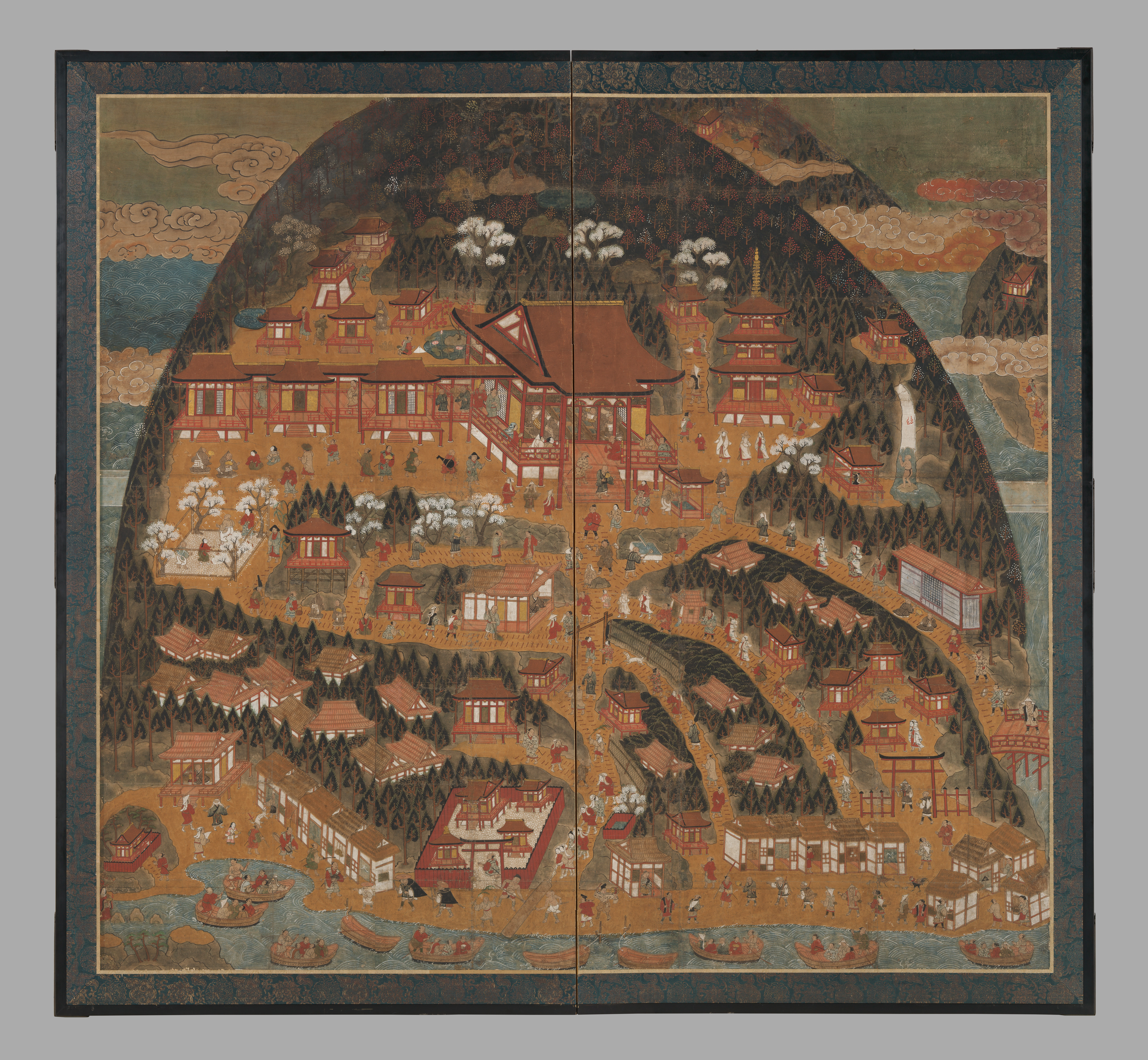
- Title
- Chōmeiji Temple Pilgrimage Mandala (Chōmeiji sankei mandara zu byōbu)
- Period
- Muromachi period (1392–1573), second quarter 16th century
- Region
- Japan, Chōmeiji on Mount Ikiya, Lake Biwa, Ōmi (Shiga) — depicted
- Medium
- Hanging scroll remounted as a two-panel folding screen; ink, color, gofun (ground shell pigment), and gold on paper
- Dimensions
- Image 148.3 × 161 cm (58 3/8 × 63 3/8 in.)
- Collection
- The Metropolitan Museum of Art
- Accession
-
2016.517 - Rights
- The Metropolitan Museum of Art, Open Access (Public Domain). Purchase, Sue Cassidy Clark Gift, in honor of D. Max Moerman, 2016.
Met 2016.517. A sankei mandara of Chōmeiji — the kind of fundraising landscape painting that carried honji-suijaku doctrine out of the temple and onto the road, narrated aloud by itinerant kanjin hijiri after the 1516 fire.
Honji-suijaku (本地垂迹) is the medieval Japanese theory that local kami are suijaku, traces, of Buddhist honji, the original ground. It grew out of Heian Tendai and Shingon thought, hardened into the Ryōbu and Sannō Shintō systems by the Kamakura period, and held until the state pulled the shrine-temple institutions apart in 1868. The Met’s Chōmeiji mandala is read here as the doctrine’s working surface.
What the doctrine claimed
Two characters do the work. Honji (本地), “original ground,” names the Buddhist source, a buddha or bodhisattva understood as the prior, universal reality. Suijaku (垂迹), “descended trace” or “manifest trace,” names what that source becomes when it touches a particular place: a Japanese kami, resident at a particular shrine, answerable to a particular clan. The claim is not that the kami is a symbol of the buddha. It is that the kami is the buddha, locally, under conditions the buddha chose for the sake of beings who could not otherwise be reached.
That is the load-bearing distinction, and it is the one a database entry flattens. The textbook version supplies a tidy correspondence table: Amaterasu is Dainichi, Hachiman is Amida, the Kasuga kami are these five buddhas. The table is real and medieval people used it. But the doctrine underneath it is a grammar, not a lookup. It licensed a buddha to be present as a god, a god to be venerated as a buddha, and, as the Fujiwara clan’s deified ancestor portraits show, a powerful human to be slotted in as a trace on the same logic. Mark Teeuwen and Fabio Rambelli, introducing the standard reframing of the subject, argue against reading the pairings as a fixed creed. They treat honji-suijaku as a combinatory paradigm: a generative system for assembling associations out of doctrine, myth, ritual need, and lineage politics rather than a settled table to be memorized.[^tr]
The reader who wants the diagram (which kami pairs with which buddha, and what the iconographic markers are) should go to bodhi’s suijaku-mandala reading guide. This article is the history of how the grammar was built and how long it held.
A Tendai distinction, before it was about kami
The compound did not begin as a statement about gods. Honji and suijaku are Tiantai exegetical terms, used in China by Zhiyi (538–597) to read the Lotus Sutra: the sutra’s later chapters disclose the buddha’s honmon, the original, eternal awakening, behind the jakumon, the historical, provisional Śākyamuni who appeared to teach. Original and trace. The pair travelled to Japan with Tendai and entered Japanese texts as philosophy first. It appears in the Eizan Daishiden, the 825 hagiography of Saichō, in this strictly Buddhist sense, with no kami in view.[^wiki]
The slide from “the eternal buddha and his historical trace” to “the buddha and his local kami” is the medieval Japanese move, and it was gradual. By around 901 the official history Sandai Jitsuroku records the formula that mahāsattvas manifest themselves at times as kings and at times as kami: the structure of the later doctrine, present before the term was fixed to it.[^wiki] What made the slide thinkable was an institutional fact already on the ground. Buddhist clergy had been building chapels at shrines, and shrines at temples, since the eighth century. These were the jingūji, the “shrine-temple” establishments, where monks chanted sutras for the benefit of a kami held to be a being still caught in the round of rebirth and in need of the dharma. The early jingūji predate the honji-suijaku formula; the doctrine arrived, in part, as a theory adequate to an arrangement that already existed.
The Heian assimilation
Through the tenth and eleventh centuries the pairings thickened from below as much as from above. They were not legislated. They accreted through temple records of monastic dreams, oracular pronouncements, and shrine revelations, each of which fixed one more kami to one more buddha. A material trace of the habit survives in the kakebotoke, the round metal plaques hung in shrine-temple halls, a kami figure worked on one face and its honji buddha on the reverse: the doctrine made into an object you could turn over in the hand.
The Heian esoteric schools gave the accretion its organizing scaffold. The Encyclopedia of Religion’s survey of the subject puts the mechanism plainly. The esoteric Buddhist mandala supplied “an important model for the systematization of the realm of sacred beings in Japan.”[^enc] A mandala is already a map of how a central buddha distributes itself into a graded retinue of subordinate presences. Tendai and Shingon thinkers had that map; the kami of Japan were a populous, ungoverned field of presences; the doctrine let the second be read through the first. By the late Heian period the major pairings that would last were in place. Amaterasu, the sun kami of Ise, was read as Dainichi, the cosmic buddha of the same solar logic. Hachiman, the Usa and Iwashimizu war kami, was read as Amida. The Kasuga kami of the Fujiwara became a set of buddhas and bodhisattvas; the Kumano kami became Amida, Yakushi, and Senju Kannon.[^enc] [^wiki] None of these was an academic exercise. Each was the theology of a working institution with land, with clergy, and with a clan behind it.
The Kamakura systematisation
What the Heian period accreted, the Kamakura period codified. The cultic centres of the great schools each built an integrative system in which honji-suijaku was the structural principle, not a decoration on top of it. Mount Hiei, the Tendai centre, produced Sannō Shintō, the theology of the Hie (Sannō) shrines at the mountain’s foot, where the resident kami was read as a manifestation of the Tendai buddha and the shrine and the monastery were a single ritual body. Mount Kōya and the Shingon establishment produced Ryōbu Shintō, “Two-Mandala Shintō,” which read the Inner and Outer Shrines of Ise as the Diamond and Womb mandalas of esoteric Buddhism, making the most prestigious kami site in Japan into a Shingon cosmogram.[^enc] [^wiki]
These were not folk improvisations. They generated their own scriptures. The Reikiki, the central text of the medieval Ise-and-esotericism synthesis, was treated from the Nanbokuchō period onward as a Shintō scripture ranking beside the Nihon Shoki, a measure of how far the combinatory system had moved from gloss to canon.[^wiki] The vocabulary hardened with it. The word gongen (権現), “provisional manifestation,” became the standard title for a kami understood through the doctrine: Sannō Gongen at Hie, the Kumano Gongen, the wrathful mountain deity Zaō Gongen at Kinpusen. To call a deity a gongen was to assert the whole theory in a single word.
Allan Grapard’s study of the Kasuga cult is the closest historical control on what this systematisation meant on the ground. Grapard reads the Kasuga shrine and its Buddhist counterpart Kōfuku-ji not as two institutions in alliance but as one combinatory institution: a single body in which kami worship and Buddhist practice were not separable activities, and were not experienced as a compromise between two religions.[^grapard] That is the corrective the word “syncretism” obscures. For a medieval worshipper at Kasuga, there were not two systems being blended. There was one practice, and honji-suijaku was its internal logic.
The doctrine on the road: reading the Chōmeiji mandala
The Met’s Chōmeiji pilgrimage mandala is where the doctrine stops being a theology and becomes a thing carried in a travelling preacher’s hands. It is not a deer-and-disc suijaku mandala; it does not diagram the honji-buddha above the kami. It is a sankei mandara, a pilgrimage mandala: a large painted aerial view of the temple, its mountain, its approach, and the people on it. Chōmeiji sits on Mount Ikiya above Lake Biwa, the thirty-first station of the Saigoku Kannon pilgrimage, its hidden honzon an eleven-headed Kannon.[^met] [^andrei] The painting shows the stepped climb up the bamboo mountain, the lake and its boats below, the halls at the top, and the pilgrims threaded along the route at the scale of ants on a hillside.
Stand where the painting puts you and the doctrine is in the composition rather than on it. There is no honji buddha floating in a gold disc to be decoded. The temple itself, set into a real and recognisable mountain above a real lake, is the manifestation — the place where the universal Kannon is locally reachable by anyone willing to climb. The unbeholden eye reads it as a map. The pilgrim reads it as a promise: the cosmic bodhisattva is at the top of these particular eight hundred steps, and the steps are walkable. Honji-suijaku is the reason the promise is not a metaphor. D. Max Moerman’s study of the Kumano pilgrimage landscape makes the general case bodhi follows here, that the sacred site is the doctrine localized into a specific walkable geography rather than illustrated after the fact.[^moerman]
The mandala’s social history sharpens the point. The Met catalogue records that the painting was made to raise funds for rebuilding Chōmeiji after a fire of 1516, and that itinerant preachers used it in etoki, picture-narration: the painting unrolled and talked through aloud, scene by scene, to a crowd.[^met] Talia Andrei’s study of the genre traces these works to low-ranking itinerant fundraisers, the kanjin hijiri, who carried them across the country and performed the site into being for audiences who would never see it.[^andrei] This is honji-suijaku at its widest reach. The Kasuga deer mandala stayed in the orbit of the shrine that owned it; the sankei mandara was built to leave. The doctrine that a buddha is locally present at a named place becomes, in this object, a fundraising instrument: donate to this place, walk to this place, because the buddha is there, and here is the painted proof, narrated for you by a stranger with a pointer.
Inversion and dismantling
A doctrine that subordinates the local to the universal invites the reverse. From the Nanbokuchō period the monk Jihen, active around 1340 and tied to the Ise establishment, articulated han-honji-suijaku, the inversion that made the kami the honji, the original ground, and the buddhas the suijaku, the traces.[^wiki] Yoshida Kanetomo (1435–1511) developed the inversion at the Yoshida shrine in Kyoto into a system asserting the priority of the kami outright. The structure of the argument did not change; only the direction of the arrow did. That the inversion was possible at all confirms Teeuwen and Rambelli’s reading: a paradigm flexible enough to run in reverse was never a fixed creed.
The system did not decay. It was abolished. In 1868 the new Meiji state issued the shinbutsu bunri edicts ordering the administrative separation of kami and buddhas, dismantling the jingūji, expelling Buddhist clergy from shrines, and stripping the gongen titles. The order was followed in places by haibutsu kishaku, the violent destruction of Buddhist images and buildings on shrine grounds.[^wiki] [^enc] Roughly a thousand years of combined institutions were unmade by legislation in a few years. The deer mandalas and the shrine mandalas stop being produced at this point not because the art exhausted itself but because the institution that owned the doctrine was dissolved by the state. The Chōmeiji mandala survives because objects outlive the systems that needed them; the system it served did not.
Where the reading commits and where it is unsettled
bodhi commits to the combinatory reading. The honji-suijaku pairings are best understood not as a creed that medieval Japanese believed but as the operating logic of institutions that were simultaneously shrine and temple. The word “syncretism,” with its implication of two prior religions being mixed, is the wrong frame for a system in which the two were not experienced as separate to begin with. Grapard’s Kasuga study and the Teeuwen-Rambelli volume are the controlling authorities for that position, and bodhi follows them.[^tr] [^grapard]
Two things stay open. The first is chronological precision: the doctrine accreted through dream-records, oracles, and local revelations whose dating is uneven, and any clean “the doctrine began in year X” claim is a simplification of a long, ragged process, for which the 825 Eizan Daishiden and the c. 901 Sandai Jitsuroku are anchors, not a start date. The second is the relation between the elite theological systems (Ryōbu, Sannō, the Reikiki) and the doctrine as a pilgrim or a kanjin preacher actually used it. The Chōmeiji mandala suggests these were not the same honji-suijaku: the systematised version belonged to the mountain monasteries, and what the etoki audience received was the doctrine’s promise without its scholastic apparatus. How far apart those two versions stood, and how much the road-level version was shaped by the cloister, is a question the surviving sankei mandara raise but do not settle.
Related
- The Wakamiya Kasuga mandala — a single kami as Monju
- Fujiwara no Muchimaro as a trace of Dainichi
- Zaō Gongen — the gongen form in the Shugendō mountain cult
- The Kumano shrine mandala — three Pure Lands at one mountain
- The Kasuga deer mandala — five kami as five buddhas
- Honji-suijaku (entity)
- Gongen (entity)
- Ryōbu Shintō (entity)
Sources
-
Met curatorial text: a sankei mandara used in etoki picture-narration by itinerant preachers; commissioned to raise funds for rebuilding Chōmeiji after a 1516 fire; central object of worship an eleven-headed Kannon. Met API object 688517 confirms public-domain status (CC0), dimensions 148.3 × 161 cm, the Clark/Moerman 2016 credit line, and objectDate 'second quarter 16th century' (objectBeginDate 1550 / objectEndDate 1575 in the same API record, an internal Met date-string inconsistency not resolved here).
-
[2]2026-05-16The Metropolitan Museum of Art (Open Access API) collectionapi.metmuseum.org/public/collection/v1/objects/688517 -
[6]— Cross-Currents: East Asian History and Culture Review, no. 23 cross-currents.berkeley.edu/e-journal/issue-23/andrei -
[8]2026-05-16Encyclopedia.com (Encyclopedia of Religion) encyclopedia.com/religion/encyclopedias-almanacs-trans…