Genshin's Ōjōyōshū: how a Tendai manual became a picture tradition
- Title
- The Essentials of Rebirth in the Pure Land (Ōjōyōshū)
- Period
- Edo period, 1790
- Collection
- The Metropolitan Museum of Art
- Accession
-
2018.954.38a - Rights
- The Metropolitan Museum of Art, New York. Gift of Betty and Paul Nomura, in memory of Nomura Shōjirō, 2018. Public domain (CC0).
Genshin’s Ōjōyōshū (往生要集, 985) opens with the six realms of suffering and turns to the Pure Land second. That two-part order, anthologised from 654 quotations, became the working program for jigoku-zōshi, the Shōjuraigōji rokudō-e, and raigō painting, and survived into Edo woodblock books such as the Met’s 1790 illustrated edition.
A book read with a brush, not only with the eyes
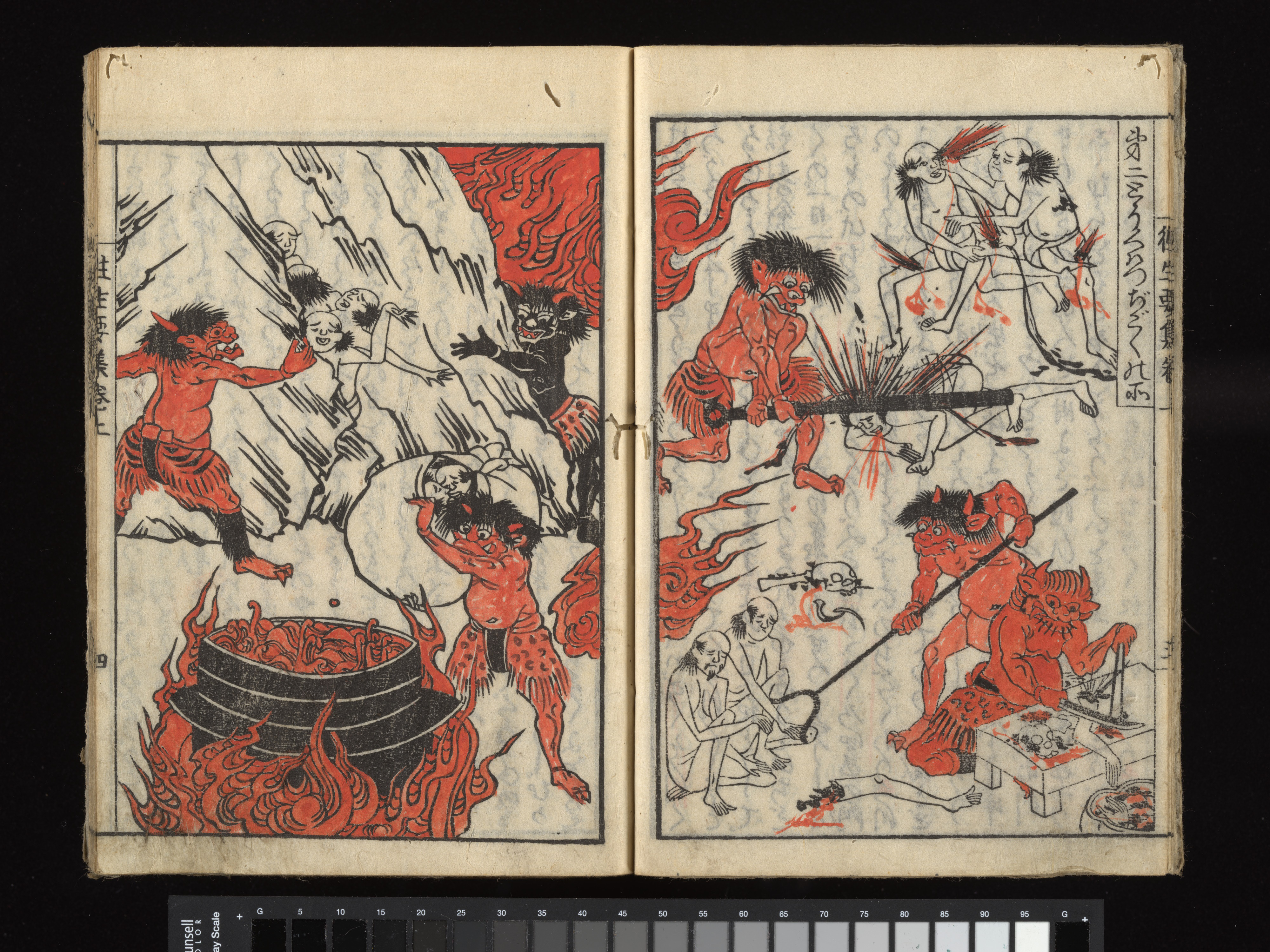
The Metropolitan’s Essentials of Rebirth in the Pure Land (acc. 2018.954.38a–c, objectIDs 74309–74311) is three thin volumes of a woodblock-printed book, dated 1790, ink and color on paper, given by Betty and Paul Nomura in memory of Nomura Shōjirō in 2018. Open the first volume to the leaf the Met photographed (its image file is labelled “volume 1 Page 8,9”) and the page does not behave like a sutra. There is no continuous column of scripture. There is a block of kanbun text and, set into it, a framed scene: figures in even black outline, an architecture of bars and gates around them, the right-hand sheet pulled a shade darker in the printing than the left. The book is eight centuries younger than the text it carries. The text is Genshin’s, written in 985; the format is the late-Edo devotional booklet, a thing meant to be cheap, portable, and looked at.
That distance is the subject. Genshin (源信, 942–1017), the Tendai monk also called Eshin Sōzu after his Yokawa retreat, did not write a picture book.1 He wrote a doctrinal anthology in roughly eighty thousand characters of literary Chinese, stitched together from 654 quotations drawn from about 160 scriptures and treatises.2 What the 1790 volumes preserve is not that anthology in its native difficulty but its afterlife: the moment, repeated for eight centuries, when a reader reached for a brush, or a publisher reached for a block-cutter, and turned Genshin’s argument into something the eye could walk through. This piece follows that turn from the text’s order, to the paintings that obeyed it, to the printed book that froze the whole sequence into a household object. The route is worth tracing because it is unusually clean: the same compound on Mount Hiei that produced the text also held the scrolls that pictured it, and the printed book that ends the line did not break the order the text began with.
The order of the chapters is the engine
The Ōjōyōshū has ten divisions, and the order of the first two is the entire mechanism.2 Division one is Onri edo (厭離穢土), “Loathing the Defiled Realm”: a systematic descent through the six realms of transmigration (hell, hungry ghosts, animals, fighting demons, humans, and the unenlightened heavens), with the hells treated first and at the greatest length and the most concrete cruelty. Division two is Gongu jōdo (欣求浄土), “Aspiring to the Pure Land”: the Sukhāvatī of Amida, described as the inverse of everything just catalogued. Only after those two does the book turn to method, in the eight remaining divisions on the classification of the nenbutsu, its aids, its occasions, its benefits, its scriptural warrants, and a closing question-and-answer.
This is a deliberately lopsided structure, and the lopsidedness is the point. Rhodes, in the standard recent English study, reads the Ōjōyōshū as a work that builds its case for Pure Land practice on a foundation of cosmological fear before it offers cosmological relief.1 The reader is taken down through the hells in graphic, enumerated detail and only then shown the alternative. The argument is not “here is a beautiful paradise”; it is “here is where you are going unless,” and the “unless” is the rest of the book. A. K. Reischauer, whose 1930 translation in the Transactions of the Asiatic Society of Japan remains the only substantial English rendering, preserved this front-loading: the hells occupy the opening and they are not abridged.3 A reader who quits the book early leaves it still inside the hells. That is a structural decision, and a later painter or block-cutter who keeps the order keeps the decision.
A text built this way is already half a picture program. It is sequenced, it is enumerated, it is spatial: each hell has a location, an architecture, a torment, a duration. It asks to be diagrammed. The medieval Japanese visual tradition took the invitation.
The Yokawa scrolls: text and image in the same place
The cleanest evidence that the Ōjōyōshū generated images, rather than merely sharing a worldview with them, sits at a single temple. Shōjuraigōji (聖衆来迎寺, the “Temple of the Welcoming Descent of the Holy Multitude”), near Ōtsu on the lake side of Mount Hiei, holds a set of fifteen mid-thirteenth-century hanging scrolls: four hell scrolls, two “hell-tearing” narrative scrolls, an Enma (judge of hell) scroll, and eight scrolls for the other five realms.4 Zhenru Zhou’s 2024 study of the set, the most detailed recent treatment, opens from the cosmology itself: the rokudō scheme the scrolls paint is the one “articulated by the Tendai monk Genshin (942–1017) in his work, the Essentials of Rebirth in the Pure Land (Ōjōyōshū, 985),” who “outlines the cosmology in the first chapter, titled ‘Loathing the Defiled Realm’ (onri edo), identifying the six realms (rokudō).”4
The provenance closes the loop. The Shōjuraigōji scrolls are recorded as originally from Ryōzen-in at Yokawa on Mount Hiei, Yokawa being the precise compound where Genshin lived, wrote, and died.4 The pictures were made for, and kept at, the institutional descendants of the place that produced the text. They were not an independent folk tradition that happened to resemble the book. They are the book’s own house illustrating the book. Zhou’s reading goes further than iconographic matching: she argues the set is organised around a counter-movement, a built architecture of hell and then its deliberate destruction, “hell-tearing,” so that the scrolls do not only depict Onri edo but stage the escape that the second chapter promises.4 The painted set, in other words, reproduces the Ōjōyōshū’s two-part argument as a sequence one walks past, not merely its first half as a catalogue of horrors. Stand at the head of such a set, where it is hung in order, and the room itself runs the book’s syllabus: the hells are passed first because they are hung first.
What the paintings took, and what they did not
Two qualifications keep the transmission honest, and the corpus itself supplies them.
First, the earliest Japanese hell handscrolls are not straightforward illustrations of Genshin. The jigoku-zōshi (“scrolls of the hells”) of the twelfth and thirteenth centuries, the Tokyo National Museum’s National Treasure example among them (acc. A-10942, color on silk, 26.9 × 249.3 cm), draw their specific hells from older sutra sources rather than from the Ōjōyōshū directly.5 The Tokyo National Museum’s own catalogue text frames the genre by social history, not by Genshin: the rokudō concept “became popular at the end of the Heian period (794–1185) as the Heian court began to lose its power and social anxiety increased,” and the painting “encouraged them to embrace the desire to be born into the Pure Land.”5 Genshin’s name does not appear in that label. The honest statement is the one the corpus forces: the Ōjōyōshū did not invent the iconography of any individual hell, and it is not the source for every painted hell. Its sutras were available to painters independently.
What the Ōjōyōshū did was different and arguably larger. It assembled the scattered sutra hells into one ordered, enumerated, walkable system, and it bound that system to a single soteriological exit. ten Grotenhuis, treating the Pure Land visual tradition in Japanese Mandalas, places Genshin’s synthesis as the conceptual armature on which the later Pure Land image-economy is built rather than as the pattern book for any one scene.6 The distinction matters: Genshin is the reason the hells and the Pure Land are read together, in that order, with the nenbutsu as the hinge. The painters supplied the demons. The Ōjōyōshū supplied the syllabus, which is the harder thing to supply and the thing that travels.
Second, the raigō tradition, Amida and his retinue descending to receive the dying, is the second-chapter half of the same program, and here Genshin’s personal hand is part of the record while resisting precise pinning. The biographical tradition holds that Genshin was himself a painter and sculptor and was involved in early raigō imagery; one strand of it has him presenting a scroll of the phases of hell to the court.7 These attributions are traditional and not securely documented at the object level, and bodhi states them as tradition, not as established provenance. What is securely transmitted is the institutional fact already established: the temple that inherited Genshin’s Yokawa lineage is named for the welcoming descent, holds the rokudō scrolls, and reads its hell pictures and its raigō within one frame. The raigō genre’s debt to the Ōjōyōshū is treated more fully in the panel-by-panel reading of Cleveland 1953.123 and the figure-by-figure Nanbokuchō twenty-five-bodhisattva scroll; this article takes the descent as the bright pole of the same axis whose dark pole is the hells, and notes that the Ōjōyōshū is the text that made them one axis rather than two unrelated genres.
The printed afterlife: the syllabus becomes a household object
The Met’s 1790 volumes are the last stage of the transmission, and they change the social location of the text without changing its order. By the late eighteenth century the Ōjōyōshū existed not only as a manuscript anthology copied within the Tendai establishment but as a commercially block-printed, illustrated booklet: three slim volumes, image roughly 26.6 × 18.7 cm, the kind of object a lay household could own and a temple could distribute.8 The Met catalogues the set plainly as an “Illustrated book,” classification “Illustrated Books,” Japan, Edo period, 1790, woodblock-printed in ink and color on paper, with no named author or illustrator recorded in the open object data.8 The anonymity is itself evidence: by 1790 the work was no longer one monk’s treatise but a genre product, reset and recut by trade publishers whose names mattered less than the title on the cover.
Look again at what the photographed spread does. The text block and the framed scene share the page; the reader does not consult a treatise and then, separately, look at a painting. The two arrive together, in sequence, bound. This is the Ōjōyōshū’s structure delivered as a reading experience: the loathsome realms first, the aspiration after, the method following, now at the scale and price of a printed book rather than a temple scroll set. The printed recension does to the household what the Shōjuraigōji set did to the temple wall: it makes the argument something a body moves through in order. The medium has dropped two registers of cost and formality since 985; the spine of the thing has not moved. A lay reader in 1790, turning the leaves, walked the same descent and ascent a Yokawa monk had walked on a temple’s scrolls five centuries earlier.
The 1790 edition is therefore not a curiosity at the end of the story. It is the proof that the transmission was complete. A text written in eighty thousand characters of literary Chinese for a monastic readership had become, eight hundred years later, a picture book a layperson could hold, and it had carried its two-part order intact the whole way. The hells still came first. The Pure Land still came second. The nenbutsu was still the hinge between them. That is what a successful transmission looks like, not a text that survived, but a text whose shape survived, across manuscript, scroll, mural, and finally the cheap printed page.
What is settled and what is not
The settled part is the structural claim, and it is well supported. The Ōjōyōshū’s ten-division order, with the six realms first and the Pure Land second, is documented and translated.23 Its function as the conceptual armature for the rokudō / hell-scroll / raigō image-economy is the consensus reading in the recent scholarship.164 The Shōjuraigōji set’s Yokawa provenance and its dependence on Genshin’s first-chapter cosmology are stated directly in the most detailed recent study of those scrolls.4
The unsettled parts are two, and bodhi names both. The first is the limit of the transmission claim: the jigoku-zōshi hells are sourced from sutras Genshin also used, not from Genshin, and the Tokyo National Museum’s curatorial text deliberately does not route the genre through the Ōjōyōshū.5 The strong claim, “the hell scrolls illustrate Genshin,” is too strong; the defensible claim is “Genshin’s order is why the hells and the Pure Land are read as one program, and the Yokawa-lineage scrolls do illustrate that program.” bodhi takes the defensible claim and flags the strong one as overreach. The second is the page-level citation gap. The structural facts rest on the Wikipedia structural summary and on Reischauer’s translation at the level of the front-loaded hells; Rhodes, ten Grotenhuis, and Zhou are cited at chapter and argument level, without specific page numbers. The interpretive spine does not depend on a single unverified page, but Rhodes on the fear-then-relief reading and Zhou on the hell-tearing argument have not yet been checked page by page against the physical volumes. The gap is stated here rather than hidden.
Related
- Amida raigō, the welcoming descent, panel by panel (Cleveland 1953.123)
- The twenty-five bodhisattvas, Nanbokuchō raigō scroll
- Kuhon ōjō, the nine grades of rebirth
- Byōdō-in Amida, the canonical Heian Pure Land image
- The bosatsu processional mask, the welcoming descent enacted
- Genshin (entity)
- Ōjōyōshū (entity)
- Rokudō, the six realms (entity)
Footnotes
-
Robert F. Rhodes, Genshin’s Ōjōyōshū and the Construction of Pure Land Discourse in Heian Japan (Honolulu: University of Hawaiʻi Press, Pure Land Buddhist Studies, 2017): the standard recent English-language monograph on the text, on Genshin’s Tendai and Yokawa context, and on the work’s role in establishing Pure Land discourse in Heian Japan. Cited here for the reading that the Ōjōyōshū builds its case on cosmological fear before offering cosmological relief; cited at work level; page numbers not verified against the print volume. ↩ ↩2 ↩3
-
The ten-division structure and their order, (1) Onri edo 厭離穢土, (2) Gongu jōdo 欣求浄土, (3) scriptural proofs of Pure Land birth, (4) the meaning and classification of nenbutsu, (5) aids to nenbutsu, (6) nenbutsu for special occasions, (7) benefits of nenbutsu, (8) scriptural proofs of nenbutsu’s efficacy, (9) other practices for Pure Land birth, (10) resolution of doctrinal questions, together with the figures of roughly eighty thousand kanbun characters, 654 quotations, and about 160 source works, and the 985 date, follow the structural summary in the Wikipedia entry “Ōjōyōshū” (en.wikipedia.org/wiki/Ōjōyōshū), cross-checked against Reischauer 1930 for the front-loading of the hells. The chapter sequence is not in scholarly dispute; the secondary structural source is flagged because the primary kanbun text was not independently paginated. ↩ ↩2 ↩3
-
August Karl Reischauer (trans.), “Genshin’s Ojō Yōshū: Collected Essays on Birth into Paradise,” Transactions of the Asiatic Society of Japan, 2nd ser., vol. 7 (1930): the only substantial English translation. Cited at work level for the preservation of the text’s front-loaded structure (the hells open the work and are not abridged); specific pages not cited. ↩ ↩2
-
Zhenru Zhou, “Escaping from Confinement: Hell Imagery in the Shōjuraigōji Rokudō-e Scrolls,” Arts 13, no. 3 (2024): 94 (MDPI; open access). Quoted verbatim for the attribution of the rokudō cosmology to Genshin’s first chapter Onri edo, the composition of the fifteen-scroll set, the Yokawa / Ryōzen-in provenance, and the “hell-tearing” counter-movement reading. Cited at argument level; specific pages not cited. ↩ ↩2 ↩3 ↩4 ↩5 ↩6
-
Tokyo National Museum, Hell Scroll (Jigoku-zōshi), acc. A-10942, National Treasure, Heian period / 12th century, color on silk, 26.9 × 249.3 cm; e-Museum (National Institutes for Cultural Heritage), accessed 2026-05-16. Catalogue text quoted verbatim: “The Buddhist concept of the Six Paths of Transmigration (J. rokudô) became popular at the end of the Heian period (794–1185) as the Heian court began to lose its power and social anxiety increased,” and the scroll “encouraged them to embrace the desire to be born into the Pure Land.” The museum label does not name the Ōjōyōshū; cited here precisely for that absence, which bounds the transmission claim. ↩ ↩2 ↩3
-
Elizabeth ten Grotenhuis, Japanese Mandalas: Representations of Sacred Geography (Honolulu: University of Hawaiʻi Press, 1999), on the Pure Land visual tradition and Genshin’s synthesis as the conceptual armature for the later Pure Land image-economy rather than as a pattern book for individual scenes. Cited at argument level; pages not cited. ↩ ↩2
-
For the biographical tradition that Genshin (Eshin Sōzu, Yokawa Sōzu, 942–1017) was himself a painter and sculptor, was involved in early raigō imagery, and presented the court with a scroll of the phases of hell, see the Wikipedia entry “Genshin” (en.wikipedia.org/wiki/Genshin) and the Japanese Wiki Corpus “Genshin (Monk).” These attributions are traditional and not securely documented at the object level; bodhi reports them as tradition, not as established provenance, and the transmission argument in this article does not rest on them. ↩
-
The Metropolitan Museum of Art, The Essentials of Rebirth in the Pure Land (Ōjōyōshū), acc. 2018.954.38a–c, objectIDs 74309–74311, Japan, Edo period, 1790, woodblock-printed book, ink and color on paper, image 26.6 × 18.7 cm, Gift of Betty and Paul Nomura, in memory of Nomura Shōjirō, 2018. Public domain (CC0), re-confirmed via the Met Open Access API 2026-05-16; the Met collection HTML returned HTTP 429 and the Wayback snapshot (20260119) carries only generic site boilerplate, so no object-level curatorial prose is quoted. ↩ ↩2