Fudaraku: reading Kannon's island pure land
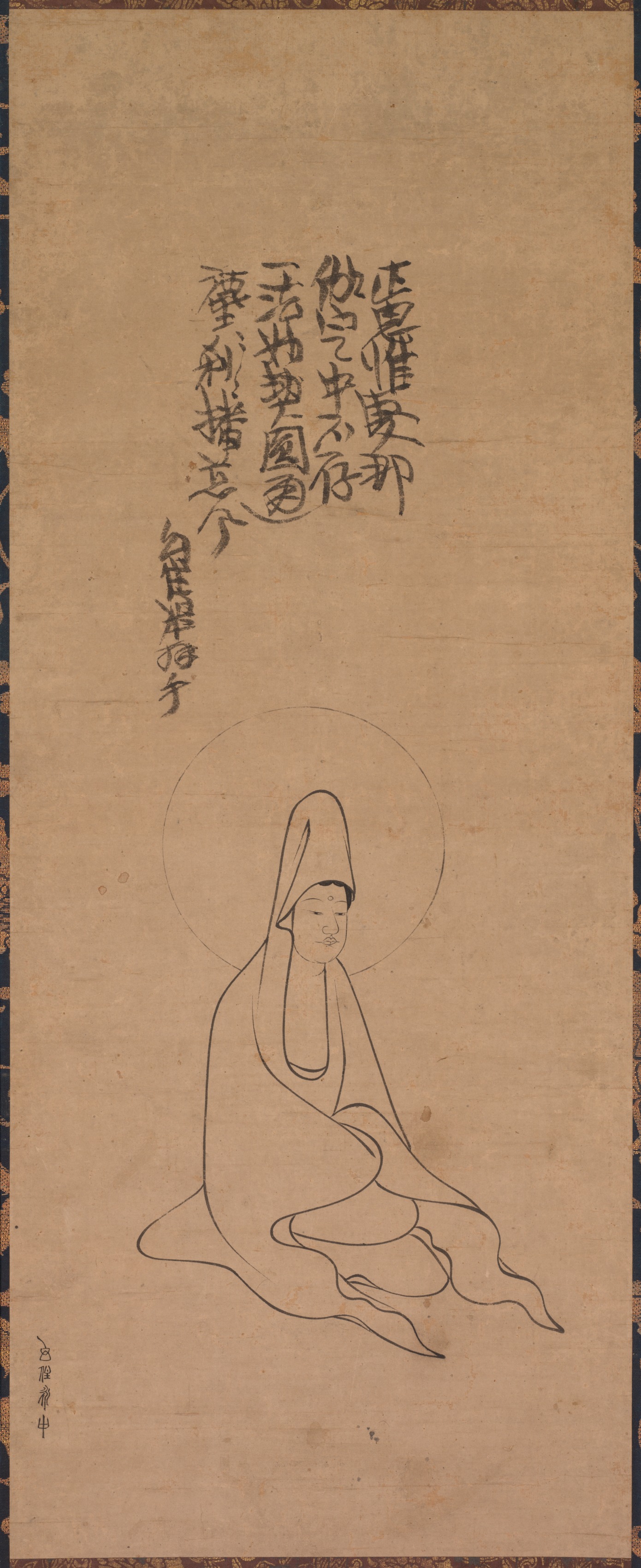
- Title
- White-Robed Guanyin / 白衣觀音菩薩像
- Period
- Yuan dynasty (1271–1368), late 1200s–early 1300s
- Region
- China
- Medium
- Hanging scroll; ink on paper
- Collection
- Cleveland Museum of Art
- Accession
-
1978.47.1 - Rights
- Cleveland Museum of Art (CC0). Purchase from the J. H. Wade Fund, 1978.47.1.
Painting 78.7 × 31.7 cm. Jueji Yongzhong (active around 1300), inscribed by the Chan master Zhongfeng Mingben (1263–1323). The white-robed Guanyin seated on the rock of Putuo (Potalaka).
Fudaraku is the Japanese name for Potalaka, Kannon’s island paradise across the southern sea. Its depiction is a place-not-a-figure iconography: a robed Kannon on a rocky islet, water, willow-vase, bamboo. The Nachi sankei mandara turns that place into a route, with the Fudaraku-tokai sea-crossing boat in its lower-right corner.
What Fudaraku is, and why it is hard to read
Most Kannon iconography is a reading of a figure: count the arms, find the Amida in the crown, identify the implement in each hand. Fudaraku (補陀落) is the exception. It is not a form of Kannon; it is the place where Kannon lives, and the iconographic problem is that a place has no mudra to check.
The scriptural source is the Gaṇḍavyūha, the final book of the Avataṃsaka-sūtra. The pilgrim Sudhana, working through his sequence of teachers, climbs to find Avalokiteśvara seated on a diamond boulder on a plateau on the western side of an isolated mountain ringed by springs and woods.1 That mountain is Potalaka. The text places it in the far south; the philologist Shu Hikosaka argued it answers to Potiyil, a hill near Ambasamudram in Tamil Nadu.2 The point that travels into the painting tradition is narrow and physical: Kannon sits on a rock, by water, and a seeker arrives by approach. Everything later painters do with Fudaraku is built from those three nouns.
So the reading guide for Fudaraku is unlike the reading guide for Senju or Batō. There is no canonical arm-count. There is a canonical situation: bodhisattva, rock, water, approach. Around it sits a small attribute set (willow, vase, bamboo, the boy Sudhana) that marks a particular painted rock as Potalaka rather than as any other ledge a Kannon happens to occupy.
The configuration on the Cleveland scroll
The Cleveland White-Robed Guanyin (acc. 1978.47.1) is a good place to learn the configuration because it shows the situation with almost nothing else in it. The museum’s catalogue states the iconography plainly: “the white-robed Guanyin sitting on a rock on the island of Putuo (Potalaka, in Sanskrit), located along the coast not far from Ningbo, in Zhejiang Province, China,” and notes that the figure was “swiftly…in only a few ink lines” drawn.3 The scroll is ink on paper, 78.7 by 31.7 cm, Yuan dynasty, painted by Jueji Yongzhong (active around 1300) and inscribed by the Chan master Zhongfeng Mingben (1263–1323).3
The scroll is tall and narrow, a little under a metre in the painted field, and it is meant to be read close, hung at reading height in a small room rather than across a hall. At that distance the first thing the eye resolves is not the rock. It is the cowl. The white robe is pulled up over the head into a continuous hood, and the brush keeps it as one long uninterrupted contour, so the figure is almost a single silhouette with a face cut into it. The rock is withheld to a few dry strokes under the hem. This is the diagnostic that catches readers out: a Potalaka painting can carry the whole place in posture and a hint of stone, with the sea omitted from the paper entirely. The water is implied by the white robe’s link to purity and by the convention itself, not always painted.
Three attributes do the identifying work when the landscape is this spare. The willow sprig in a water-vase is the standard Kannon-of-the-southern-sea pairing, marking the figure as the form that dispenses the water of compassion. A stalk or screen of bamboo, where present, is read as the phenomenal world seen through against the figure’s halo. The boy Sudhana (Zenzai-dōji), when included, is the Gaṇḍavyūha pilgrim arriving at the rock, and he is the single most reliable marker that a generic “Kannon on a ledge” is specifically Potalaka rather than a water-moon meditation scene. The Cleveland scroll leaves Sudhana out. It banks the identification on the seated-on-the-rock posture, the white cowl, and the inscription’s frame of reference. That economy is thrifty to the edge of withholding, and it is why the catalogue has to tell the viewer the rock is Putuo: the painting will not over-explain itself.
How the place became three places
Fudaraku iconography is unusually entangled with real geography, and reading it well means knowing that the rock is a claim about a location, not only a scriptural image. Chün-fang Yü’s Kuan-yin: The Chinese Transformation of Avalokiteśvara devotes a chapter to how the scriptural Potalaka was relocated onto Mount Putuo, an island off Zhejiang near Ningbo, which became the national pilgrimage center for the cult and the place every later Chinese “Guanyin on a rock by the sea” silently points to.4 The same scriptural mountain was claimed elsewhere too: in Tibet (the Potala at Lhasa), in Korea (Naksansa), and in Japan in more than one spot, by folk etymology at Futarasan in Nikkō and, definitively for the painting tradition, on the Kumano coast at Nachi.
This matters for reading. The white-robed Guanyin type on the Cleveland scroll is a Chinese Putuo image that arrived in Japan inside the Chan/Zen transmission; its inscriber, Zhongfeng Mingben, was among the most influential Yuan Chan masters, and scrolls of this kind moved into Japanese Zen collecting precisely as portable Putuo-Potalaka icons. The Japanese reception then did something the Chinese tradition did not. It attached the place to a devotional act performed in Japanese water.
Nachi: when the place becomes a route
The fullest Japanese reading of Fudaraku is not a single-figure scroll at all. It is the Nachi sankei mandara (Kumano pilgrimage mandala), the painting around which D. Max Moerman built Localizing Paradise; he treats the mandala as the book’s structuring object and reads the entire pilgrimage landscape out of it.5 Where the Cleveland scroll compresses Potalaka into one figure on one rock, the Nachi mandala expands it into a whole coastline a pilgrim walks.
These mandara were not hung for quiet study. They were prop and screen for etoki, picture-explaining performance by itinerant nuns, unrolled or stood up while a narrator walked a pointer across the surface for a standing audience.5 The configuration is built for that use: it is meant to be traversed by a stick and a voice along a fixed path, not taken in at a glance, which is why its logic is a route rather than a composition.
The mandala is read as a diagram, not a view. A diagonal runs from the upper left down to the lower right, and the lower-right corner is where Fudaraku sits, not as a paradise tableau of palaces and lotus ponds but as a boat. A pilgrim couple in white threads the route; the eye is led down the diagonal to Fudarakusan-ji on the shore and, past it, a small vessel standing out to sea. The pure land here is not a destination one sees. It is a departure one makes. That inversion is the single most distinctive thing about Japanese Fudaraku iconography, and it is why a reader trained on Pure Land raigō, where Amida descends toward the viewer from his western paradise, has to reverse the habit. In the Nachi mandala the figure does not come for the devotee. The devotee goes, by water, into the south.
Fudaraku-tokai: the boat in the corner
The boat in that lower-right corner is the ritual the iconography exists to record. Fudaraku-tokai (補陀落渡海), “crossing the sea to Fudaraku,” was a devotional sea-departure: a practitioner sealed into a small craft and set adrift southward toward Kannon’s island, on the doctrine, promoted by some priests as easier than rebirth in Amida’s western land, that the southern pure land could be reached bodily across actual water.6 The craft is iconographically specific and worth learning to recognize, because the boat is the marker. It carried a cabin nailed shut from the outside, no windows or doors, provisioned only with enough oil and food for the occupant to keep reciting to Kannon until the end. The cabin was ringed by a forty-nine-paling fence with four vermilion torii gates, a Kumano syncretic element that makes the boat read at a glance as a floating shrine rather than a vessel.6
Fudarakusan-ji at Nachi was the institutional center. The practice is recorded from 868 to 1722, with more than twenty crossings listed on a stone monument at the temple, the last associated with the head priest Yūshō in 1722.6 By the seventeenth century the act had shifted from a living departure to a posthumous one, the priest placed aboard after death, which is itself a useful dating signal when reading a late depiction. The doctrinal grounding, the ethics of the practice, and its place in Buddhist mortuary history sit outside this article’s iconographic remit; what the iconographic record carries is narrower and verifiable. When a Kumano-related painting sets a small fenced-and-torii’d boat at the foot of a diagonal, that boat is Fudaraku, and the painting is using a vessel to depict a paradise.
How to tell Fudaraku from its neighbors
Fudaraku is most often misread as two adjacent Kannon subjects, and the distinctions are clean enough to hold.
It is not the same as the Byakue (white-robed) Kannon as a form. The white robe is a frequent vehicle for the Potalaka subject, and the Cleveland scroll is exactly this overlap, but Byakue Kannon is classified as a form of the figure (a form-study, treated separately on bodhi), while Fudaraku is a place the figure inhabits. A white-robed Kannon is a Fudaraku image only when the situation (rock, water, southern-sea reference, sometimes Sudhana) is present; absent the place-markers it is simply the Byakue form.
It is also not Suigetsu (water-moon) Kannon, the meditation scene of a Kannon regarding the moon on water. Suigetsu and Fudaraku share the rock-and-water staging and the relaxed royal-ease posture, and Chinese painters often blurred them on purpose. The reliable separator is the seeker: Fudaraku admits the approaching pilgrim Sudhana and the pilgrimage frame; the water-moon scene is contemplative and unvisited. Where neither a boy nor a moon-on-water is present, the inscription and the collection context decide, which is exactly the situation the Cleveland scroll forces, and which is why its catalogue identification rests on the Zhongfeng Mingben inscription rather than on internal evidence.
The substantive scholarly question is not which Kannon this is but where Potalaka is. The textual mountain is southern and Indian; Shu Hikosaka located it concretely at Potiyil near Ambasamudram in Tamil Nadu on combined philological and field grounds, while the devotional tradition relocated it onto Putuo in China and onto Nachi in Japan.2 Yü reads the Chinese relocation onto Putuo as the operative one for the painting tradition: the rock every later Chinese scroll points to is Putuo, not Potiyil.4 bodhi follows Yü for reading purposes (a Yuan scroll’s rock is a Putuo rock) while keeping Hikosaka’s South Indian identification as the still-open question for the scriptural origin, since it bears on where the iconography is from even if not on what a given painting depicts.
Why this iconography matters
Fudaraku is the case where Japanese Buddhist art treats a pure land as a geography rather than a vision.5 Amida’s western paradise is, in the painting tradition, something seen: the raigō descends, the jōdo-hensō lays the palaces out for the eye. Fudaraku, in its fully Japanese form, is something done: a coastline, a temple on a shore, a sealed boat going south. The Cleveland scroll preserves the quiet end of that spectrum, the place held in a single hooded figure on a barely-drawn rock; the Nachi mandala preserves the loud end, the place dissolved into a route and a departure. Reading Fudaraku well means holding both: the rock-and-water situation as a portable icon, and, when the boat appears in the corner, the same icon turned back into an act.
The open question is not iconographic but documentary: the precise page-level mapping of the twenty-some recorded crossings to the surviving mandala recensions is handled at chapter level in Moerman and is not tied here to specific folios. That gap is flagged honestly rather than papered over.
Related
- Koyasu Kannon — the child-granting form of the bodhisattva
- Byakue Kannon: the white-robed form (form vs. place)
- Fukūkenjaku Kannon: an adjacent Kannon form
- Senju Kannon: the figure-reading method, contrasted
- Kannon (entity)
- Fudaraku / Potalaka (entity)
- Fudarakusan-ji, Nachi (entity)
- Nachi sankei mandara (entity)
Footnotes
-
Gaṇḍavyūha, the final book of the Avataṃsaka-sūtra (Indian Mahāyāna, ca. 200–300 CE): Sudhana’s visit to Avalokiteśvara, who is found seated on a diamond boulder on a plateau on the western side of Potalaka, an isolated mountain in the far south ringed by springs, ponds, and woods. Cited at work level; no specific recension or translation specified. ↩
-
Shu Hikosaka, Buddhism in Tamil Nadu: A New Perspective (Institute of Asian Studies, 1989), for the identification of the scriptural Potalaka with Potiyil / Potikai near Ambasamudram, Tirunelveli District, Tamil Nadu, on combined Buddhist-scriptural, Tamil-literary, and field-survey grounds. Cited at work level via secondary report; the primary volume has not been consulted. ↩ ↩2
-
Cleveland Museum of Art, White-Robed Guanyin, acc. 1978.47.1, catalogue entry (quoted verbatim): the figure is “the white-robed Guanyin sitting on a rock on the island of Putuo (Potalaka, in Sanskrit),” drawn “swiftly…in only a few ink lines,” inscribed by Zhongfeng Mingben, “perhaps the most widely respected and influential Chan (Zen in Japanese) master in the Yuan dynasty.” Accessed 2026-05-16. ↩ ↩2
-
Chün-fang Yü, Kuan-yin: The Chinese Transformation of Avalokiteśvara (Columbia University Press, 2001), the chapter on P’u-t’o Shan, for the relocation of the scriptural Potalaka onto Mount Putuo and its rise as the national pilgrimage center of the cult. Cited at chapter level; specific pages not given. ↩ ↩2
-
D. Max Moerman, Localizing Paradise: Kumano Pilgrimage and the Religious Landscape of Premodern Japan (Harvard University Asia Center, 2005). Moerman builds the book around the Nachi sankei mandara and reads the Kumano landscape, including the Fudaraku-tokai material, out of it. The diagonal-axis reading and the lower-right placement of the Fudaraku boat are the standard reading of the mandala; cited at chapter level, folios not specified. ↩ ↩2 ↩3
-
Japan Tourism Agency (MLIT), “Fudaraku-tokai: Crossing the Sea to the Southern Pure Land,” for the sealed cabin, the forty-nine-paling fence with four vermilion torii gates, the 868–1722 span, the more-than-twenty crossings recorded on the Fudarakusan-ji stone monument, and the 1722 crossing associated with the head priest Yūshō. Accessed 2026-05-16. Corroborated by Moerman 2005 at chapter level. ↩ ↩2 ↩3
Sources
-
Indian Mahāyāna, ca. 200–300 CE; the scriptural source for Potalaka