Koyasu Kannon: reading the child-granting form
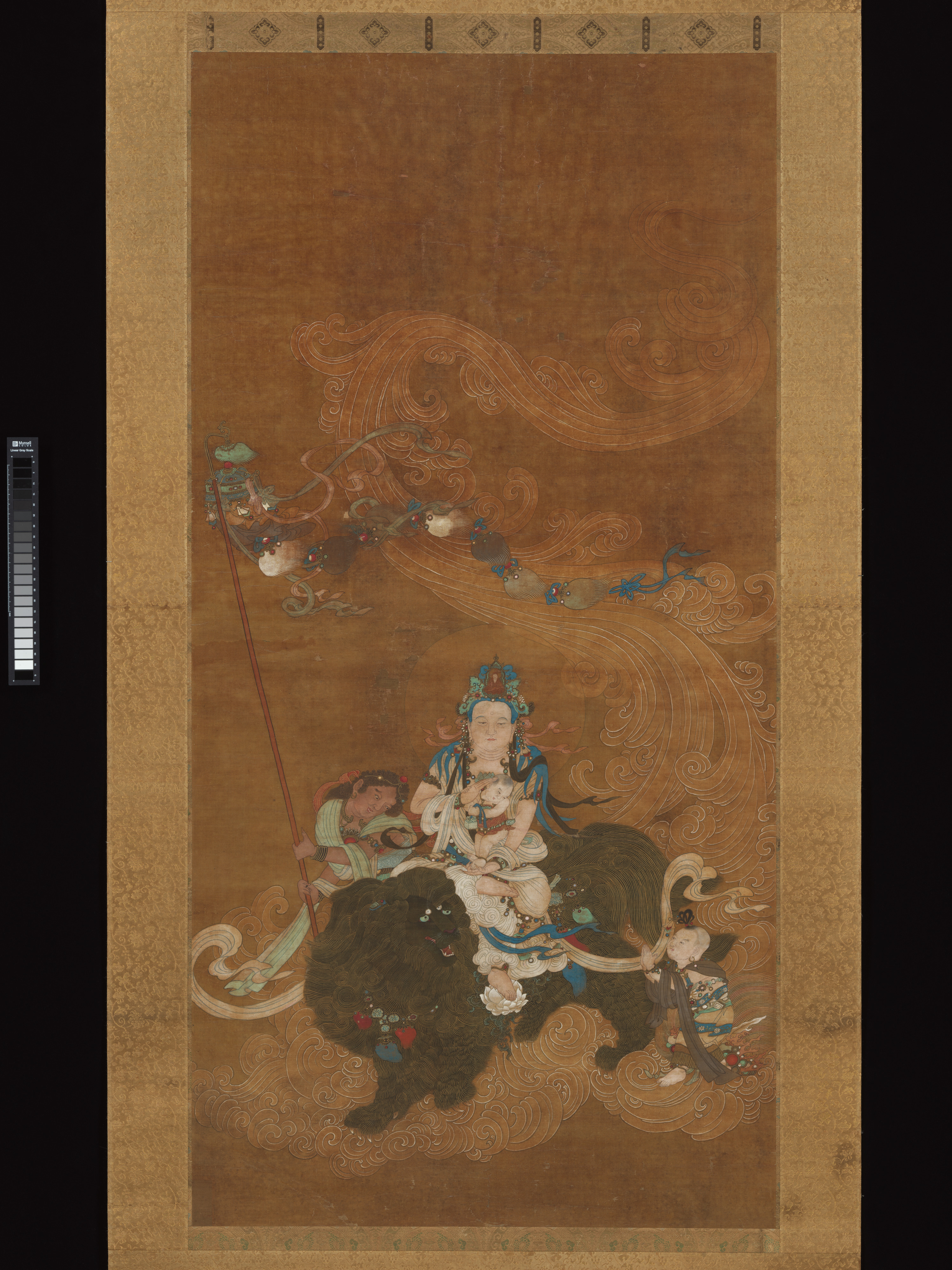
- Title
- Guanyin the Bringer of Sons (送子観音)
- Period
- Ming dynasty (1368–1644)
- Medium
- Hanging scroll; ink, color, and gold on silk
- Dimensions
- Image: 120.7 × 60.3 cm. Overall with mounting: 217.8 × 77.5 cm.
- Collection
- The Metropolitan Museum of Art
- Accession
-
1989.152 - Rights
- Public domain (Met Open Access, CC0). The Metropolitan Museum of Art, accession 1989.152. Purchase, Friends of Asian Art Gifts, 1989.
Unidentified artist, Guanyin the Bringer of Sons, late 16th century. Hanging scroll, ink, color and gold on silk, 120.7 × 60.3 cm (image). The Metropolitan Museum of Art, Purchase, Friends of Asian Art Gifts, 1989. Accession 1989.152. Public domain (Met Open Access).
Koyasu Kannon (子安観音) is the child-granting, safe-childbirth form of Kannon. It descends from the late-Ming Chinese Songzi Guanyin, the child-bringing Guanyin, and is read against two adjacent maternal figures, Kishimojin and the disguised Maria-Kannon. The held or standing child is the diagnostic marker.
The marker is the child, and the child is doing something specific
Koyasu Kannon (子安観音, “Kannon of safe childbearing”) is the form invoked for conception, for a safe delivery, and for an infant’s survival of its first years. The iconography is not abstract. On the Met’s Ming hanging scroll Guanyin the Bringer of Sons (acc. 1989.152, late 16th century, ink, color and gold on silk), the figure sits on a lion, descending toward the worshipper on a plume of cloud, and holds an infant. At 121 cm of image height the scroll hangs at devotional rather than gallery scale; read from directly in front, the eye is pulled first to the bright infant against the white robe and only afterward up to the adult face, which is the order of attention the painter built and the order in which the cult worked. The Met’s catalogue entry records what the infant is wearing: the child “is girded by a jewel-encrusted belt and holds an imposing seal, both emblems of high official rank,” and below the group kneels Sudhana, “the young boy whose auspicious birth enabled him to set forth immediately on a quest for spiritual enlightenment.”
That detail is the whole point of the form. A reader who knows only “Kannon holding a baby” will pass over the belt and the seal. They are not generic infant attributes. They are the insignia of a successful imperial examination candidate, a future office-holding son. The Ming scroll is not a picture of motherhood in the abstract; it is a petition for a particular kind of son, painted into the iconography itself. This is the single most useful thing to carry into any child-holding Kannon: read what the child holds before reading the adult.
The Sudhana figure below the cloud is the second tell, and it is easy to misfile. Sudhana (Zenzai-dōji in Japanese) is the pilgrim-boy of the Gaṇḍavyūha, the seeker who visits fifty-three teachers; he is a fixed companion of the white-robed and water-moon Guanyin and signals that the painter knew the orthodox iconographic stock. His presence at the foot of a son-granting scroll does double duty. It anchors the figure as canonically Guanyin rather than a folk fertility deity, and it quietly equates the wished-for son with a child whose birth was itself a beginning of the religious path. The petition and the doctrine are stacked in the same picture, the cult request on top, the canonical Guanyin underneath, and the order in which a viewer reads them depends entirely on what the viewer came for.
Where the form comes from: Songzi Guanyin, a Ming invention
The Japanese Koyasu Kannon is downstream of a Chinese form, the Songzi Guanyin (送子観音, “child-sending Guanyin”). The scriptural license is old: the Lotus Sutra’s twenty-fifth chapter, the Universal Gateway (普門品, in Japan the Kannongyō), states that a woman who reveres Avalokiteśvara and wishes for a son will bear a son of merit and wisdom, and one who wishes for a daughter will bear a daughter. The license is gender-neutral in the text. The cult was not.
Chün-fang Yü, Kuan-yin: The Chinese Transformation of Avalokiteśvara (Columbia University Press, 2001), is the controlling study. Her argument, sustained across the book, is that Guanyin’s shift from the masculine bodhisattva of the first Chinese millennium to the maternal White-robed and child-giving figure is a Ming-period development, carried by indigenous Chinese scriptures and miracle literature rather than by the Indian canon. The child-giving Songzi Guanyin is, in Yü’s account, a sub-form of the White-robed Guanyin (Baiyi Guanyin), specialised toward the request for a son in a society where only sons could sit the examinations and hold office. Jeong-Eun Kim’s Athanor article (Florida State University, 2014) reaches the same conclusion from the iconographic side: the held-male-child image does not appear before the Ming, and the surviving body of son-granting miracle stories clusters in the late Ming. The form, in other words, is roughly contemporary with the Met scroll, not ancient.
This is the first thing to keep honest. Koyasu Kannon is not a survival from the Asuka or Heian introduction of Kannon to Japan. It is a late form, imported into Japan with the Ming and Qing trade and the Ōbaku Zen channel, and naturalised under a Japanese name. The Japanese byakue (white-robed) and Koyasu forms are the same Chinese development arriving in Japanese dress.
What the standing-type Koyasu Kannon looks like
In Japan the form stabilises into a small, recognisable set of markers:
- The held or standing child. A single infant, usually male, either carried on the left arm or standing against the figure’s knee. This is the diagnostic. Without a child the figure is read as Byakue (white-robed) or Shō Kannon; with a child it is Koyasu.
- The white robe. Koyasu Kannon inherits the Byakue Kannon’s enveloping white mantle drawn up over the head. The two forms are continuous; the child is what specialises one out of the other.
- A seated maternal pose, frequently on rock or lotus. The figure sits relaxed, often in the posture of royal ease (rājalīlāsana) or simply with one knee raised, the body turned toward the child rather than frontal. The Ming scroll’s lion-and-cloud descent is the more elaborate end of the range; the Edo Japanese village type is plainer.
- No wrathful or multi-armed apparatus. Koyasu Kannon is a two-armed, benign form. It carries none of the implements of the esoteric Kannon (no thousand arms, no horse head, no wheel-and-jewel of Nyoirin). The reading is entirely in the child and the maternal address.
- In the imported sculptural type, a globe-like smoothness. The Dehua (blanc-de-chine) porcelain Songzi Guanyin, the form most often carried into Japan as a small devotional object, has a noncommittal ivory-white glaze that gives the face no fixed expression, and a child tucked into the crook of the arm. This is the type that mattered for the Maria-Kannon problem below.
The seated frontal Heian-Kamakura esoteric Kannon and this relaxed child-turned form do not share a sculptural lineage. A reader trained on the Sanjūsangen-dō Senju Kannon will find nothing familiar here except the name Kannon.
The Kishimojin adjacency, and how to keep them apart
The most common misreading in the Japanese material is the collapse of Koyasu Kannon into Kishimojin (鬼子母神), and the collapse is understandable because devotional practice itself collapsed them. Kishimojin is the Japanese form of Hārītī, the child-devouring yakṣiṇī of the Indian story who, after the Buddha hides the youngest of her five hundred children and lets her feel the loss, converts and becomes the protector of children and of safe delivery. In Japan she is also called Kariteimo (訶梨帝母) in the Shingon transmission, and in the Nichiren tradition she is a major protective deity, appearing with her ten daughters (the Jūrasetsunyo) in the Lotus Sutra’s twenty-sixth chapter.
The reading test is the attribute. Kishimojin’s diagnostic is the pomegranate (or an auspicious fruit) held in one hand, the fruit that the converted demon eats in place of children. She is frequently shown surrounded by several children, not holding one. She wears Song-dynasty robes and may be seated on an octagonal dais. Mark Schumacher’s iconographic survey records her as carrying the pomegranate in the right hand with a child in the left, and as the subject of late-Heian painted images at Daigo-ji and Kamakura sculpture at Onjō-ji (Mii-dera). Koyasu Kannon, by contrast, carries no fruit and no demonic backstory; the child is the only attribute, and the figure is unambiguously a Kannon, not a converted yakṣiṇī. Where the devotional epithet “Koyasu Kishimojin” (子安鬼子母神, “safe-childbirth Kishimojin”) appears, the two have been fused in cult; the iconographic record still separates them by the pomegranate. The Onmark survey notes the further entanglement that Juntei Kannon was itself read in some Japanese practice as a gentler form of Kariteimo and given the Koyasu name, which is why the Juntei reading guide and this one have to be read together rather than as rivals.
The Maria-Kannon adjacency, and why it is iconographically real
The second adjacency is the one that makes this form historically important well beyond the Kannon cluster. When Christianity was proscribed in Japan across the Tokugawa period, the prohibition hardening from the 1610s and enforced for over two centuries, the Kakure Kirishitan, the hidden Christians, kept devotional images that could pass a magistrate’s inspection as Buddhist. The image they reached for was the child-holding Kannon. A small white Songzi Guanyin holding an infant, read by a hidden Christian as the Virgin and Child, was materially indistinguishable from a Koyasu Kannon to an inspecting official.
Stephen R. Turnbull, The Kakure Kirishitan of Japan (Japan Library, 1998), is the standing study. The point worth carrying is that the camouflage worked because the iconographic convergence was already there: the Dehua blanc-de-chine Songzi Guanyin, the white-robed child-bearing porcelain figure exported through the same late-Ming trade that Yü documents, looked enough like a European Madonna-and-Child that European observers in Ming and Qing China had already remarked on the resemblance. The Maria-Kannon is not a Christian object disguised as a Buddhist one by clever modification. It is, very often, an unmodified imported Songzi Guanyin porcelain re-read. The Met’s own essay Compassion, Mercy, and Love: Guanyin and the Virgin Mary frames the two maternal figures as parallel intercessors and treats the visual convergence as the historical fact it is, not as a curiosity. Surviving Maria-Kannon in Japanese collections include unmodified Dehua figures and the better-known case of an Edo Maria-Kannon found concealed inside an Amida statue in the Kawaguchi city holdings.
The iconographic lesson is precise and slightly uncomfortable: the held child is such a strong, simple marker that it carried three different cults (son-petition, demon-turned-protector, and disguised Marian devotion) on the same body. The form’s legibility is exactly what made it portable across religions.
The museum-versus-cult divergence worth naming
There is a genuine tension between the catalogue record and the popular reading, and it is worth stating where bodhi stands. The Met catalogues the 1989.152 scroll with a masculine pronoun for the deity: Guanyin “descending toward the worshiper on a plume of clouds while holding a baby in his arms.” That is not a museum error. It preserves the Ming textual fact that Guanyin is doctrinally a bodhisattva without sex, and that the source scriptures speak of the bodhisattva, not a goddess. The popular reading, Chinese, Japanese, and Western alike, sees a mother. Yü’s book is precisely the account of how the second reading overtook the first during the Ming, without the doctrinal position ever formally changing.
bodhi’s reading follows Yü: the child-granting form is best understood as a cult development that feminised a doctrinally sexless figure through use, not through scripture, and the catalogue’s masculine pronoun is the honest residue of the doctrinal layer underneath the maternal one. The residual uncertainty is real and should not be smoothed over: the indigenous Chinese scriptures that licensed the son-granting cult are apocryphal and imperfectly dated, and the exact channel and date by which the Songzi type entered Japanese practice under the Koyasu name (Ōbaku Zen, the Nagasaki trade, or the hidden-Christian network itself) is not settled in the English-language scholarship and would need the Japanese-language temple gazetteers to pin.
Why this form matters for reading Japanese Kannon
The Koyasu form is the case where the iconography is almost nothing and the cult is almost everything. There is no esoteric implement to decode, no mudrā programme, no multi-armed schema. There is a white-robed Kannon and a child, and the entire interpretive weight sits on what the child is, what it holds, and which of three devotional communities is doing the looking. It is the cleanest demonstration in the Kannon cluster that an iconographic marker is not the same thing as a fixed meaning: the same held child meant a future office-holder to a Ming petitioner, a reformed demon’s charge to a Nichiren devotee, and the Christ child to a hidden Christian under sentence of death. The reading guide for this form is therefore shorter on attributes and longer on context than any other Kannon form — which is itself the lesson.
Related
- Byakue Kannon — the white-robed form Koyasu specialises out of
- Juntei Kannon — the form some Japanese practice read as Koyasu/Kariteimo
- Hōgai’s Hibo Kannon (1888) — the Meiji merciful-mother reworking of the child-holding type
- Fudaraku — the Potalaka Kannon and the white-robed lineage
- Kannon (entity)
- Koyasu Kannon (entity)
- Kishimojin / Kariteimo (entity)
- Maria-Kannon (entity)