A lacquered repository for the 600-fascicle Great Wisdom Sutra
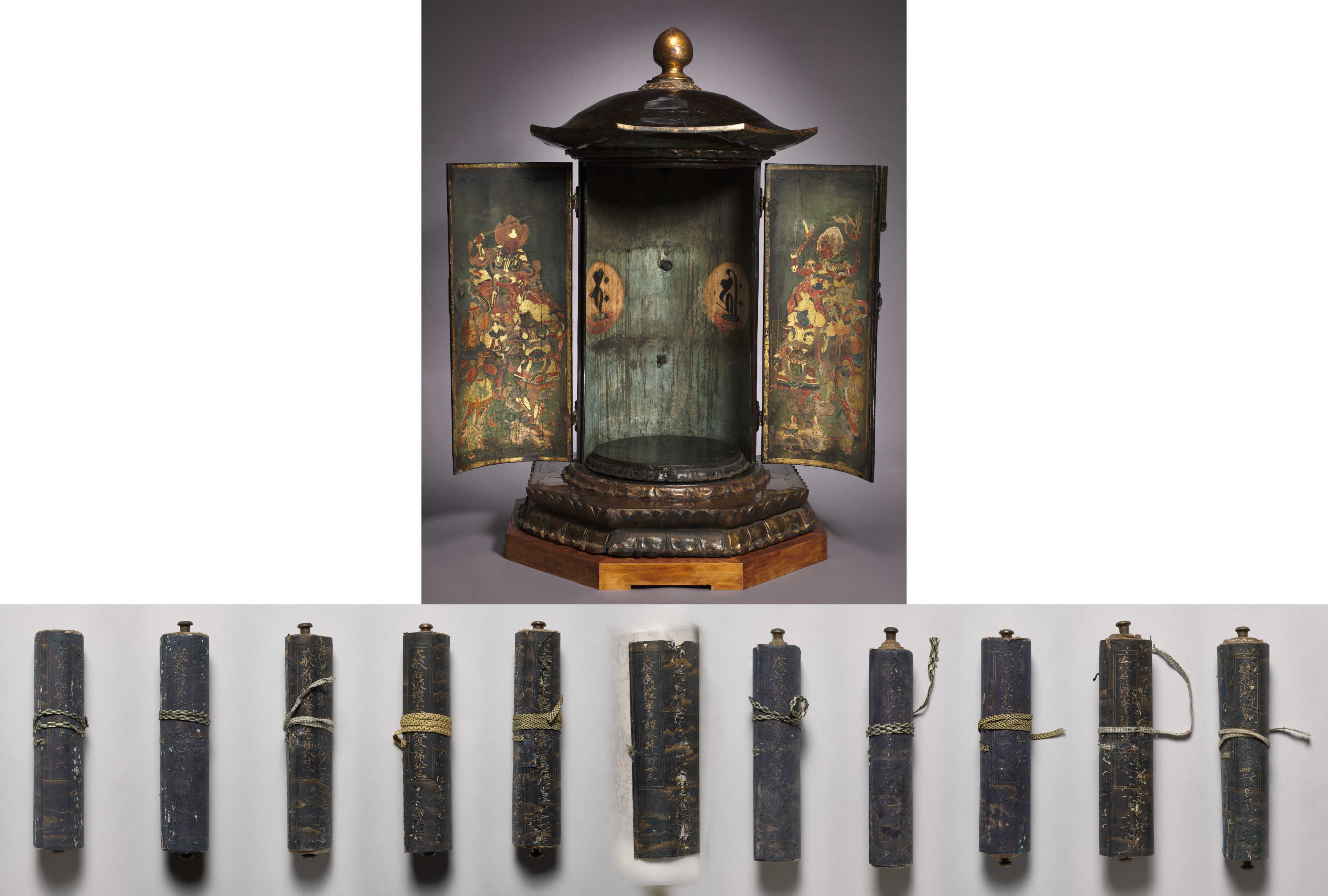
- Title
- Repository for the Great Perfection of Wisdom Sutra and Eleven Volumes of the Great Perfection of Wisdom Sutra
- Period
- Japan, Heian period, late 1100s
- Region
- Japan
- Medium
- Lacquered wood with ink, color, gold, cut gold, and metalwork
- Dimensions
- Height: 160 cm (63 in.)
- Collection
- Cleveland Museum of Art
- Accession
-
1969.130 - Rights
- Repository for the Great Perfection of Wisdom Sutra, Japan, Heian period, late 1100s. The Cleveland Museum of Art, John L. Severance Fund, accession 1969.130. CC0 (public domain).
Cleveland Museum of Art, accession 1969.130. John L. Severance Fund. CC0 (public domain).
Cleveland 1969.130 is a late-12th-century lacquered cylindrical repository for the 600-fascicle Daihannya-kyō. Its mate is in the Nara National Museum; the doors carry painted guardian deities and the back wall the seed-syllables of Shaka and Amida. The object was made for the Daihannya-e ritual of turning the 600 scrolls.
The work
Cleveland 1969.130 is a cylindrical lacquered cabinet, 160 cm tall, that once held scrolls of the Daihannya-kyō, the Great Perfection of Wisdom Sutra, 600 fascicles in the standard Japanese reckoning.[^cma-1969-130] It is one of a pair. The mate, Nara National Museum accession 1115, is the same height to within five centimeters (the Nara catalog gives 165 cm, diameter 62.5 cm) and the two designs are identical.[^narahaku-1115] The Cleveland catalog dates the object to the late 1100s, late Heian; the Nara catalog gives “Heian period, 12th century.” The pair was reunited for an exhibition at the Nara National Museum in 2000 after the Cleveland piece was conserved through a joint program.[^cma-1969-130]
The form is a tall drum on a stepped octagonal base, capped by a low pagoda-style roof and a gilt-bronze finial. Two doors open on the front. Open, they reveal an interior back wall painted with two roundels, each containing a single Sanskrit seed-syllable (shuji): the catalog identifies them as the syllables for Śākyamuni and Amida.[^cma-1969-130] The exterior of the doors and the drum are black lacquer worked with ink, color, gold, and cut gold (kirikane), gold leaf cut into hairline strips and laid into the lacquer.[^cma-1969-130] The Nara record specifies “gilt bronze fittings” and “bright pigments and cut gold leaf” for the figural painting.[^narahaku-1115]
The painted figures are the point. Across the four doors of the two repositories appear the sixteen guardian deities of the Daihannya-kyō (the jūroku zenshin), eight per object, four to a door.[^narahaku-1115] On the Cleveland piece the eight read as armored, frontal figures in red and gold against the dark ground, ranged in two stacked registers per door. They are, in the Cleveland catalog’s phrase, “benevolent but fierce looking.”[^cma-1969-130] The paint has thinned to the wood in places; on the left door the lower figure’s halo survives as a flat gold disc while the pigment of the body has gone translucent, so the brush underdrawing reads through it. This is a working object that was opened and closed for centuries, not a sealed reliquary, and the wear is on the door edges and the lower registers where hands would have reached.
The geometry is the function. A repository for 600 fascicles is a storage problem before it is a devotional one: the object has to hold and release a very large number of scrolls in an order that can be followed during a ceremony. The drum form solves this by stacking the fascicles around a circular interior, the octagonal stepped base raising the whole to a working height off the temple floor, the pagoda roof and finial marking it as architecture rather than furniture. The pairing of two near-identical drums for one 600-fascicle set is itself a clue to use: a single cabinet that size would be unwieldy to work from in a ceremony, while two matched drums let officiants draw from both at once. The eleven scrolls Cleveland now shows, dark indigo-black with gold-ruled columns and several still bound with their cords in mid-unroll, are the surviving trace of what filled it; the Nara mate still holds 166, enough to see the interior as it was meant to look when stocked.[^cma-1969-130][^narahaku-1115] The eleven against the 600 is the first thing the object asks a viewer to hold in mind.
Among the eleven, one scroll lies fully extended, its paper a paler grey where a conservation insert replaces loss; the others keep their rolled bulk and their ties. The eleven are a remnant the catalog is honest about: the object’s full title records “Eleven Volumes,” not 600. What the repository was built to hold and what it now holds are different objects, and the late-Heian commission has to be read across that loss.
Iconographic reading
The two seed-syllables on the back wall are the doctrinal hinge. A repository for the Daihannya-kyō naturally invokes Śākyamuni: the sutra is preached, in its frame narrative, by the historical Buddha, and the assembly of Shaka with the sixteen protectors is the standard Japanese pictorial vehicle for the text.[^narahaku-1115] The presence of Amida alongside him is the part worth slowing on. Amida is the buddha of the Pure Land, the focus of the rebirth-oriented devotion that dominated late-Heian aristocratic religion. Pairing the Wisdom-sutra buddha with the Pure-Land buddha on the interior wall folds a text-cult object into the merit economy of Pure Land practice: copying, housing, and reciting the sutra generates merit, and the merit is dedicated toward rebirth. The object is iconographically bilingual: a Wisdom-sutra container that speaks Pure Land.
The sixteen guardians on the doors belong to a specific iconographic family. Tanabe, treating the parallel material culture of the Lotus Sutra, frames the decorated sutra container as a continuous surface with the text it holds: the protective and devotional imagery on the box is not ornament around the scripture but part of the scripture’s presentation as a sacred object.[^tanabe-1988] In the Shaka jūroku zenshin painting type, the sixteen are warlike yaksha figures arrayed in two groups around an enthroned Shaka attended by Monju and Fugen, and the type was hung as the principal image for the Daihannya-e itself.[^narahaku-1115] On the repository the assembly is disaggregated: the guardians are distributed onto the doors as a perimeter, and the buddhas are reduced to their seed-syllables on the wall behind the scrolls. The container reorganizes a painting into an architecture. The viewer who knows the hanging-scroll type recognizes the doors as its unfolded edges; the viewer who does not sees eight armored figures guarding a dark interior, which is also correct.
The common misreading is to take the repository as a reliquary and the scrolls as relics in the relic sense, objects venerated for contact with a holy body. The sutra-cult logic is different. The Daihannya-kyō is treated as the Buddha’s word made into a physical body of text, the dharmakāya in scroll form; the repository houses a body, but a textual one, and the ritual that activated it was reading, not contemplation of a relic.
Comparanda
The closest comparandum is the object’s own mate. Nara National Museum 1115 lets the pair be read against each other: same height range, same identical design, same sixteen-guardian program split eight and eight, the difference being that the Nara piece retains 166 fascicles and a fuller paint surface while the Cleveland piece retains eleven and more wear.[^narahaku-1115] Read together they reconstruct a single commission of two cabinets for one 600-fascicle set: 300 fascicles intended per drum on the simplest reading, though neither now holds anything near that.
For the contents rather than the container, the late-Heian decorated Daihannya-kyō survives in Western collections through the Chūsonji-kyō, the gold-and-silver sutra scrolls produced for Chūsonji in the early 12th century, of which the Metropolitan Museum holds examples.[^met-44887] The Chūsonji-kyō and the Cleveland repository are roughly contemporary expressions of the same impulse: the Daihannya-kyō as a luxury object, written in precious media or housed in lacquer, commissioned by the Fujiwara-era elite. bodhi’s existing study of the Heian gold-and-silver indigo sutra reads the scroll side of this material culture; the repository is the architecture built to hold it.
Within bodhi’s corpus the nearest formal sibling is the Yūzū Nenbutsu engi handscroll, which also belongs to the cluster of late-Heian-to-Kamakura material culture organized around merit, recitation, and the Pure Land. Both objects are functional ritual apparatus before they are pictures; both have their iconography subordinated to a use.
Provenance and the Daihannya-e
The pair’s recorded history runs through Kyoto religious institutions. The Nara record states the shrines stood originally in the Sutra Chanting Room of the Kamigamo Shrine before being moved to Jinkō-in temple in Kyoto.[^narahaku-1115] A “Sutra Chanting Room” attached to a Shinto shrine is the precise institutional setting the object was built for: a space where the Daihannya-kyō was read aloud as a continuing ritual, in the shrine-temple combinatory religion (shinbutsu shūgō) normal before the Meiji separation. The Cleveland piece entered the museum in 1969 through the John L. Severance Fund; the Nara piece is held under accession 1115.[^cma-1969-130][^narahaku-1115]
The function is the Daihannya-e (大般若会), the great Wisdom-sutra assembly. The ritual difficulty is built into the text: at 600 fascicles, on the order of five million characters in Xuanzang’s 7th-century Chinese translation, a complete spoken reading is a multi-day undertaking for a large body of clergy.[^met-44887] The institutional solution was tendoku (転読), “turning-reading”: rather than read every character, the officiants fan the concertina-folded fascicle open and shut, sweeping the leaves through the air while calling the sutra’s title and the fascicle number aloud. The whole 600 are “read” in a single session by being turned. The Metropolitan’s catalog of the Chūsonji Daihannya-kyō records the practice and its visual character, the cascade of folded leaves through the air, as the normal Japanese mode of reading this text from the early period onward.[^met-44887] The historical shift the Met entry describes is the key one: the early practice was a literal recitation by a large body of assembled clergy reading character by character over several days, and when that proved impractical at the 600-fascicle scale the concertina-folded book made the abbreviated turning-reading possible. Tendoku is the ritual form a 600-fascicle scripture takes once the institution accepts that the merit of the reading does not require every character to be voiced.
That acceptance is what the repository is built around. The object’s logic only makes sense if the sutra is going to be physically handled in bulk and in sequence during a ceremony, not consulted as a reference text. A repository tall enough to stand on a temple floor, with doors that open frontally onto an interior of stacked scrolls, is apparatus for retrieving and returning 600 fascicles in the choreography of a single rite, not a cabinet for storage between rare consultations. The wear pattern observed on the doors, edges and lower registers abraded where hands reach, is the physical residue of exactly that repeated handling. The Daihannya-e was performed recurrently, often as a state-protective or shrine-protective rite, which is why the pair stood in a shrine’s Sutra Chanting Room rather than in a temple treasury: the object lived in use, not in storage, and the repository’s form is the form a continually-turned scripture demands.
The wider Heian context is the sutra-cult economy. Blair’s study of Kinpusen documents the late-Heian aristocratic practice of copying and burying sutras, and argues that on that mountain the burial was tied to the site’s own deity and meanings rather than driven primarily by mappō anxiety, the fear of the Dharma’s decline.[^blair-2015] The Daihannya-kyō repository belongs to the same milieu of elite text-devotion but to its other pole: not the buried sutra, sealed against the age of decline, but the housed and continually turned sutra, kept in use. Von Verschuer’s work on Heian material culture and exchange situates the precious media themselves—the imported and domestic lacquer, gold, and pigment economy—as part of how the period’s elite converted wealth into religious objects.[^verschuer-2016] The Cleveland repository is one terminal of that conversion: a 600-fascicle scripture given a body of lacquer and gold, and a pair of doors guarded by sixteen armored figures, so that the act of turning it could be performed with the apparatus the text was held to deserve.
What stays unresolved is the commission itself. The pair’s design is identical and its program coherent, but neither catalog assigns a workshop, a patron, or a year tighter than “late 12th century”; the Kamigamo-to-Jinkō-in line is the earliest secure provenance, and it begins after the object was already made. The repository is exactly datable as a type and unattributed as an object. That is the honest position the catalogs hold, and this article holds it with them.
Related
- The Heian gold-and-silver indigo sutra — the scroll side of this material culture
- Yūzū Nenbutsu engi — late-Heian merit-and-recitation material culture
- Daihannya-kyō (entity)
- Sutra cult (entity)
- Kirikane — cut-gold-leaf decoration (entity)
- Amida (entity)
- Shaka (entity)