Amida vs Shaka vs Yakushi vs Dainichi: reading the four principal honzon
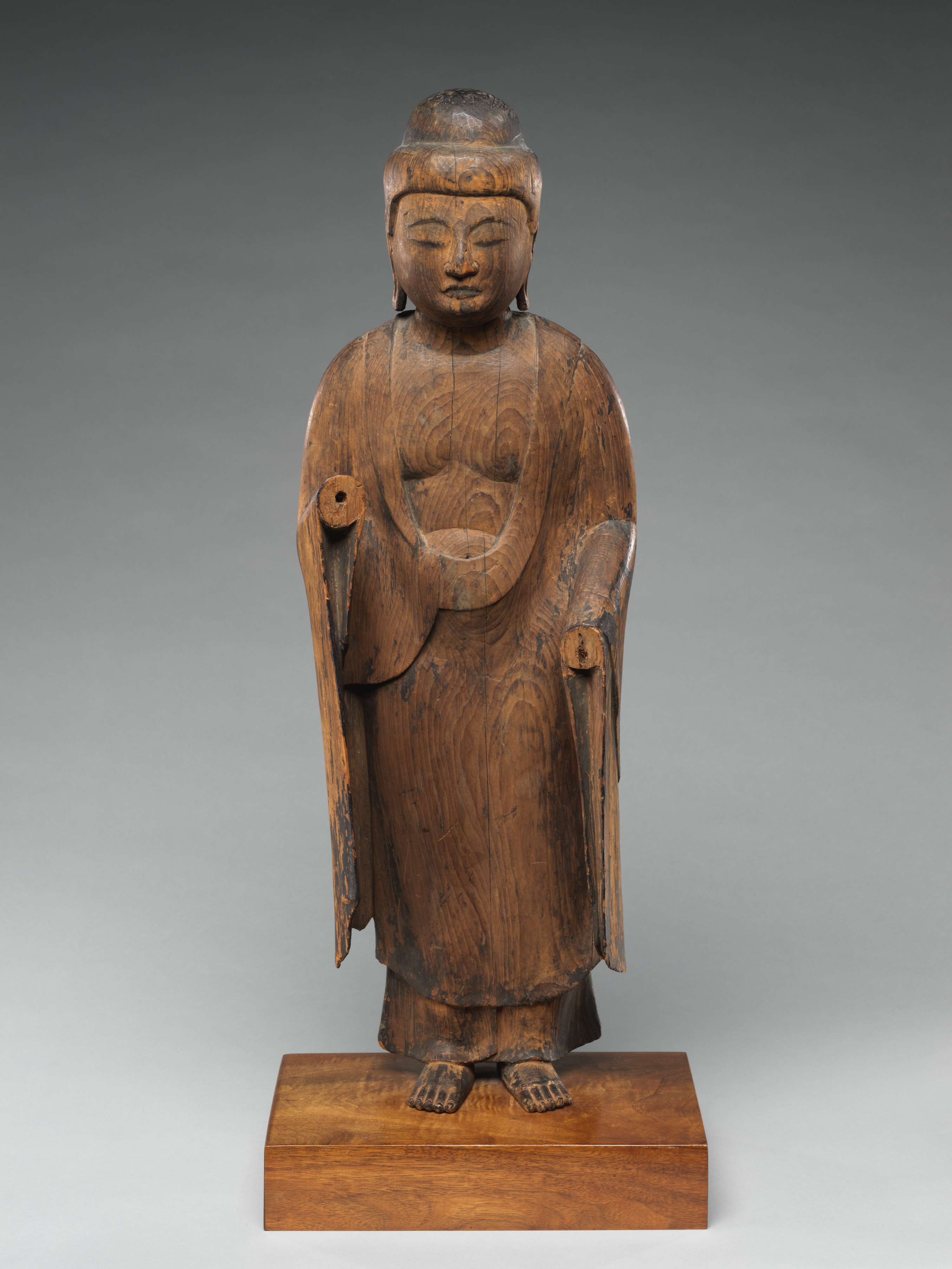
- Title
- Standing Buddha
- Period
- Heian period, early 9th century
- Region
- Japan
- Medium
- Wood
- Dimensions
- H. 58.4 cm (23 in.); W. 21.6 cm (8 1/2 in.); D. 12.7 cm (5 in.)
- Collection
- The Metropolitan Museum of Art
- Accession
-
2015.500.9.60 - Rights
- The Metropolitan Museum of Art, Gift of Florence and Herbert Irving, 2015 (acc. 2015.500.9.60). Public domain (CC0 / Open Access).
Standing Buddha, Japan, Heian period, early 9th century. Wood. The Met catalogs it as 'Standing Buddha' — not Amida, not Shaka — because the hands that would carry the diagnostic mudrā are lost.
Four Buddha honzon dominate Japanese Buddhist practice: Amida, Shaka, Yakushi, and Dainichi. They are told apart not by face but by mudrā, by attribute (Yakushi’s medicine jar, Dainichi’s crown and chiken-in), and by setting. When the diagnostic is missing, the responsible catalog says “Standing Buddha” and stops — as the Met does for acc. 2015.500.9.60.
What the four-honzon problem is
A honzon (本尊) is the principal object of devotion of a temple, a hall, or a rite. Four Buddhas carry most of that weight across the Japanese tradition: Amida (Amitābha), Shaka (Śākyamuni), Yakushi (Bhaiṣajyaguru), and Dainichi (Mahāvairocana). The first three are nyorai in the plain monastic mode: shaven head, the cranial ushnisha, the simple double robe, no jewellery. Dainichi is the exception that proves the rule, and is the one figure in this set a viewer can name from across a gallery.
The problem the lay and curatorial eye actually meets is this. A seated or standing wooden Buddha arrives without provenance, missing its hands or its attendant figures, the gilding gone. Three of the four look alike. The face does not disambiguate; the robe does not; the lotus pedestal does not. What disambiguates is the hand-gesture, the held attribute, and the company the figure keeps. When those are absent, the figure cannot be named, and the discipline is to say so rather than default to the most famous candidate.
The Met holds a small early-Heian example that states the problem cleanly. Object 2015.500.9.60 is a wooden standing Buddha, roughly 58 cm tall, dated to the early 9th century. The forearms are lost. The Met catalogs it as Standing Buddha, not Amida, not Shaka, because without the hands there is no mudrā — and without the mudrā there is no name.[^1] That refusal is the model this article argues for.
Dainichi: the crowned Buddha you can name across the room
Dainichi Nyorai is the only one of the four that breaks the plain-monastic rule, and the break is total. Where Amida, Shaka, and Yakushi wear the patched double robe of a renunciant, Dainichi wears the body of a bodhisattva: a high jewelled crown, a chest ornament, armlets and bracelets, a sash and a skirt-like lower garment, the hair bound up rather than shaven.[^2] The figure is a Buddha dressed as a prince, the cosmic Buddha of Esoteric Buddhism rendered in the regalia of sovereignty rather than the rags of withdrawal.
The hand-gesture confirms it. The Diamond-World Dainichi makes the chiken-in (智拳印), the wisdom-fist: the left index finger raised and enclosed in the right fist at the chest, the gesture of the union of the practitioner and the cosmic Buddha. Saunders treats the chiken-in as the single mudrā exclusive to Dainichi in the Japanese repertoire, made by no other Buddha.[^3] The Womb-World Dainichi instead sits in the hokkai-jō-in (dharma-realm meditation gesture), hands stacked in the lap; that form needs the crown to disambiguate, since the lap-hands alone read like a meditating Buddha.
The common misreading runs the other direction. Because Dainichi wears a crown and jewellery, an unprovenanced crowned figure is sometimes catalogued as a bodhisattva, a Kannon or a Monju, when it is in fact a Buddha. The diagnostic that resolves it is the chiken-in or the hokkai-jō-in plus the absence of a bodhisattva’s lotus-bud, water-flask, or sword: Dainichi holds nothing. The Met’s Heian Dainichi (acc. 26.118a, b), read at length in the bodhi single-work study, is the crowned-Buddha witness for this; it is cited here rather than re-described.[^4]
Yakushi: the medicine jar and the company he keeps
Yakushi Nyorai is the Medicine Master, the Buddha of the eastern Pure Land of Lapis Lazuli, whose twelve vows in the Bhaiṣajyaguru Sūtra are vows of healing.[^5] In the developed Japanese form he is the most positively identifiable of the three plain-robe Buddhas, because he carries a thing: a small covered medicine jar (yakko, 薬壺) cradled in the left palm, usually at lap height, while the right hand drops toward the knee in a giving gesture or rises in the fear-not gesture.
The jar is decisive when it is present. When it is absent, Yakushi collapses into Shaka. Yui Suzuki’s monograph makes the historically sharp version of this point: before roughly the end of the 8th century, the Japanese Yakushi did not hold a jar at all, and his depiction was effectively the same as Śākyamuni’s; the jar, and the standing Yakushi form, are early-Heian developments tied to the Tendai school’s promotion of the icon.[^6] An early Yakushi without the jar is therefore not a mislabel of Shaka so much as a figure from a period when the two were not yet visually separated. This is the cleanest case in the set of an attribute, not a face, doing the entire identifying work.
The second Yakushi diagnostic is the retinue. Yakushi is canonically attended by the Jūni Shinshō (十二神将), the Twelve Heavenly Generals, one per vow, a programmatic group no other Buddha carries. Cleveland’s Kamakura silk Medicine Master Buddha and the Twelve Divine Generals (acc. 1938.422) preserves the full programme; where the central figure’s jar is unclear, the twelve armoured guardians name him.[^7] That painting is read in full in the published bodhi spoke and is cited here as the retinue witness, not re-expounded.
Amida: the hand-positions, not the face
Amida Nyorai is the Buddha of the Western Pure Land, the central honzon of Pure Land Buddhism and the most-collected Japanese Buddha in Western museums. He has no held attribute. He is plain-robed like Shaka and the jar-less Yakushi. Everything rests on the hands.
The Japanese tradition fixes a set of nine Amida hand-positions (the kuhon raigō-in / jō-in system), built from a meditation gesture and a contact-or-reassurance gesture in three grades each.[^8] Two recur most in sculpture. The first is the jō-in (定印): both hands stacked in the lap with the thumbs and index fingers touching to form a ring or rings, the meditating Amida of the Byōdō-in type. The second is the standing raigō gesture, the right hand raised and the left lowered, both with thumb-and-finger rings, the welcoming-descent Amida who comes for the dying believer. The Byōdō-in Amida by Jōchō (1053) is the canonical seated jō-in form and is treated in its own bodhi study; it is the reference point, not the subject, here.
The common misreading is the default. Because Amida is the most familiar Japanese Buddha in the West, an unprovenanced seated Buddha with the hands in the lap is reflexively called Amida. The same lap-hands, without the finger-rings, are the plain meditation gesture (jō-in in the generic sense) that Shaka, Yakushi, and the Womb-World Dainichi also use. The disambiguator is narrow and specific: the touching thumb-and-finger rings of the Amida grades, not merely hands in the lap. Saunders is explicit that the ring-forming contact is the load-bearing detail, and that its absence pushes the identification back to “unspecified Buddha.”[^9]
Shaka: the Buddha defined by what he lacks
Śākyamuni, Shaka Nyorai, the historical Buddha, is the residual category, and that is the most useful single fact about him. He is the plain monastic Buddha with no crown (so: not Dainichi), no jar (so: not the developed Yakushi), and no ring-forming Amida hand-grades. His standard gestures are the broadest in the repertoire: the semui-in / yogan-in pair (fear-not and wish-granting), the earth-touching gesture of the enlightenment moment, the teaching gesture of the first sermon. None of these is exclusive to him.
This means Shaka is rarely identified by a positive mark and usually identified by setting and narrative. The clearest Shaka anchor in the Japanese record is the Hōryū-ji Kondō Shaka triad of 623 with Tori Busshi’s dedicatory inscription, where the inscription, not the iconography, names the Buddha; that work is the bodhi spoke for the figure and is cited rather than re-expounded.[^10] The corollary for the museum eye: a plain seated Buddha with broad non-exclusive gestures and no attribute, no crown, no securely Amida rings, and no retinue is most defensibly catalogued as Buddha or Śākyamuni-type, not promoted to Amida by familiarity.
Object 2015.500.9.60 is mounted at adult-eye-level in the Met’s Asian galleries, unusually low for a Buddha, which is typically pedestalled to look down on the viewer. It is small, barely shoulder-high on its case, the wood gone to a dry pale grey where the lacquer-and-gilt skin has flaked entirely away. The body gives a date and a region. The lost forearms take the name with them. A confident label here would be an invention; the honest label is the one the Met used.
A working disambiguation table
| Buddha | Sanskrit | Diagnostic mudrā / gesture | Attribute and body | Throne / setting | Cult function | Common museum mislabel |
|---|---|---|---|---|---|---|
| Dainichi | Mahāvairocana | chiken-in (wisdom-fist) or hokkai-jō-in | crown, jewellery, sash; bodhisattva-ornamented body; holds nothing | lotus; centre of the Two-World mandalas | cosmic Buddha of Esoteric Buddhism | read as a bodhisattva (Kannon / Monju) because of the crown |
| Yakushi | Bhaiṣajyaguru | giving gesture + jar-holding left hand | covered medicine jar (yakko) in left palm; plain robe | lotus; eastern Lapis-Lazuli realm; Twelve Generals retinue | healing | read as Shaka when the jar is lost or pre-9th-c. |
| Amida | Amitābha | jō-in or raigō-in with thumb-and-finger rings | none; plain robe | lotus; Western Pure Land; raigō descent | Pure Land salvation | default name for any lap-handed seated Buddha |
| Shaka | Śākyamuni | broad non-exclusive set (fear-not, earth-touching, teaching) | none; plain robe | lotus; narrative / triad settings | the historical teaching Buddha | absorbs the residue when no diagnostic survives |
The diagnostic priority below follows the mudrā-and-attribute order Saunders sets out for the figure-specific gestures, with the retinue and setting as the secondary register when the primary hand-and-attribute evidence is lost.[^3] The table reads top-down by ease of identification. Dainichi is named from the body alone. Yakushi is named from the jar, failing that from the Twelve Generals. Amida is named only from the ring-forming hand-grades, not from lap-hands as such. Shaka is what is left when nothing positive survives, which is also the correct catalogue answer for a great many unprovenanced figures.
Where the four are commonly misread
The dominant error in popular and even some institutional sources is upgrade-by-familiarity: a seated plain-robe Buddha with hands in the lap becomes “Amida” because Amida is the Buddha the Western audience knows. The corrective is Saunders’ narrow criterion, the thumb-and-finger contact rings of the kuhon grades, not lap-hands in general.[^9] A plain lap-handed Buddha with no rings, no jar, no crown, and no retinue is an unspecified Buddha, and the discipline is to leave it unspecified.
The second error runs the opposite way for Dainichi: the crown and jewellery get read as a bodhisattva’s, and a cosmic Buddha is demoted to a Kannon. The resolver is that Dainichi holds nothing and makes a Buddha’s mudrā, where a bodhisattva holds an attribute (lotus, flask, sword) and makes a bodhisattva’s gesture.[^3]
The third is the genuinely hard case Suzuki documents: the early Yakushi and the early Shaka are not reliably separable, because before the late-8th-century jar convention they were not separate in the visual record.[^6] Here the museum-versus-scholarship divergence is real and worth stating plainly. A catalogue may print “Yakushi” for an early seated Buddha on the strength of provenance or temple tradition; the iconographic record alone, for a pre-jar figure, supports only “Buddha.” bodhi’s reading follows Suzuki: where the jar and the Twelve Generals are both absent and the work predates the standardised jar convention, the defensible label is the generic one, with the temple-traditional identification noted as tradition rather than as iconographic fact. The residual uncertainty is that temple tradition is sometimes right for reasons the surviving object no longer carries. Provenance can know what iconography has lost, so the generic label is the floor of what can be asserted, not a claim that the traditional name is wrong.
Related
- Byōdō-in’s Amida by Jōchō — the canonical seated jō-in form
- Dainichi as the cosmic Buddha — the Met Heian Mahāvairocana
- Yakushi and the Twelve Generals — the Cleveland 1938.422 reading
- Hōryū-ji Kondō Shaka triad (623) — Tori Busshi and the inscription
- Amida raigō — the welcoming-descent iconography
- Amida Nyorai (entity)
- Shaka Nyorai (entity)
- Yakushi Nyorai (entity)
- Dainichi Nyorai (entity)
Sources
-
The standard English reference for the figure-specific mudrā: the jō-in / Amida meditation-and-contact gestures, the chiken-in of Dainichi, the segan-in / raigō hand-positions. Cited at work level; line-level page references not verified.
-
Monograph on Yakushi. Anchors the reading that the pre-9th-century Yakushi was iconographically near-indistinguishable from Shaka before the medicine jar became the standard attribute, and that the standing Yakushi form is an early-Heian Tendai development. Chapter-level citation; page numbers not verified.
-
Hero object. Met API confirms public-domain status (CC0), objectID 667003, accession 2015.500.9.60, Heian early 9th century, wood, H. 58.4 cm. Catalogued generically as 'Standing Buddha' — the anti-mislabel teaching object.
-
Comparandum for Yakushi. Cleveland Open Access API confirms accession 1938.422, title as given, share_license_status CC0, creation 1200s. The Twelve Generals programme is itself a Yakushi diagnostic. Read in full in the published bodhi spoke; cited here, not re-expounded.
-
Second comparandum. Cleveland API confirms accession 1973.85, title 'Seated Buddha', CC0, 1100s, Jōchō-style. A second museum that declines to name the honzon — reinforces the generic-catalogue point.
-
Dainichi comparandum. Read in full in the published bodhi single-work study; cited here as the crowned-Buddha witness, not re-expounded.
-
The scriptural source naming Yakushi's twelve vows and the healing function; the textual ground for the medicine-jar attribute and the Twelve Generals retinue.
-
Taishō 848, trans. Śubhakarasiṃha + Yixing, 725 CE. The principal Japanese scriptural anchor for Dainichi as the cosmic Buddha of the Womb-World mandala and the crowned bodhisattva-ornamented body.
-
The scriptural ground for Amida's Western Pure Land and the raigō (welcoming-descent) iconography that fixes the segan / raigō-in hand positions.