How the Tang Buddha image reached Nara
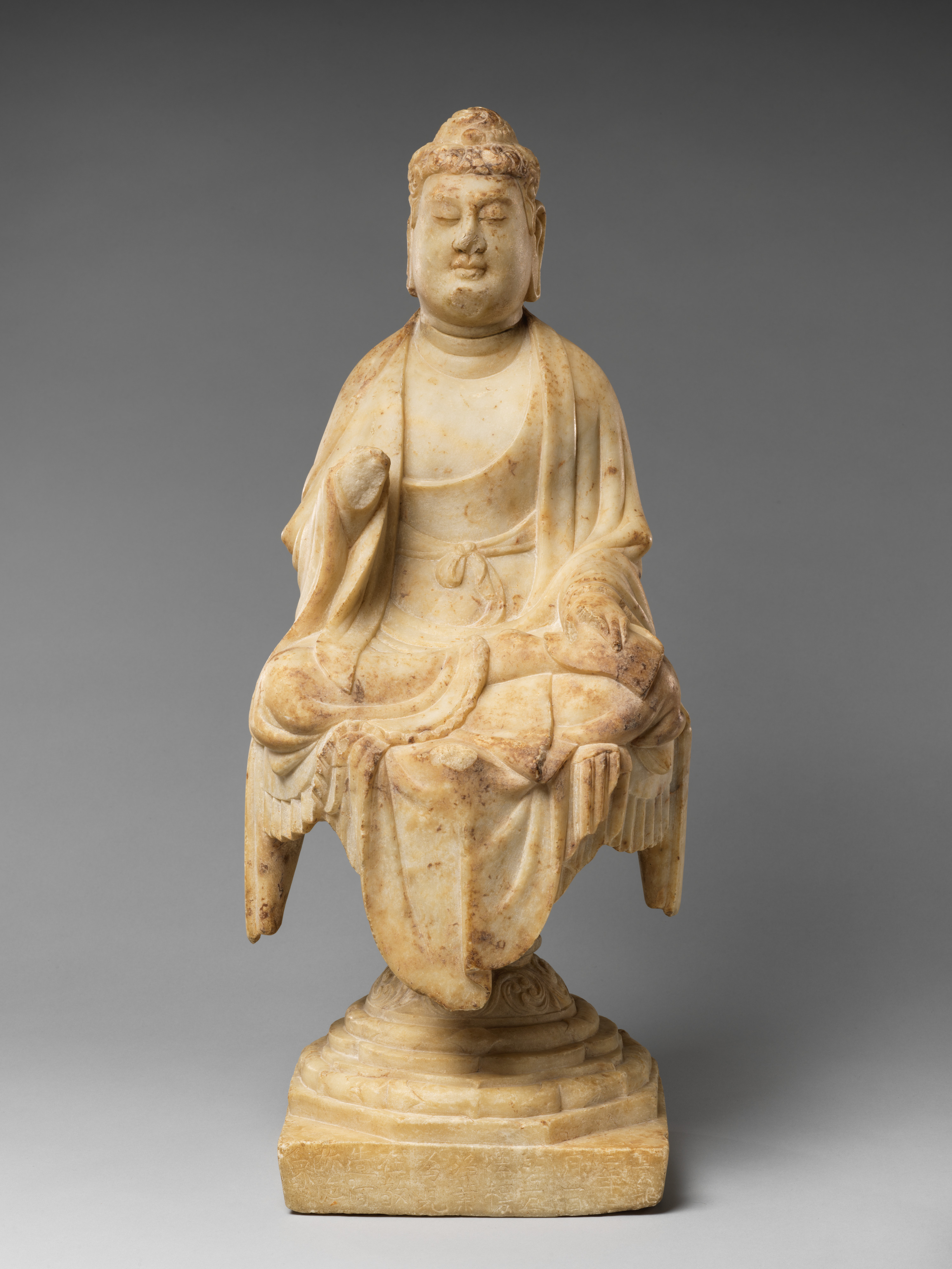
- Title
- Buddha
- Period
- Tang dynasty, China, dated 707
- Region
- China
- Medium
- Marble
- Dimensions
- H. 54.6 cm; W. 22.2 cm; D. 21.6 cm
- Collection
- The Metropolitan Museum of Art, New York
- Accession
-
28.114 - Rights
- Public domain (CC0). The Metropolitan Museum of Art, New York, Gift of Ralph M. Chait, 1928 (28.114). Public-domain status re-confirmed via the Met Collection Open Access API, 2026-05-16.
Buddha, China, Tang dynasty, dated 707, marble. The Metropolitan Museum of Art 28.114. Read here not as a Japanese object but as the continental model — the Tang international style the Nara workshops received and assimilated.
By the 8th century the Buddha image in Japan was no longer a trailing-edge Northern Wei form mediated through Paekche. It was the Tang international style, carried direct from China by the kentōshi embassies, the returning monks Dōshō (653) and Genbō (717–735, with the Hossō canon), imported icons, and sūtra-borne copybooks. A Tang marble Buddha dated 707 (Met 28.114) is the model Tenpyō workshops localised. The post-Asuka channel.
A different transmission from the Asuka one
The story of how Buddhism’s image-making first entered Japan is told elsewhere on bodhi, and it is a sixth-century story: a Paekche king’s diplomatic gift in 538 or 552, the Soga clan as patrons, the Kuratsukuri Tori workshop, and a sculptural register descended from Northern Wei China, a style already historical in China at the moment Yamato received it. That account stops, deliberately, at the point where it has done its work: the Hōryū-ji Shaka Triad of 623 is a Yamato recension of a Chinese style two centuries out of date, reached by way of Korean workshops.
This article begins where that one defers. It is about a second, separate transmission, running through the 7th and 8th centuries: not Northern Wei via Paekche, but Tang China direct. The two are easy to collapse into one continuous “China to Japan” arrow, and the collapse loses the most consequential fact about Nara-period Buddhist art: that the Tang model reached the Yamato court fresh, by a channel the Asuka transmission did not use, and that the Tenpyō workshops then did something to it the Asuka ateliers had not been positioned to do.
The object that opens the question is not Japanese. It is a Tang Chinese marble Buddha, dated 707, in the Metropolitan Museum (28.114), and it is here as the control, not the experiment: the continental model in the form a Japanese artisan of the early eighth century would have been working toward.
What the 707 Buddha actually shows
The figure is small for a temple image, about fifty-five centimetres of pale, slightly translucent marble, now warmed to honey and rust where the stone has weathered, but it is not conceived small. It sits with one knee drawn up and the other leg folded, the weight thrown unevenly to one hip, and that asymmetry is the whole point. The Tori-workshop Buddha of a century earlier was a triangular silhouette built for one viewing axis, the body a vertical column under stylised parallel pleats. This figure has a body. The shoulders slope under the cloth rather than carrying it like a frame; the chest reads as a mass with breath in it; the robe does not pleat, it falls, gathering in a soft pooled cascade over the front of the throne and breaking into a fringed flare down both sides where the cloth runs out of support.
The face is the other tell. It is round and fleshed, the cheeks full to the point of heaviness, the chin a soft second curve below the mouth, the exact opposite of the elongated rectangular Asuka mask with its archaic smile. The eyes are lowered but the lids are modelled, not incised. Nothing about the figure is frontal in the Asuka sense; turn it and the raised knee, the displaced hip, the diagonal of the hanging sleeve all keep working. This is the Tang international style at the moment it was the international style: full-bodied, weight-bearing, naturalistic drapery, a body the cloth describes rather than hides. It is what a Japanese atelier of the Yakushi-ji and Tōdai-ji generation was trying to learn.
The contrast registers spatially, not just in photographs. Met 28.114 stands at standing-eye height in an open Asian-art case, free on all sides, and it rewards the walk around it: the back of the throne is finished, the side flares carry the same modelling as the front, and the figure resolves from every angle the visitor takes. The Hōryū-ji Shaka Triad, by contrast, is met head-on in the dim of the kondō, raised above the worshipper and built to be correct from exactly one axis. The Tang figure assumes a viewer who moves; the Asuka triad assumes a viewer who kneels. That difference, more than any single drapery fold, is what the Nara workshops had to absorb when the model arrived as a free-standing body rather than a frontal icon.
One honest caveat belongs here before the argument leans on the object. The date, 707, is the museum’s stated date; this study did not retrieve and read the dated inscription that presumably grounds it, so the 707 anchor is held at museum-record level rather than verified against the epigraphy. The stylistic reading above does not depend on the exact year; an early-eighth-century Tang marble Buddha makes the point whether the inscription says 707 or a few years either side. The precision is the museum’s; the use made of it here is deliberately coarser than the museum’s claim.
The channel was a fleet, not a gift
The Asuka transmission arrived as objects and artisans moved by Korean kingdoms. The Nara transmission arrived through a state programme of embassies the Yamato court itself ran: the kentōshi, the missions to Tang China. They are the load-bearing infrastructure of this whole period and they were neither casual nor frequent. Between 630 and 838 the court mounted on the order of nineteen embassies to Sui and Tang China; the ones that matter for the image are the seventh- and eighth-century crossings of 630, 653, 669, 702, 717, 733, 752, and 759.1
These were not trading voyages with cargo manifests of statues. The principal freight was knowledge: students and monks who went to study and came back changed, plus the texts and images they carried as the physical residue of that study. The ships themselves were lethally unreliable; the embassies are remembered partly for how many of their people the sea kept. What crossed was therefore expensive in a specific way. It was whatever a small number of survivors could bring back in their heads and in their luggage, which is exactly why the returning monk, not the imported crate, is the decisive vector.1
The monks who carried it back
Two figures stand for the channel. Dōshō (629–700) went to Tang China with the embassy of 653 and studied, for roughly eight years, under Xuanzang: the same Xuanzang of the great translation bureau, the pilgrim who had brought the Yogācāra corpus out of India.2 Dōshō returned and transmitted the Hossō (Faxiang / consciousness-only) teaching into Japan, established what is described as Japan’s first meditation hall at Gangō-ji, and is recorded as the first person cremated in Japan, in 700. The point is not the doctrine in itself. It is that the most prestigious living scholastic lineage in Tang Buddhism was now installed in Nara by a man who had sat in Xuanzang’s own assembly. The image-making that travelled with that prestige did not arrive as a trinket; it arrived attached to the authority of the metropole.
Genbō is the eighth-century instance, and the more material one. He left on the embassy of 717, the same crossing that carried Kibi no Makibi and Abe no Nakamaro, stayed in China for about seventeen years, and returned around 735 with a large body of Buddhist scriptures, the textual basis of the Hossō school as it would be taught at Kōfuku-ji.31 Emperor Shōmu made him abbot at Kōfuku-ji; he became, briefly, one of the most powerful clerics at court before a factional collapse exiled him in 745 and he died in 746. The often-quoted round figure for the number of scrolls he brought back is not confirmed by the sources consulted here and is left as “a large body” rather than asserted to a digit. What is not in doubt is the shape of the event: a single returning monk delivering, in one consignment, the working scriptural library of a school. And a scriptural library in the eighth century did not arrive bare. It arrived with its frontispieces, its iconographic prescriptions, its prescribed forms.
The later, more famous instance, Kūkai on the embassy of 804, returning with the esoteric corpus and its mandalic image-system, is the same mechanism running one more time, and bodhi treats the mikkyō reception separately. The pattern is the constant: the embassy is the road, the monk is the vehicle, the canon is the freight, and the image rides with the canon.
Sūtra-borne images and the copybook
This is the least visible part of the channel and the most important for explaining the speed of the change. A returning monk’s scriptures were not only text. A sūtra in this period travelled as a decorated object: a frontispiece tableau, a prescribed iconographic programme, sometimes a separate set of drawn models. Iconography in Tang Buddhism was substantially text-bound: a deity’s posture, attributes, the number of arms, the mudrā, were specified in dhāraṇī and ritual scriptures, and the image was understood as the visual obverse of the text. When Genbō’s consignment landed at Kōfuku-ji, it brought not a free-standing aesthetic but a set of correct forms, copyable, with the authority of scripture behind their correctness.
The mechanism that turned this into a national style was duplication. The provincial-temple system that Shōmu legislated in the 740s, a state monastery and convent in every province, created an enormous demand for orthodox images on a short timetable. The standard account is that the imported icons and the texts’ prescribed images were copied, and copied again, as working models for ateliers that would never see Chang’an: the metropolitan form propagated outward through copybooks rather than through each workshop independently reinventing it.45 A copybook is a humble object and it is the reason the Tang register saturates Nara work within a generation rather than over centuries. The Asuka transmission had no comparable amplifier; that is part of why the Asuka register stayed a workshop style and the Nara one became a period style.
What the Nara workshops did with it
A model received is not yet a tradition. The interesting half of any transmission is what the receiver does that the donor did not ask for, and Nara did three things.
It changed the material. The signature techniques of Tenpyō sculpture are kanshitsu, hollow dry lacquer, and sōzō, unfired modelled clay, both arriving as current Tang methods, both then pushed in Japan to a refinement and a scale the Chinese precedents do not obviously reach.4 The dry-lacquer surface in particular gave Nara modellers a way to hold the full-bodied Tang volume and the weighted drapery in a medium more forgiving than stone or cast bronze, and bodhi reads that material substitution at length in a separate technique-history study. The 708 discovery of domestic copper then made monumental bronze possible at all, and the programme escalated to the only end available to it, the Tōdai-ji Daibutsu of 752, a colossal Birushana (Vairocana) cast at a scale no imported icon could have been.4
It changed the register from copy toward something the surveys are willing to call classicism. The standard English-language account holds that early-Nara work reflected Tang models fairly directly and that mid-century Tenpyō work, while unmistakably continental, develops a realised fullness and an emotional legibility, visible in the Tōdai-ji Hokke-dō figures and the Tōshōdai-ji images associated with Ganjin’s Chinese atelier, that reads as a synthesis rather than a reproduction.5 The face on the 707 marble Buddha is a Tang fact; the particular held gravity of the best Tenpyō faces is the local addition, and it is a real one.
It changed the institution. Genbō’s scriptures did not just supply images; they supplied a school, and a school at Kōfuku-ji under imperial abbacy is a different kind of object than a clan’s private hall at Asuka-dera. The Nara transmission lands inside a centralising state that wants a uniform Buddhist establishment, and that political fact is why the imported model became compulsory rather than fashionable.
Where the disagreement actually sits
The phrase that gets misread is “the Tang international style,” and the misreading is to hear it as one thing transmitted once. It is not. There is a real scholarly tension about how much of the early-Nara achievement is Japanese at all. One tradition, the one bodhi’s published Asuka article also names, treats the Asuka–Nara sculptural sequence as a long importation in which the genuinely Japanese contribution is institutional and devotional context rather than visual invention, with even Tenpyō a regional adaptation of a Tang register. The connoisseurial tradition associated with the major Japanese-sculpture surveys treats the finest Tenpyō work as a true synthesis: continental in vocabulary, Japanese in the held inwardness of its best faces and the refinement of its dry-lacquer execution.
bodhi reads the evidence with the second tradition for the strongest Tenpyō works and with the first for the bulk of the provincial-temple output. The Tōdai-ji Hokke-dō and Tōshōdai-ji peaks earn the word synthesis; the mass of copybook-driven provincial images earn the word recension and no more. The residual uncertainty is not rhetorical and should be stated plainly: most provincial Nara images are undocumented as to atelier, the copybooks themselves largely do not survive, and “directly from a Tang model” versus “from a Japanese copy of a copy” is, for most individual objects, an inference from style and not a chain of evidence. The 707 marble Buddha is firmer ground than almost any Japanese object this argument concerns, precisely because it is the parent and not one of the children — and even it carries a museum date this study could not check against its own inscription.
Where this transmission sits
The cleanest way to hold the two transmissions together is by what each one moved. The Asuka transmission moved a workshop and a trailing style, through Korea, into a clan’s patronage. The Nara transmission moved a metropolitan canon and its prescribed images, through a state embassy programme and a handful of returning scholars, into a centralising court, and then amplified it through copybooks into the first period style Japan can be said to have had. The 707 Tang Buddha is what was being received; the Tenpyō workshops are what receiving it produced. Everything downstream, the Heian single-block Shakyamuni that follows, the Jōchō workshop, the Kamakura Kei-school revival that consciously reaches back past Heian toward exactly this Tang fullness, is a branch of the channel this article describes, not of the Asuka one it begins by setting aside.
Related
- The Asuka transmission — the upstream story this article deliberately does not retell
- The continental Kannon behind the Asuka bronze — the earlier-phase continental-model reading
- Dry lacquer versus wood core, Tenpyō to Heian — the material the Nara workshops did the assimilation in
- An early-Heian single-block Shakyamuni — one object downstream of this channel
- Japanese Buddhism (entity)
- Kanshitsu — hollow dry lacquer (entity)
Footnotes
-
Wikipedia, “Japanese missions to Tang China” — embassy chronology (630, 653, 669, 702, 717, 733, 752, 759, 804) and the named monks attached to specific crossings (Genbō, Kibi no Makibi, Abe no Nakamaro on the 717 embassy; Kūkai and Saichō on 804). Reference-tier; used for chronology and the embassy-as-channel argument, not as the authority for any contested attribution. ↩ ↩2 ↩3
-
Wikipedia, “Dōshō,” corroborated by Encyclopædia Britannica, “Dōshō” — travel to Tang China 653, roughly eight years’ study under Xuanzang, return and the Hossō (consciousness-only) transmission, the Gangō-ji meditation hall, and the first recorded Japanese cremation (700); dates 629–700. Reference-tier, two independent sources agreeing on the Xuanzang study and the Hossō founding. ↩
-
Wikipedia, “Genbō” — departure on the 717 embassy, c.17-year stay, return c.735 with a large body of scriptures, Kōfuku-ji abbacy under Emperor Shōmu, Hossō affiliation, 745 exile and 746 death. The frequently cited round figure for the scroll count is not confirmed by this source and is deliberately carried here as “a large body” rather than to a digit. ↩
-
Mark Schumacher, “Nara Era Buddhist Statuary” (onmarkproductions.com) — reference-tier corroboration for the Tenpyō technique shift (kanshitsu and sōzō arriving as current Tang methods), the 708 domestic copper find enabling monumental bronze, the Tōdai-ji Daibutsu of 752, and the copybook/imported-image duplication mechanism. Not used as the authority for any datable attribution; cross-checked against Mason. ↩ ↩2 ↩3
-
Penelope Mason (rev. Donald Dinwiddie), History of Japanese Art, 2nd ed., Pearson, 2005 — the Nara/Tenpyō chapter on the move from the Asuka–Hakuhō register to the Tang international style, the Tōdai-ji and Yakushi-ji programmes, and the synthesis-versus-recension question. Cited at chapter level; page numbers not verified against the print volume. ↩ ↩2
Sources
-
Object facts authoritative via the Met Collection Open Access API (CC0; objectBeginDate 707 / objectEndDate 707; Marble; H. 54.6 cm; Gift of Ralph M. Chait, 1928), re-confirmed live 2026-05-16. The 707 date is carried as the museum's stated date; the inscription basis was not independently retrieved and is held at museum-record level.
-
The standard prosopography of the student-monks who travelled on the 7th–early-8th-century embassies. Used for the returning-monk channel (Dōshō, Genbō and the cohort). Cited at work level; page numbers for specific entries not verified.
-
The standard English-language survey. The Nara/Tenpyō chapter covers the shift from the Asuka–Hakuhō register to the Tang international style and the Tōdai-ji/Yakushi-ji programmes. Cited at chapter level; page numbers not verified.
-
Cross-checked for the embassy chronology (630, 653, 702, 717, 733, 752, 759, 804) and the monks attached to specific missions (Genbō, Kibi no Makibi, Abe no Nakamaro on 717; Kūkai and Saichō on 804). Reference-tier corroboration, not the primary authority for any contested claim.
-
Cross-checked for Genbō's 717 departure, ~17-year stay, return c.735 with a large body of scriptures, Kōfuku-ji abbacy under Shōmu, Hossō affiliation, 745 exile and 746 death. Reference-tier; the scripture count is carried as 'a large body' rather than the often-cited round figure, which the source does not pin.
-
Cross-checked for Dōshō (629–700), travel to Tang China 653, study under Xuanzang, return and the Hossō transmission, Gangō-ji meditation hall, and the first recorded Japanese cremation (700). Britannica entry corroborates the Xuanzang study and Hossō founding.
-
[7]— Mark Schumacher (onmarkproductions.com) onmarkproductions.com/html/nara-buddhist-sculpture.htmlReference-tier corroboration for the Tenpyō technique shift (kanshitsu dry-lacquer and sōzō clay arriving as Tang methods), the 708 copper find enabling monumental bronze, the Tōdai-ji Daibutsu (752), and the copybook/imported-image mechanism ('texts and images … copied endlessly for the provincial temples'). Not used as the authority for any datable attribution.