The continental Kannon behind the Asuka bronze
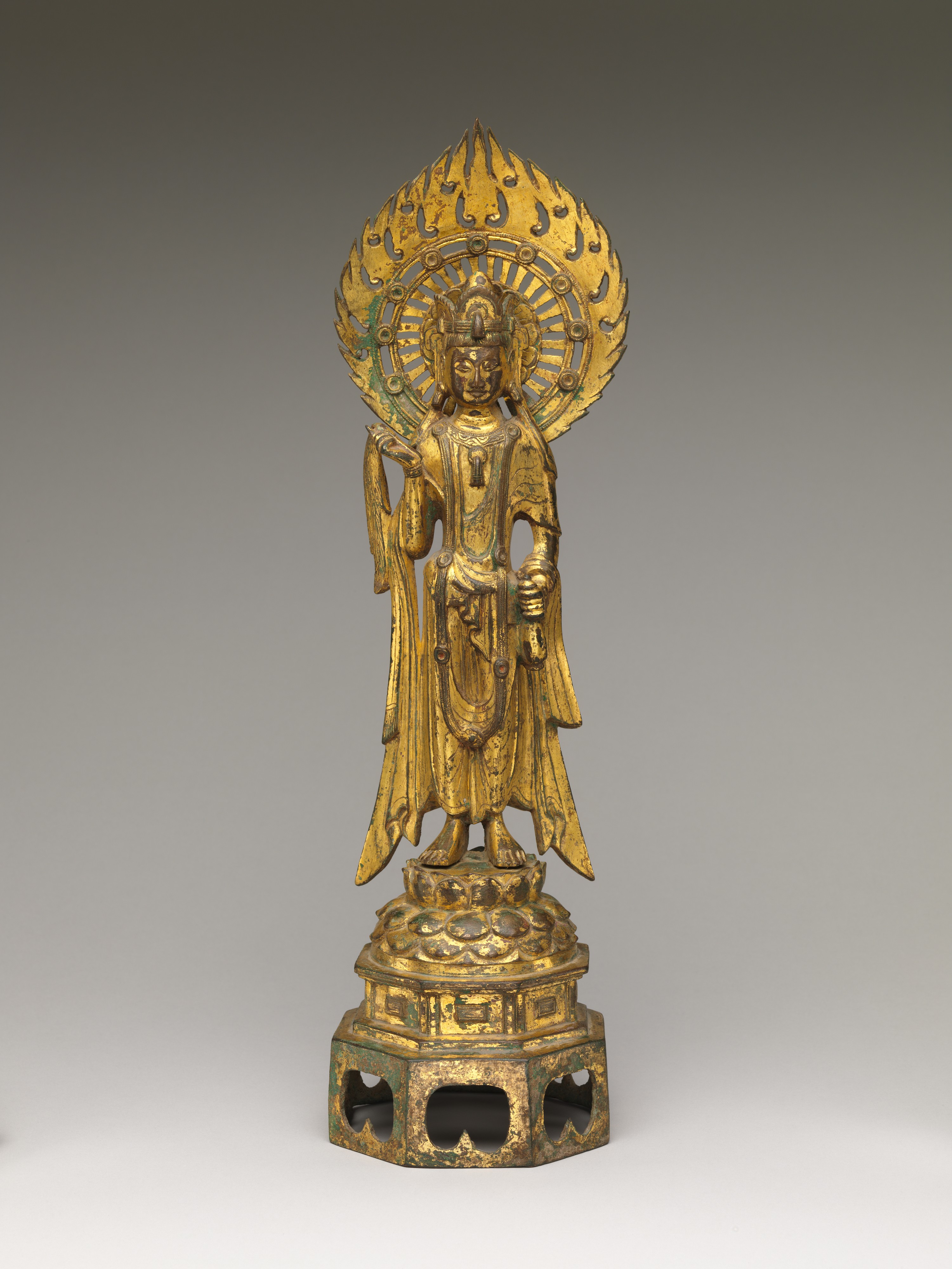
- Title
- Bodhisattva Avalokiteshvara (Guanyin)
- Period
- Chinese, Sui dynasty / late Northern dynasties, late 6th century
- Medium
- Gilt bronze
- Dimensions
- H. 43.8 cm; W. 12.7 cm; D. 12.4 cm
- Collection
- Metropolitan Museum of Art, New York
- Accession
-
12.161a–c - Rights
- Public domain (Met Open Access, CC0, verified via the Met API 2026-05-16)
Met 12.161a–c is a Chinese gilt-bronze standing Avalokiteśvara of the late 6th century — vase in the left hand, willow in the right, a tall crown over a frontal columnar body. It is the kind of object the Asuka kondōbutsu Kannon descends from, and reading it closely shows what the Japanese small bronzes inherited and what they changed.
The object, and why a Chinese bronze opens a Japanese question
The Metropolitan Museum’s accession 12.161a–c is a standing gilt-bronze Avalokiteśvara, 43.8 cm high, catalogued by the museum as Chinese and dated to the late 6th century. The Met API records an object-date range of 567 to 599, which straddles the last decades of the Northern dynasties and the founding of the Sui in 581.1 It came into the collection in 1912 on the Rogers Fund, long before the iconographic categories were as carefully drawn as they are now, and it is public domain under Met Open Access.1
It is not a Japanese object. There is no honest way to call it one. But it sits at the head of a line that runs directly into the Asuka and Hakuhō halls, and a single-work study of “the Asuka standing gilt-bronze Kannon” that does not first look hard at a continental bronze of this kind is studying the descendant without the ancestor. The kondōbutsu (the small gilt-bronze devotional figure, kon for the metal, dō for the gilded surface) arrived in Yamato as an already-finished idea. The 7th-century Japanese examples are not first attempts at a new form; they are local castings of a form perfected on the mainland a few generations earlier. This figure is what that perfected form looked like.23
So the close looking happens here, on a figure a reader can pull up in full resolution and check, and the Japanese works it points toward (the Hōryū-ji forty-eight bronzes now in the Tokyo National Museum, the Cleveland Asuka Kannon, the hieratic icons at Hōryū-ji) are named where they belong without being re-read out of other articles’ heroes.45
What the figure is doing with its hands
Start with the attributes, because they are the part the catalog tradition argues about and the part a reader can verify. The left hand is raised at the shoulder and holds a small vessel; the right hand, lowered, holds a slender branching form. The Met’s older catalog reading and the standard description of this object type identify these as the kundikā or water-bottle in the left hand and a willow sprig in the right.16 This is the vase-and-willow Avalokiteśvara: the bottle holds the sweet-dew water of compassion, the willow is the instrument that disperses it, and the pairing is the iconographic signature that fixes the figure as Avalokiteśvara rather than a generic attendant bodhisattva.
The willow-and-vase pairing matters for the Japanese question in a specific way. The Asuka small bronzes that can be identified as Kannon are most often identified not by the willow but by a different marker: the small Buddha set into the front of the crown, the Amida-in-the-crown that the Pure Land literature later codified as Kannon’s fixed sign. The Yamada-den triad’s right bodhisattva is read as Kannon precisely on the crown-Buddha, not on a willow.3 What this continental figure shows is that the willow-and-vase reading was available and current on the mainland in the late 6th century, and that the Japanese tradition, receiving the type, did not lean on it as hard. The reader who knows only the crown-Buddha test will miss the willow on a figure like this one; it is carried low, against the drapery, and on a worn surface it reads almost as a continuation of a sash rather than as an object held.
A short word of caution belongs here. The Met record for 12.161a–c is sparse (accession, date, medium, dimensions, credit line) and the museum’s full curatorial essay was not retrievable during research (the Met catalog HTML returned 429, the expected throttling). The willow-and-vase identification is the standard reading for this object class and is asserted at object-class level, cross-checked against the dedicated discussion of Met early Chinese bronzes; it is not tied to a Met curatorial sentence about this accession specifically.
The frontality, and the columnar body under the sashes
Stand the figure up in the mind and look at the silhouette before the detail. It is a column. The body is a near-cylindrical mass; the shoulders are narrow; the weight does not shift onto one hip. There is no contrapposto, no torsion, almost no acknowledgement that a body has a side as well as a front. The figure is built to be met head-on, from one position, by a worshipper standing directly before a small altar.
This is the trait the Japanese tradition inherited most completely and held onto longest. The Asuka Tori-style figures (the term comes from Kuratsukuri no Tori, the sculptor of the Hōryū-ji Kondō Shaka triad of 623) are described in exactly these words: marked frontality, the two-dimensionality of a figure meant to be read from the front, drapery resolved into symmetrical repeating folds rather than into the fall of real cloth.23 The continental bronze here has all of it. The sashes, the long scarves that cross the body and loop below the waist, do not hang; they are diagrammed. They fall in flat, paired, mirror-image loops, the left side answering the right with a regularity that no real textile under gravity would produce. The hem flares slightly at the sides into the small wing-like points that the Asuka bronzes exaggerate into the sawtooth skirt-edges seen on the Tamamushi Shrine figures.2
The unexpected thing, looking at the actual surface rather than the diagram of it, is how thrifty the modelling is. The face is long and the features are economical: a narrow ridge for the nose, incised arcs for the brows, the eyes more drawn than carved. The crown rises tall and is the most worked passage on the whole figure, which is consistent across the class, because the crown is where the workshop spent its detail budget and where, on the Japanese descendants, the identifying crown-Buddha had to be legible. Below the crown the figure is almost severe. It is not a poverty of skill. It is a decision about where a small bronze should concentrate its information: at the head, where the worshipper’s eyes go, and in the attribute hands, which carry the doctrine.
How a small bronze of this kind was made
The casting question is where the continental-to-Japanese line is least visible to the eye and most consequential under it. Two methods are in play across the early East Asian gilt-bronze corpus: piece-mold casting, the older Chinese technology inherited from the ritual-bronze tradition, in which the model is encased in sectional clay molds; and lost-wax casting, in which a wax model is melted out of an investment. The current technical consensus, set out in the Korean-archaeology casting literature on the closely related pensive-bodhisattva bronzes, is that early archaic-style gilt-bronze images were mainly produced by piece-mold casting, and that lost-wax casting was introduced later and adopted progressively, with piece-mold methods continuing in parallel for larger images.7
The single most authoritative technical treatment of the object class this Met figure belongs to is the conservation half of Leidy and Strahan’s Wisdom Embodied, the Met’s own catalogue of its Chinese Buddhist and Daoist sculpture, whose second introductory essay and technical appendices are built specifically around how early Chinese bronzes, as distinct from Gandhāran and other western bronzes, were cast, and around the layered gilding and consecratory deposits in metal images.8 The catalogue reassesses 120 works including the Met’s early gilt bronzes; this accession sits inside the corpus it surveys. The specific page entry and any solid-versus-hollow determination for 12.161a–c could not be confirmed from the open Internet Archive scan, and no page or casting verdict is invented here.
What can be said honestly at the level the sources support: a figure of this scale, 43.8 cm, is in the range that small devotional bronzes were frequently cast solid, and the gilding on the class is mercury-amalgam fire-gilding, gold dissolved in mercury, painted on, the mercury then driven off with heat to leave a thin bonded gold skin (Japanese tokin).2 On this figure the gold survives unevenly; the darker bronze shows through across the body where handling and time have worn the amalgam thin, while it holds better in the protected recesses of the crown and the drapery loops. That wear pattern is itself a reading aid. It tells you where hands touched the object and where they did not, and it is the kind of evidence the Met conservation essay is built to interpret and the open record is not.
What the Asuka bronzes took, and what they changed
Set this figure beside the Japanese small bronzes it stands ancestral to and the inheritance is easy to overstate in one direction and miss in the other.
What the Asuka and Hakuhō kondōbutsu took, almost without alteration: the scale (the Hōryū-ji forty-eight images are uniformly small, none more than about 30–40 cm, made for private and sub-temple worship rather than for a main hall), the frontality, the columnar body, the diagrammed symmetrical drapery, the tall worked crown, the mercury-gilt surface.42 The forty-eight Buddhist images (actually a group of about fifty-nine miniature gilt bronzes spanning the Asuka through the Nara period, given by Hōryū-ji to the imperial household in 1878 and now in the Tokyo National Museum’s dedicated gallery) are the densest single body of evidence for this, and roughly twenty-some of them are identifiable as Kannon.4 They are, as a class, this continental form, cast in Yamato.
What changed is subtler and is where the Japanese material stops being derivative. The Korean Three Kingdoms workshops, through which much of the continental style reached Japan, had already pushed the type toward an extreme attenuation, bodies and limbs stretched unrealistically long, robe-creases stacked like thin sheets, and that Baekje and Silla inflection, not the Chinese original alone, is what the Asuka casters were copying directly.2 The Japanese works then make their own move: in the finest of them the frontal severity is kept but the surface is given a held, inward quality that the continental bronze here, for all its authority, does not reach for. The continental figure is a diagram of a compassionate being executed with great economy. The best Asuka descendants keep the diagram and add a stillness to it.
That is a reading, and it is contestable. The honest version of the disagreement is this: one tradition of scholarship treats the Asuka small bronzes as essentially provincial copies of Korean-mediated Chinese models, valuable as transmission evidence more than as independent art; the connoisseurial tradition associated with the major Japanese-sculpture surveys treats the best of them as a genuine local synthesis. bodhi reads the evidence with the second tradition — the surface decisions on the finest Asuka bronzes are choices, not failures to copy fully — while granting that on the merely competent examples, of which the forty-eight-image group has many, the first tradition is plainly describing what is there. The residual uncertainty is real and is a dating-and-attribution problem: for most individual small bronzes there is no inscription, the workshop is unknown, and “Asuka” versus “early Hakuhō” is a stylistic call that the sources themselves hedge. This continental figure is firmer ground than most of its Japanese children precisely because it is the parent, and even it carries a three-decade catalog date and a curatorial essay this study could not retrieve.
Where to go from this object
The natural next step from 12.161a–c is the Cleveland Asuka Kannon (acc. 1950.392), read in bodhi’s sibling single-work study: a Japanese gilt-bronze standing Kannon of the mid-600s, the descendant object where the continental form is already speaking with a Yamato accent.5 From there the line runs to the hieratic icons, the Hōryū-ji Kondō Shaka triad of 623 and the Yumedono Guze Kannon the temple still keeps wrapped, where the same frontality is scaled up from the private altar to the temple hall.3 The forty-eight-image group at the Tokyo National Museum is the place to see the small-bronze type at population scale, where the variation between workshops is the evidence rather than the noise.4
The point of beginning with a Chinese bronze is not to demote the Japanese material. It is the opposite. You cannot see what the Asuka casters did until you can see clearly what they were handed, and a public-domain figure a reader can examine at full resolution is a better place to learn the inherited form than a wrapped hibutsu or a National Treasure behind glass. The continental Kannon is the control. The Asuka Kannon is the experiment.
Related
- An Asuka-period gilt-bronze Kannon at Cleveland — the sibling Japanese descendant
- Hōryū-ji Kondō Shaka triad (623) — the Tori-style hieratic scale-up
- Hōryū-ji’s Yumedono Guze Kannon — the wrapped Asuka hibutsu
- Asuka transmission: Tang precedent into Yamato
- Kannon (entity)
- Avalokiteśvara (entity)
- Kondōbutsu — the small gilt-bronze devotional figure (entity)
Footnotes
-
Metropolitan Museum of Art, accession 12.161a–c, objectID 54208, “Bodhisattva Avalokiteshvara (Guanyin),” China, late 6th century (Met API objectBeginDate 567 / objectEndDate 599); gilt bronze; H. 43.8 cm, W. 12.7 cm, D. 12.4 cm; Rogers Fund, 1912; classification Sculpture; public domain (CC0). Retrieved from the Met Open Access API 2026-05-16. The Met catalog HTML page returned HTTP 429 (expected throttling); accession/date/medium/dimensions/credit/PD status are taken from the authoritative API record, not the HTML essay. ↩ ↩2 ↩3
-
Mark Schumacher, “Asuka Period (538–710): Buddhist Sculpture from Early Japan,” A to Z Photo Dictionary of Japanese Buddhism (onmarkproductions.com), accessed 2026-05-16: kondōbutsu scale (~30 cm), kon-dō / tokin gilding, Tori-shiki marked frontality and symmetrical repeating folds inherited from Northern Wei, vase as the nectar-of-compassion attribute, Baekje/Silla mediation of the continental style, the forty-eight/fifty-nine Hōryū-ji bronzes. Reference-synthesis source, used for orientation and cross-checked against the museum and survey records; not the primary authority for any contested claim. ↩ ↩2 ↩3 ↩4 ↩5 ↩6
-
Washizuka Hiromitsu, Roger Goepper, et al., Enlightenment Embodied: The Art of the Japanese Buddhist Sculptor (7th–14th Centuries) (New York: Japan Society, 1997). Standard English-language survey of the Japanese sculptural tradition from the Asuka period; cited at chapter/work level for the Tori-shiki frontality definition, the kondōbutsu type, and the crown-Buddha identification of Kannon (the Yamada-den triad reading). Page numbers not verified against the print volume. ↩ ↩2 ↩3 ↩4
-
Tokyo National Museum, Gallery of Hōryū-ji Treasures, “the forty-eight Buddhist images” (Hōryū-ji kenmotsu shijūhattai-butsu): a group of approximately fifty-nine miniature gilt-bronze images, none more than ~30–40 cm, produced from the Asuka through the Nara period, given by Hōryū-ji to the imperial household in 1878 and now in the museum’s dedicated gallery; roughly twenty-some are identifiable as Kannon. Museum gallery record and the godscollections.org Hōryū-ji Treasures case study, accessed 2026-05-16. ↩ ↩2 ↩3 ↩4
-
Cleveland Museum of Art, accession 1950.392, “Kannon,” Japan, Asuka period, mid-600s to early 700s, gilt bronze, CC0; the subject of bodhi’s sibling single-work study
asuka-kannon-gilt-bronze-mid-600s; named here as the Japanese descendant object, not re-read in this article (collision avoided by design). ↩ ↩2 -
Anthony Wu, “Visualizing the Divine: Early Chinese Buddhist Bronzes at the Metropolitan Museum of Art” (anthonywuart.com), accessed 2026-05-16, on the Met’s Sui-dynasty gilt-bronze Avalokiteśvara: described as one of the earliest known depictions of Avalokiteśvara in China, the left hand holding a bottle of sacred elixir and the right a willow branch; cites Leidy & Strahan (2010) as the recommended technical reference. Used to corroborate the vase-and-willow identification at object-class level; not a Met curatorial sentence pinned to this accession. ↩
-
International Journal of Korean Art and Archaeology, casting-techniques study of the gilt-bronze pensive bodhisattva (jkaa-15-86), and the Nara National Research Institute survey of early casting: early archaic-style gilt-bronze images were mainly piece-mold cast; lost-wax casting was introduced later and adopted progressively, with piece-mold continuing for larger images. Applied here by analogy to the closely related standing-bodhisattva class; not a casting determination for accession 12.161a–c specifically. ↩
-
Denise Patry Leidy and Donna Strahan, Wisdom Embodied: Chinese Buddhist and Daoist Sculpture in The Metropolitan Museum of Art (New York: Metropolitan Museum of Art / Yale University Press, 2010). The volume reassesses 120 works fourth–twentieth century and is built around two technical questions directly relevant here: how early Chinese bronzes (as opposed to Gandhāran) were cast, and the layered gilding and consecratory deposits of metal images. Cited at catalogue/essay level for the casting-and-gilding framework; the specific catalogue-entry page for accession 12.161a–c was not verified (the open Internet Archive scan is access-restricted). ↩
Sources
-
[1]2026-05-16Metropolitan Museum of Art collectionapi.metmuseum.org/public/collection/v1/objects/54208 -
[4]2026-05-16Tokyo National Museum — Gallery of Hōryū-ji Treasures tnm.jp/modules/r_exhibition/index.php -
[6]2026-05-16A to Z Photo Dictionary of Japanese Buddhism onmarkproductions.com/html/asuka-art.html