Shōtoku Taishi as a painted subject: the e-den tradition
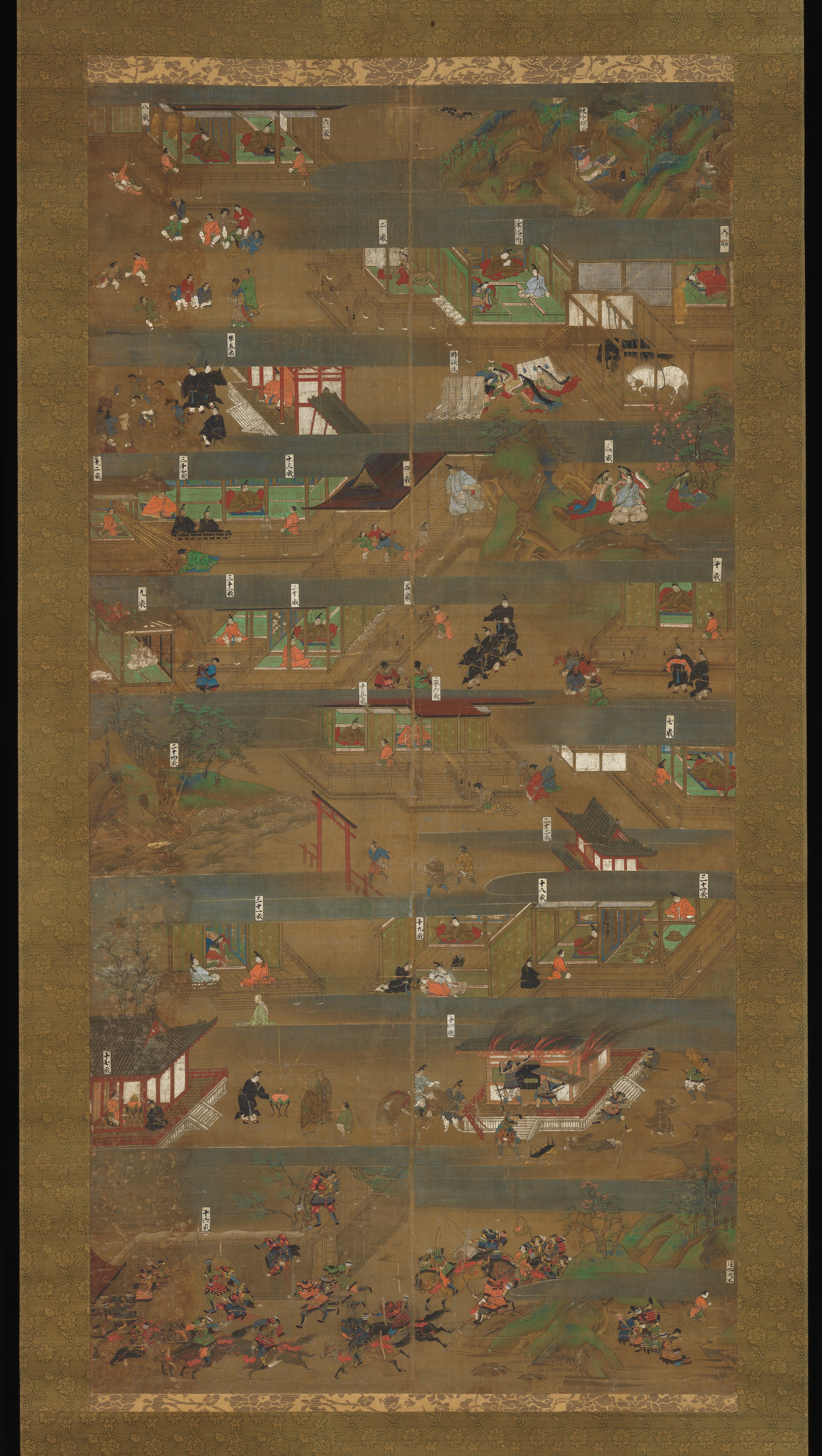
- Title
- Illustrated Biography of Prince Shōtoku (Shōtoku Taishi e-den)
- Period
- Kamakura period (1185–1333), 14th century (1300–1333)
- Region
- Japan
- Medium
- One of two hanging scrolls; ink, color, and gold on silk
- Dimensions
- Image 171.8 × 84.4 cm; with mounting 269.2 × 102.9 cm
- Collection
- The Metropolitan Museum of Art
- Accession
-
29.100.471 - Rights
- The Metropolitan Museum of Art, H. O. Havemeyer Collection, Bequest of Mrs. H. O. Havemeyer, 1929 (29.100.471). Public domain (Met Open Access).
Illustrated Biography of Prince Shōtoku, one of two hanging scrolls, Japan, Kamakura period, 14th c. Met 29.100.471, Open Access.
Prince Shōtoku (574–622) survives less as a historical regent than as a painted subject standardized by the Shōtoku Taishi e-den, the biographical-painting tradition that began in temple picture halls and proliferated as transportable Kamakura hanging-scroll sets. The episode-and-cartouche format, the fixed age-types, and the Shōryō-e memorial assembly that displayed the scrolls were all driven by the Hōryū-ji / Shitennō-ji reading of Shōtoku as a Kannon avatar and reincarnated Tiantai patriarch.
What the scroll shows before the prince does
The first thing the Met scroll (29.100.471) does is withhold its subject. A viewer who comes to a Shōtoku painting expecting a portrait (a single robed figure, frontal, the way the age-two and age-sixteen devotional types present him) gets instead a tall silk field crowded with small figures, palace roofs, a horse, hills folding back into gold-flecked distance, and no one obviously in charge of the picture. The composition is administrative rather than devotional: it disperses its hero across a managed landscape instead of centering him. Prince Shōtoku is in it many times. He is not in it once.
This is the structural fact of the e-den (絵伝, “picture-biography”) and the reason it has to be read differently from the single-figure cult images. The Met scroll is one of two surviving hanging scrolls from a larger set; the Metropolitan dates it to the 14th century, within the Kamakura period (1185–1333), in ink, color, and gold on silk, the painting itself 171.8 by 84.4 cm.1 The scale matters to the argument: this is a wall-sized object, not an intimate one. It was made to be looked at by a crowd, and the way it organizes Shōtoku’s life across a continuous landscape, birth at the bottom and later episodes climbing the silk, is the organizing logic of a tradition, not the invention of one painter.
The standing English-language study of that tradition is Kevin Gray Carr’s Plotting the Prince (University of Hawai’i Press, 2012), which treats the medieval Shōtoku materials not as a devotion but as a mapped thing: episodes plotted onto sacred geography, the prince’s biography functioning as a chart of religious legitimacy across the institutions that owned him.2 The Met scroll is one sheet of that map.
The picture hall the tradition came out of
The e-den did not begin as a portable scroll. It began as a building.
The earliest Shōtoku Taishi eden recorded by tradition was painted on the walls of the Edo (絵殿, “picture hall”) of Shitennō-ji in Osaka, the prince’s own Naniwa foundation, as early as the Tenpyō-shōhō era (749–57).3 That work does not survive. The earliest extant e-den is the set painted in 1069 (Enkyū 1) by Hata no Chitei (秦致貞) for the Edo of Hōryū-ji, the prince’s Asuka-period foundation near Nara: ten compositions in color on twill-weave silk, originally fixed to the inner walls of the hall, depicting roughly fifty-eight episodes drawn from the Shōtoku Taishi Denryaku, the hagiographic life of the prince completed in the early tenth century.4 The Hōryū-ji panels were remounted as freestanding screens in the Edo period and again, more recently, onto ten panels; an 18th-century replica hangs in the temple’s Edo today while the originals are held by the Tokyo National Museum.4
Two things in that origin are load-bearing for everything downstream. The first is that the painted Shōtoku was, from the start, architecturally bound to the two temples that claimed him. Hōryū-ji and Shitennō-ji each traced their religious authority back to Shōtoku personally; an e-den on the wall of the picture hall was not decoration but the institution’s title deed in pictures. The second is that the canon of episodes was textual before it was visual. The Denryaku supplied the script; the painters supplied the staging. This is why the same scenes recur, in the same order, across objects made centuries and provinces apart: the painter was illustrating a fixed text, not inventing a biography.
From wall to scroll: the Kamakura format shift
The transmission’s decisive move was a change of support. A wall painting stays in its hall. A hanging scroll travels.
In the Kamakura period the e-den migrated off the picture-hall wall and into the hanging-scroll-set format: a biography painted across several large scrolls that could be hung side by side to reconstitute the wall-sized field, then rolled and carried to the next hall. The four-scroll Hōryū-ji set (now Tokyo National Museum) and the eight-scroll Tachibana-dera set are the canonical surviving examples; the Met’s two scrolls are a fragment of one such set.3 The format’s advantage was reach. A scroll set could be assembled wherever the cult had reached, viewed by a far larger audience than a fixed picture hall in Nara could ever gather, and that portability is the mechanism by which the Shōtoku cult moved out of its two founding temples and into provincial devotional life. Carr reads the Kamakura proliferation of these objects, the sheer number of surviving scroll-sets, as the material trace of the cult’s expansion rather than an art-historical accident of survival.2
The episode-and-cartouche apparatus is the part of the format that signals its working life most plainly. Small paper cartouches were pasted onto the painted surface, each inscribed with the content of the scene beside it; the Hōryū-ji prototype carries cartouches for its near-sixty episodes, and the Kamakura scrolls keep the convention.4 These are not labels for connoisseurs. They are scaffolding for e-toki (絵解き, “picture-explaining”), the practice in which a temple lecturer stood before the assembled scrolls and narrated the prince’s life episode by episode for an audience that could not read the painting unaided. The cartouche tells you the painting expected to be talked through, not silently contemplated.
The age-type grammar the scroll runs on
The single-figure devotional Shōtoku images compress the whole biography into one body at one age. The e-den does the opposite: it spreads the biography out and lets the age-types do the navigating.
The standard episode set, read from the Denryaku, runs through fixed waypoints. The prince’s birth and the banquets that followed it; the age-two moment in which the infant faced east, joined his palms, and uttered “Namu Butsu,” the episode that generates the Namu-busshi devotional type, treated as its own object on bodhi and deliberately not re-argued here.5 The boy prodigy: the levitation episode around age eleven, the veneration by a sage from the kingdom of Baekje at age twelve. The age-sixteen episode in which Shōtoku, in monastic robes and holding a long-handled censer, prays for the recovery of his ailing father Emperor Yōmei, the kōyō (“filial-piety”) moment, which likewise hardened into its own painted devotional type, examined separately on bodhi via Cleveland 1964.278.6 Then the adult regent: lecturing on the Shōmangyō (the Śrīmālā Sūtra) and the Lotus Sūtra to Empress Suiko in 606, the scene that fixes the court-robed, scepter-bearing administrator type; and the equestrian Shōtoku, armored on horseback, associated with the subjugation of the anti-Buddhist Mononobe faction.
What the e-den does that the single images cannot is show these as one continuous life on one continuous ground. The Hōryū-ji prototype places Ikaruga Palace at the center of its field but reaches outward to Asuka, to Naniwa, and as far as Mount Heng (衡山) in China — the mountain of the Tiantai patriarch Nanyue Huisi, whose presence in a Japanese prince’s biography is the next section’s problem.4 The age-types are not portrait conventions in the e-den. They are positions on a map.
The reincarnation engine that drove the program
A biography does not become a wall-sized cult object on the strength of good government. The e-den exists because the medieval institutions read Shōtoku as something other than a regent, and the painted program is the argument for that reading made visible.
Two identifications did the work. The first: Shōtoku as the reincarnation of Nanyue Huisi (J. Nangaku Eshi, 515–577), the Tiantai patriarch and master of Zhiyi. Pei-ying Lin’s study of the rebirth legend (in Buddhist Encounters and Identities Across East Asia, Brill, 2018) traces how a network of Tang and Nara monks, among them Jianzhen and Saichō’s lineage, constructed and propagated the Huisi-rebirth claim despite its plain chronological impossibility (Shōtoku was already born when Huisi died), because the rebirth functioned as a transmission lineage: it docked Japanese Buddhism directly onto a Chinese patriarchal source.7 The Mount Heng in the Hōryū-ji e-den is that claim painted into the landscape. The second identification: Shōtoku as a suijaku (trace manifestation) of Kannon (Avalokiteśvara). Kenneth Doo Young Lee’s The Prince and the Monk (SUNY, 2007) documents how the Pure Land sects, through Shinran’s reported dream-visions of Shōtoku-as-Kannon, adopted the prince as a Japanese founder-figure for their own lineage.8
How to weigh those two identifications against each other is where the scholarship divides. Lin treats the Huisi-rebirth claim as the prior and structurally decisive move: a lineage-construction comparable to the invention of Bodhidharma in early Chan, with the Kannon-avatar reading layered on later by the Pure Land sects.7 Lee’s account, working from the Shinran materials, gives the Kannon identification a heavier devotional weight and treats it as the engine of the cult’s popular reach rather than a late accretion.8 bodhi follows Lin on the question of which reading the e-den specifically serves: the continuous-biography format is built to carry a lineage-and-legitimacy argument, not a devotional encounter, and the Mount Heng in the Hōryū-ji prototype is the Huisi claim painted into the ground in a way no Kannon-avatar reading requires. The residual uncertainty is real and worth stating plainly: the two readings were not kept apart by the medieval institutions themselves, and the same scroll set could be narrated either way at a given assembly depending on the lecturer and the audience. Carr’s mapping is the frame that holds both without collapsing them: the Kannon-avatar reading concentrated at Shitennō-ji and in the single-figure cult images; the patriarch-rebirth and founder-of-court-Buddhism reading concentrated in the e-den.2 The e-den is the institutional-historical instrument of the cult. That is what the crowded, portrait-withholding silk is for.
The assembly the scroll was unrolled for
The last piece of the transmission is the occasion. An e-den set was not stored hung. It was brought out for a rite.
The governing occasion was the Shōryō-e (聖霊会), the memorial assembly for Shōtoku’s spirit. Hōryū-ji holds its Shōryō-e in the Eastern Precinct, the precinct built around the prince’s memory; Shitennō-ji holds a week-long Shōryō-e every year in mid-April.3 These are the assemblies at which the scroll set was hung, the cartouches put to use, and the prince’s life narrated through e-toki to the gathered congregation. The object’s working life was annual and performative: assembled for the memorial, talked through, rolled away. The Met scroll’s wall scale and its dense episode-stacking are not aesthetic choices independent of this use — they are the use, in silk. A devotional icon is made to be knelt before by one person at a time. An e-den is made to be stood in front of by a hall full of people while someone points at it and tells the story.
That is the cleanest way to state what changed when Shōtoku became a painted subject. The historical regent of the Nihon Shoki became, through the Denryaku and the picture halls and the portable scrolls and the memorial assemblies, a fixed visual script: one the institutions could carry to a new hall, hang on a wall, and use to argue, every April, that their authority ran back through this prince to Kannon and to the Chinese patriarchs. The Met’s two scrolls are one surviving instrument of that argument.
What is secure and what is not
The iconographic identification is secure: a tall multi-episode hanging scroll of court-robed figures across a continuous palace-and-landscape field, with cartouches, is a Shōtoku Taishi eden, and the Met’s catalog so identifies 29.100.471.1 The textual spine is secure: the episode canon descends from the Shōtoku Taishi Denryaku, with the Hōryū-ji 1069 set by Hata no Chitei as the earliest extant fixing of it.4 The institutional reading, that the e-den is the institutional-historical instrument of a cult driven by the Huisi-rebirth and Kannon-avatar identifications, follows Carr 2012, Lin 2018, and Lee 2007, and is the reading bodhi commits to.278
Three things remain open. First, the Met scroll’s exact place in its parent set: the catalog records it as “one of two hanging scrolls,” but which episodes the surviving pair carries, and how many scrolls the complete set originally numbered, are not established in the published catalog text available; the Met’s full curatorial entry could not be loaded, which is why the object facts here come from the Met Collection API.1 Second, the page-level scholarship: the Carr, Lin, and Lee arguments are cited here at chapter and work level with claim-clauses, not at page level; the page references have not yet been verified against the physical volumes. Third, the workshop and provenance of 29.100.471 before the 1929 Havemeyer bequest are not established here. None of these unsettles the transmission argument; they bound how precisely the single object can be placed inside it.
Related
- Shōtoku Taishi at sixteen — the kōyō painted type (Cleveland 1964.278)
- Prince Shōtoku at age two — the Namu Busshi image-type (Cleveland 1989.76)
- Honji-suijaku — the original-ground / trace-manifestation logic
- Shōtoku Taishi (entity)
- Kannon (entity)
- E-den — the picture-biography format (entity)
Footnotes
-
The Metropolitan Museum of Art, accession 29.100.471, Illustrated Biography of Prince Shōtoku (Shōtoku Taishi e-den), Japan, Kamakura period (1185–1333), 14th century (object date 1300–1333 per the Met Collection API), “one of two hanging scrolls; ink, color, and gold on silk,” image 171.8 × 84.4 cm, H. O. Havemeyer Collection, Bequest of Mrs. H. O. Havemeyer, 1929; public domain under Met Open Access. Object facts confirmed live via the Met Collection API (objectID 45371), 2026-05-16; the museum’s HTML catalog page could not be loaded, so the object data here is API-sourced. The figure 45371 is the Met objectID; the accession number is 29.100.471. ↩ ↩2 ↩3
-
Kevin Gray Carr, Plotting the Prince: Shōtoku Cults and the Mapping of Medieval Japanese Buddhism (University of Hawai’i Press, 2012). Cited for (a) the framing of the medieval Shōtoku materials as a mapped landscape of episodes plotted onto sacred geography rather than a single devotion, and (b) the reading of the Kamakura proliferation of e-den scroll-sets as the material trace of the cult’s institutional expansion. The two-register split applied here (Kannon-avatar/devotional concentrating in the single-figure images, patriarch-rebirth/institutional-historical concentrating in the e-den) is bodhi’s organization of Carr’s mapping argument; page references have not been verified against the physical volume. ↩ ↩2 ↩3 ↩4
-
“Shōtoku taishi eden,” Encyclopædia Britannica, and corroborating tradition summaries, accessed 2026-05-16. Cited for the Tenpyō-shōhō (749–57) Shitennō-ji Edo wall-painting tradition predating any surviving work, the Kamakura hanging-scroll-set format and its portability advantage, the four-scroll Hōryū-ji and eight-scroll Tachibana-dera canonical survivals, and the Shōryō-e memorial-assembly display occasion (week-long, mid-April, at Shitennō-ji). Reference-tier source; the institutional and ritual claims are corroborated by the TNM/CPCP record and Carr 2012. ↩ ↩2 ↩3
-
Tokyo National Museum / National Center for the Promotion of Cultural Properties, “National Treasure: Illustrated Biography of Prince Shōtoku,” accessed 2026-05-16. Cited for the 1069 (Enkyū 1) date, the painter Hata no Chitei (秦致貞), the ~58-episode count, color on twill-weave silk on ten panels, the original placement on the inner walls of the Hōryū-ji Edo (picture hall), the Shōtoku Taishi Denryaku as the textual source completed in the early tenth century, the cartouche convention, the Edo-period and modern remounting history, the 18th-century replica in the Hōryū-ji Edo, and the central placement of Ikaruga Palace with views extending to Asuka, Naniwa, and Mount Heng in China. ↩ ↩2 ↩3 ↩4 ↩5
-
The age-two “Namu Butsu” episode (the infant prince facing east, joining his palms, and praising the Buddha) is the textual basis of the Nisai-zō (age-two) devotional image-type, treated as its own single-work study on bodhi (
shotoku-taishi-age-two-namu-busshi, Cleveland 1989.76). It is named here only as one waypoint in the e-den episode grammar; the devotional sculptural type and its Pure Land–polemical reading are deferred to that article and not re-argued here. ↩ -
The age-sixteen kōyō (孝養, “filial-piety”) episode (Shōtoku in monastic robes with a long-handled censer, praying for the recovery of his father Emperor Yōmei) is treated as its own single-work study on bodhi via Cleveland Museum of Art accession 1964.278 (
cma-1964-278-shotoku-age-sixteen-koyo), accessed 2026-05-16. Named here as an e-den waypoint; the devotional kōyō-zō painted type and its attendant-identification questions are deferred to that article. ↩ -
Pei-ying Lin, “The Rebirth Legend of Prince Shōtoku: Buddhist Networks in Ninth Century China and Japan,” in Buddhist Encounters and Identities Across East Asia, Dynamics in the History of Religions vol. 10 (Brill, 2018), open-access chapter. Cited for the construction and propagation of the claim that Shōtoku was the reincarnation of the Tiantai patriarch Nanyue Huisi (515–577), the monastic network (including Jianzhen and the Saichō lineage) that promoted it, the chronological impossibility of the rebirth, and the argument that the rebirth functioned as a transmission lineage docking Japanese Buddhism onto a Chinese patriarchal source, comparable to the construction of Bodhidharma in early Chan. Cited at chapter level; specific page references not given. ↩ ↩2 ↩3
-
Kenneth Doo Young Lee, The Prince and the Monk: Shōtoku Worship in Shinran’s Buddhism (State University of New York Press, 2007). Cited for the honji-suijaku identification of Shōtoku as a trace manifestation (suijaku) of Kannon, Shinran’s reported dream-visions of Shōtoku-as-Kannon, and the Pure Land sects’ adoption of the prince as a Japanese founder-figure for their lineage. Cited at work level for the doctrinal context of the Kannon-avatar register; page references not given. ↩ ↩2 ↩3
Sources
-
[5]2026-05-16National Center for the Promotion of Cultural Properties cpcp.nich.go.jp/modules/r_exhibition/index.php