Shakyamuni and the Sixteen Benevolent Deities
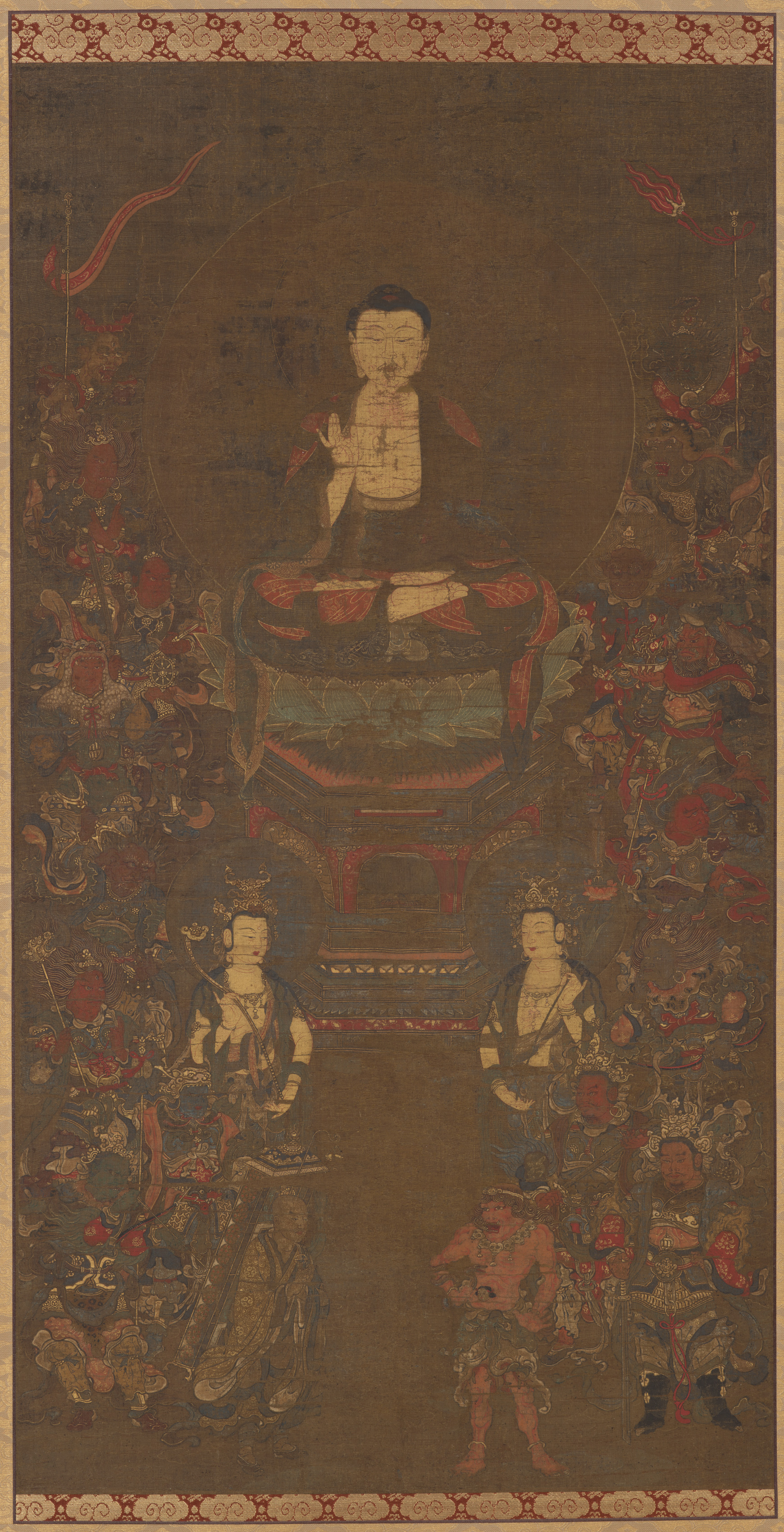
- Title
- Shakyamuni with the Sixteen Benevolent Deities (釈迦三尊十六善神像)
- Period
- Japan, Nanbokuchō period (1336–92), mid- to late 14th century
- Region
- Japan
- Medium
- Hanging scroll; ink, color, gold, and cut gold on silk
- Dimensions
- Painting 106.5 × 56.6 cm; overall with knobs and cord 201.5 × 80.4 cm
- Collection
- Cleveland Museum of Art
- Accession
-
1941.279 - Rights
- Shakyamuni with the Sixteen Benevolent Deities, Japan, Nanbokuchō period (1336–92). The Cleveland Museum of Art, Gift of Mrs. Henry S. Upson, 25th Anniversary Gift, accession 1941.279. CC0 (public domain).
Cleveland Museum of Art, accession 1941.279. Gift of Mrs. Henry S. Upson. CC0 (public domain).
Cleveland 1941.279 is a Nanbokuchō hanging scroll of the Shaka triad ringed by the sixteen armored Jūroku Zenjin who protect the 600-fascicle Daihannya-kyō. The pilgrim-translator Xuanzang stands at lower left as the human transmitter. It was the altar icon for the Daihannya-e recitation rite: the protective-deity picture, distinct from the lacquered box that holds the scrolls.
What it is, and what it is not
Cleveland 1941.279 is an altar icon for reading a sutra, not a devotional image of the Buddha for its own sake. The Cleveland “did you know” note states the function without hedging: the painting “would have been the main icon for ceremonial readings of the Great Perfection of Wisdom Sutra.”[^cma] That single fact reorders how the picture should be read. Everything in it, the central Buddha, the two bodhisattvas, the ring of armed deities, the monk in the corner, is organized around a text that is not depicted anywhere on the silk, the 600-fascicle Daihannya-kyō, which hung on the wall while the scrolls themselves were fanned open on the table below.
This is the distinction worth fixing at the start, because the genre name elsewhere on bodhi invites a collision. The lacquered cylindrical repository at Cleveland, accession 1969.130, is the box that physically holds the 600 fascicles; this scroll is the painting that hung above those fascicles during the rite. One is a container; the other is the icon the container’s contents were read in front of. They belong to the same ceremony, the Daihannya-e, and to almost nothing else in common. Calling either one “the Great Wisdom Sutra object” without saying which is the error this article exists to prevent.
The Japanese title on the Cleveland record is exact: 釈迦三尊十六善神像, Shaka sanzon jūroku zenjin zō, “Shaka triad, sixteen benevolent deities, image.” The title is the iconographic program in five characters. Read them in order and the picture decodes itself: a triad first, sixteen guardians second, and the word “image” last, because the thing is built to be an instrument and the title says so.
The center: a triad, not a single Buddha
The central figure is Shakyamuni (Shaka), the historical Buddha, but he is not alone, and the not-alone is the first reading. The Cleveland entry identifies a triad: Shakyamuni flanked by the bodhisattvas Fugen (Samantabhadra) and Monju (Mañjuśrī).[^cma] That pairing is deliberate and tied to the text. Monju is the bodhisattva conventionally associated with prajñā, transcendent wisdom, and the Daihannya-kyō is the Great Perfection of Wisdom sutra. The triad is not a generic Shaka-sanzon lifted from a Lotus context; it is a wisdom-cult triad assembled for a wisdom text. Tanabe’s study of sutra-related painting makes the broader point that medieval Japanese sutra pictures are not illustrations of narrative content but visual arguments about a text’s authority and protective power, assembled from a fixed cast for ritual use.[^tanabe] The Shaka, Monju, and Fugen core here is that argument’s opening clause: the text being read is the Buddha’s own perfect wisdom, with the wisdom-bodhisattva seated at his side as the visible warrant of it.
The triad sits on a lotus throne on a gold ground, with kirikane, cut-gold-leaf line, threaded through the haloes and the textile patterns. This is the standard luxury technique of fourteenth-century Buddhist painting, and it is the reason the surface still reads as metallic rather than as flat yellow under gallery light. Bogel’s work on the Mikkyō icon argues that gold ground and cut-gold detailing are not ornament but a claim about the figure’s mode of presence, the icon as a thing that manifests rather than merely depicts.[^bogel] On a ritual scroll meant to be looked at while a six-hundred-scroll text is turned at speed in front of it, that mode-of-presence claim is not decorative theory; it is operational. The icon has to be the unmoving, manifest center the rite physically rotates around, and the gold is how the picture asserts that it is.
The ring: sixteen armed guardians
Around the triad stand sixteen small figures in armor, the Jūroku Zenjin, the Sixteen Benevolent Deities, and the picture is named for them rather than for the Buddha at its center. That titling choice is itself a tell about what the painting is for. They are not a generic crowd of devas. They are the specific yakṣa-class protectors assigned by the sutra tradition to guard the Daihannya-kyō and anyone who recites or upholds it.[^narahaku] Iconographically they are set out in two tiers of eight to either side and toward the front of the triad, stepping down in scale toward the viewer in a stacked, almost heraldic rank rather than a naturalistic crowd.[^narahaku] The arrangement is regimental, not anecdotal: a guard drawn up in order, not a scene of attendants milling around a throne.
The grouping has internal structure that rewards a slow look. The set absorbs the Four Heavenly Kings, the Shitennō, Jikoku-ten, Zōchō-ten, Kōmoku-ten, and Tamon-ten/Bishamon-ten, into its sixteen, so the ring is not sixteen interchangeable warriors but a layered guard with the canonical directional kings embedded among lesser yakṣa generals.[^narahaku] The names of the full sixteen vary across the textual and pictorial tradition rather than resolving to one fixed roster, and the honest position is that the precise sixteen-name list is not stable across sources; what is stable is the function. De Visser’s old but still-cited account of the Daihannya cult in Japan reads the sixteen as a protective apparatus generated by the sutra’s own promises of protection to those who keep it, not as an independent pantheon imported whole and then attached.[^devisser] That is the reading this article follows. The ring is not a borrowed assembly that happens to surround a wisdom text; it is the text’s own protective clause made into figures.
The number sixteen is not arbitrary and not aesthetic. It is fixed by the sutra. The Daihannya-kyō in Xuanzang’s translation is enormous, 600 fascicles in sixteen assemblies, and its later sections carry explicit clauses in which guardian spirits vow to protect those who keep, recite, or copy the text. The pictorial sixteen are the visual settlement of that textual promise: the painting does not invent a guard for the sutra, it shows the guard the sutra says it has. This is why de Visser reads the set as generated by the text rather than imported into it, and it is why the genre is so stable across three centuries while the individual names drift.[^devisser] The roster is negotiable because it was always secondary; the count is fixed because the text fixed it.
That distinction has a practical edge for anyone trying to identify one of these paintings. A viewer who counts sixteen armed figures around a Shaka triad and stops there has read the genre but not the picture. The diagnostic question is not how many guardians there are but whether the Shitennō are findable inside the sixteen and whether a monk stands at the lower margin, because those two features are what separate a Daihannya protective icon from the much commoner Shaka-sanzon with a generic deva entourage.
The corner: the human who carried the text
The figure that turns the painting from icon into transmission document is small and at the bottom left. The Cleveland entry identifies him: the Chinese monk Xuanzang, “noted as a Buddhist scholar and translator of religious texts from India, including the Great Wisdom Sutra.”[^cma] Xuanzang (602–664), Genjō Sanzō in Japanese, made the overland journey to India and back across the seventh century and produced the Chinese translation of the 600-fascicle Daihannya-kyō from which the entire East Asian cult of the text descends. His presence in the corner is not staffage. It states the chain of custody: the perfect wisdom enthroned at the center reached the hall where this scroll hangs because this man walked to India and carried it back.
Xuanzang is rarely alone in these paintings. He is conventionally paired with a fierce dark guardian, Jinja Daishō, the Great General of the Deep Sands (Shinsha Daishō), the deity the legend credits with saving him when he was lost in the desert on the outbound journey.[^narahaku] The juxtaposition is unusually candid for a Buddhist altar picture: the monk shown carrying a box of scrolls on his back, the desert spirit that kept him alive shown facing him, the human cost of the transmission written into the lower corner of an otherwise serene icon. The Japanese-language iconographic study in the Kajima Journal of Art History takes exactly this pairing as its subject, treating the Xuanzang-and-Jinja-Daishō group in medieval Shaka-jūroku-zenshin paintings as a distinct iconographic problem rather than a settled given.[^kajima] That study is where the open questions would be settled: which specific figure at lower left on this scroll is Xuanzang and which is the desert general, and what the Cleveland composition’s variant is. The general identification is secure from the museum record; the figure-by-figure correspondence on 1941.279 specifically is not established here.
How the picture was used
The Daihannya-e, the assembly for reading the Daihannya-kyō, did not read the 600 fascicles through. It performed tendoku: the scrolls were fanned rapidly open and shut and the chapter headings chanted at speed, the physical turning of the text standing in for a complete recitation that would take far longer than any assembly could sit through.[^devisser] This scroll hung above that performance as its fixed visual anchor. The function explains the composition’s logic better than any aesthetic reading does. The triad is the text’s authority; the sixteen are the protection the text promises and the rite invokes; Xuanzang is the warrant that this is the real text and not a corruption of it. The picture is, in effect, a single-image statement of why the ceremony is supposed to work, assembled, on Tanabe’s argument about sutra paintings, as a ritual instrument rather than as a narrative illustration.[^tanabe]
The protective purpose was concrete, not abstract. The Daihannya-e was performed to avert epidemic, drought, and military threat at the level of the state, the province, and the temple, the sutra’s promised protection cashed out as apotropaic ritual at institutional scale.[^devisser] In that frame the sixteen armed deities are the operative part of the picture rather than its border decoration: they are precisely what the rite is asking to be present in the hall. The serene gold center is the reason the ritual has standing; the armored ring is the part the ritual is actually calling on.
Dating, comparanda, and where the scholarship is open
The Cleveland catalog dates the scroll to the Nanbokuchō period (1336–92), “mid- to late 1300s,” anonymous, in ink, color, gold, and cut gold on silk, with a painted surface of about 106 by 57 centimeters.[^cma] That places it in the productive fourteenth-century phase of the Shaka-jūroku-zenshin type, which runs strongly out of the Kamakura period and on into the Muromachi. The type is well attested in major Japanese collections: the Nara National Museum holds a comparable Shaka Jūroku zenshin, and Saidai-ji in Nara holds a Kamakura-period example on silk.[^narahaku] The Cleveland scroll is therefore a securely placed instance of a known and dated genre, not an outlier that needs special argument to locate.
What is genuinely unsettled is internal, not chronological, and it is worth stating as a real disagreement rather than a flat “scholars differ.” The museum record presents the lower-left figure simply as Xuanzang and moves on.[^cma] The standing scholarly treatment, the Kajima Journal study, exists precisely because the Xuanzang group in this picture type is not a fixed two-figure formula: its composition, the presence and identity of the desert general, and the iconographic source for the pilgrim’s depiction vary painting to painting and are an open research question.[^kajima] The position this article commits to is the scholarly one: the museum’s single-name caption is correct as far as it goes but understates a live problem, and the lower-left group on 1941.279 should be treated as an instance of a variable iconography rather than as a closed identification. The reading the article does commit to without reservation, the wisdom-triad core, the sixteen as the sutra’s protective clause made visible, Xuanzang as the transmission warrant, and the whole as a Daihannya-e altar instrument, does not depend on resolving that variable. The figure-level identification of the lower-left group on this scroll, and a confirmed sixteen-name roster, are the parts the Japanese-language scholarship would have to settle.
Related
- The lacquered Daihannya-kyō repository — the box that holds the scrolls
- Fujiwara no Muchimaro as an avatar of Dainichi — combinatory logic on a human
- The Daihannya-kyō (concept)
- Xuanzang / Genjō Sanzō (entity)
- The Sixteen Benevolent Deities (concept)