Fūgai Ekun's Daruma: the hermit's reading
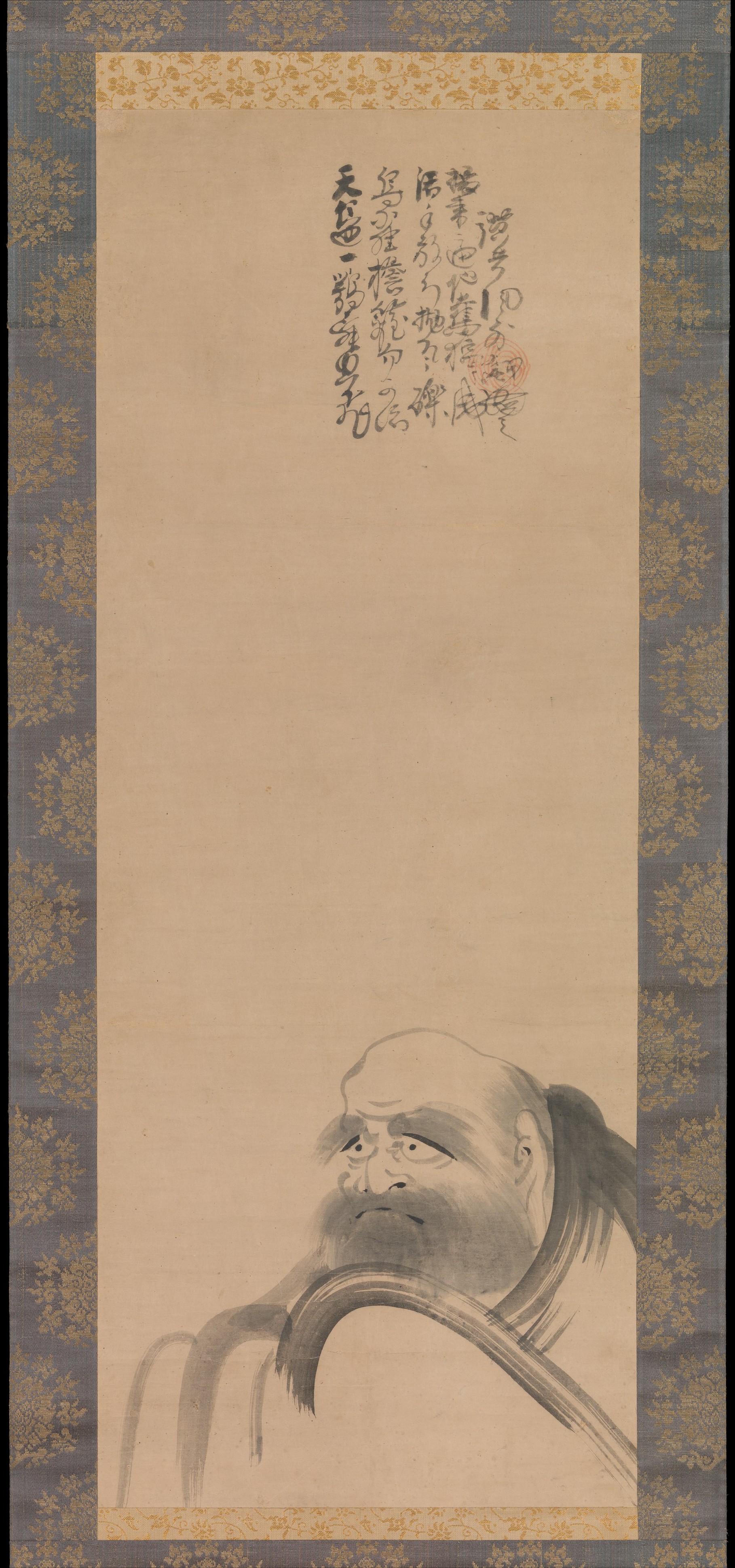
- Title
- Portrait of Daruma (達磨像)
- Period
- Momoyama (1573–1615) – Edo (1615–1868) period, early 17th century
- Region
- Japan
- Medium
- Hanging scroll; ink on paper
- Dimensions
- Image 77.5 × 30.8 cm
- Collection
- The Metropolitan Museum of Art
- Accession
-
2015.500.9.5 - Rights
- The Metropolitan Museum of Art, Open Access (Public Domain). Gift of Florence and Herbert Irving, 2015.
Fūgai Ekun (1568–1654), Portrait of Daruma. The scroll is small (77.5 × 30.8 cm), and the brushwork is the hermit-painter idiom that anticipated Hakuin's eccentric tradition by nearly a century.
Set the Fūgai scroll next to the Hakuin half-length at Met 2015.500.9.3 and the differences land immediately.
The Fūgai is smaller — 77.5 × 30.8 cm against the Hakuin’s 117.5 × 54 cm. The brushwork is drier; the ink-load is thinner; the paper-tooth is more visible. The figure proportions are narrower in the painted field. The eyes are present but less compositionally emphatic. The brow is multiple short strokes rather than one wet sweep. The contour breaks into discrete dry-brush strokes rather than reading as the single wet sweep that defines Hakuin’s hand.1
What you are looking at is the earlier Daruma. Fūgai Ekun (1568–1654) painted his Daruma works a full century before Hakuin began his.2
Who Fūgai Ekun was
The biography is the painting’s context. Fūgai was a Sōtō Zen monk, ordained before the age of ten, who briefly served as abbot of Seigan-ji in Kanagawa and then withdrew to a life of cave-dwelling seclusion in the mountains for the greater part of his remaining decades. His nickname Ana Fūgai — “Cave Fūgai” — registers the practice; the cave-dwelling was understood by his contemporaries to be in deliberate emulation of Daruma’s own legendary nine-year wall-gazing.3
This matters for the painting. Fūgai is painting Daruma as a hermit-monk painting another hermit-monk; the gesture is one of practice-identification, not iconographic illustration. Stephen Addiss, in his 1986 Eastern Buddhist essay on Fūgai, treats the hermit-painter’s painted Daruma as continuous with the hermit-painter’s life — both as Daruma-imitations, both as cave-practice expressions, both as readings of the Daruma figure from inside a comparable existential position rather than from outside.4
The Sōtō affiliation is significant. The Edo eccentric Daruma tradition that culminates with Hakuin (1686–1769) and Sengai Gibon (1750–1837) is Rinzai. Fūgai’s Daruma sits in the Sōtō register a century earlier — and Brinker and Kanazawa, in Zen: Masters of Meditation (1996), argue that the brushwork conventions Fūgai established became available to the later Rinzai eccentric painters precisely because Fūgai operated outside the institutional Rinzai-Daruma painting tradition. The hermit-painter idiom was available to be inherited only because Fūgai produced it in a position institutionally adjacent to the major Zen schools.5
What the painting does that Hakuin’s later work does not
The Fūgai Daruma at the Met operates with a deliberately rough brushwork register. Three features distinguish it from the Hakuin half-length:
-
Dry-brush dominance. Where Hakuin’s brushwork is wet-on-absorbent with controlled wet-edge management, Fūgai’s is dry-brush throughout. The contour lines break into discrete strokes; the ink-load is thin enough that the paper-tooth shows through. The aesthetic effect is rough rather than fluid.
-
The eyes are not the compositional anchor. Hakuin’s half-length Daruma centres on the eyes-as-wet-edge-ovals; the rest of the figure subordinates to them. Fūgai’s painting distributes the compositional weight more evenly. The eyes are present but do not carry the full weight of the painting’s address to the viewer.
-
The figure is smaller and narrower in proportion. Hakuin’s half-length fills the upper third of a large-format scroll with the head dominant. Fūgai’s painted figure is more contained, occupying a smaller portion of a smaller scroll, with the head in proportion to the body rather than amplified.
These are not casual variations. They are register choices. Fūgai’s Daruma is a hermit-painter’s Daruma — rough, contained, watching from within a comparable seclusion. Hakuin’s Daruma is the institutional Rinzai pedagogical Daruma — bold, large, addressed outward to the student-recipient.
The eccentric-painter tradition that runs from Fūgai through Hakuin to Sengai is unified by the willingness to subordinate calligraphic polish to immediacy of gesture. What changes across the century is the institutional position of the painter: Fūgai paints from a cave; Hakuin paints from a temple; Sengai paints from a city.
The Bodhidharma narrative — historiographically
The Daruma figure Fūgai painted is the Tang and Song Chan literary construction crystallized in texts like the Lidai fabao ji and the Jingde Chuandeng lu between the eighth and eleventh centuries, on the basis of a thin biographical kernel.6 The nine-year wall-gazing, the encounter with Liang Wudi, the meeting with Huike: all are textual constructs that the seventeenth-century Japanese Zen tradition Fūgai painted within inherited as canonical narrative.
Fūgai’s deliberate cave-dwelling-in-emulation-of-Daruma is itself a reading of this narrative — a Japanese hermit-monk reading the Chinese narrative figure as a model for monastic practice. The painted Daruma works are the visual articulation of that reading. They are not biographical illustrations; they are practice-identifications rendered in ink.
The site’s Daruma framing discipline — treat the Bodhidharma origin narrative as a hagiographic construction, not as biographical fact — does not weaken Fūgai’s Daruma as a painting. It strengthens it. Fūgai is reading the narrative as a textual figure; his painting reads the way it does because he understood Daruma as the construction Daruma is. Pop framings that treat the narrative as biography flatten exactly what makes Fūgai’s painting interesting.
The 2015 Irving gift — and the pair with the Hakuin scroll
The Florence and Herbert Irving collection assembled Met 2015.500.9.5 and Met 2015.500.9.3 — the Fūgai and the Hakuin — together. Both came to the Met in the same 2015 gift. The accession numbers (.9.3 and .9.5) are adjacent in the Irving 2015 transfer sequence.
This means the Irving collection treated the two as a pair while assembling them. The Irvings — or their advising curators — saw the Fūgai-Hakuin lineage as a single collectable narrative: the proto-Hakuin Sōtō hermit and the institutional Rinzai master of the eccentric-painter tradition’s culmination.
The Met’s gallery presentation has, when both works are on view, sometimes paired them. The pairing is the right curatorial reading. To see Hakuin without seeing Fūgai is to miss the lineage; to see Fūgai without seeing Hakuin is to miss the tradition’s later flowering. The Met’s 2015 acquisition of both, in a single Irving transfer, gave the institution the capacity to do the pairing in perpetuity.
Comparable Fūgai works in Western collections
The published corpus of Fūgai works is small relative to Hakuin’s. Addiss 1986 catalogues roughly forty surviving secure-attribution works; the actual production was likely larger, but the cave-dwelling production circumstances and the lack of an institutional temple base (Fūgai was not anchored to a major temple, unlike Hakuin at Shōin-ji) meant fewer works survived in documented condition.
Western institutional holdings:
- Denver Art Museum 1982.135 — a comparable Fūgai Daruma; published in the museum’s Asian art catalog.
- MFA Houston (Gitter-Yelen Collection) — multiple Fūgai works including Daruma and Hotei subjects.
- Met 77179 — Fūgai’s Hotei Pointing at the Moon, also Irving 2015 gift; demonstrates Fūgai’s non-Daruma subjects and gives a broader read on his hand.
A reader who unrolls the Met Fūgai Daruma alongside the Denver work via both museums’ Open Access platforms can read the corpus consistency directly. The brushwork register is recognizable across the comparison; the variations are in scroll-size, inscription content, and the figure’s exact orientation.
What stays open
Three questions on this specific work:
-
The inscription’s reading. The Met’s open-access record does not transcribe the inscription text. Addiss 1986 may include a transcription of the work in his catalog appendix, but this has not been confirmed.
-
The dating within the early 17th century. The Met gives “early 17th century” without further specificity. Fūgai’s documented production is concentrated in his late life (the cave-dwelling decades after he left Seigan-ji); a tighter dating within the first half of the seventeenth century would place this scroll within or outside the major hermit-period production.
-
The pre-Irving Japanese provenance. The Met’s record does not document where the scroll was held in Japan before it entered the Irving collection. Fūgai’s works circulated through small temple networks and private collections rather than through institutional temple holdings; a tracked provenance pass through the Irving collection’s pre-Met records could surface this.
Footnotes
Footnotes
-
The Metropolitan Museum of Art, accession 2015.500.9.5, “Portrait of Daruma,” Fūgai Ekun (Japanese, 1568–1654). Momoyama–Edo period, early 17th century. Hanging scroll; ink on paper. Image 77.5 × 30.8 cm. Gift of Florence and Herbert Irving, 2015. Public Domain (Met OA). Catalog record accessed 2026-05-13 via the Met OA API (object 78147). ↩
-
Fūgai’s life dates (1568–1654) and Hakuin’s life dates (1686–1769) are separated by roughly a century. Fūgai’s documented painted production is concentrated in his late life; Hakuin’s painted production is concentrated in his last three decades (c. 1734 onward). The Fūgai-to-Hakuin chronology is roughly a hundred years from Fūgai’s mature production to Hakuin’s first painted Daruma works. ↩
-
Stephen Addiss, “The Life and Art of Fūgai Ekun (1568–1654),” The Eastern Buddhist, Vol. 19, No. 1 (Spring 1986). The cave-dwelling biographical detail and the Ana Fūgai nickname are documented in Addiss’s article, drawing on the surviving 17th-century Japanese sources. The biographical record is thin (Fūgai operated outside major temple institutions for most of his life), but Addiss’s reconstruction is the working consensus. ↩
-
Addiss’s reading of the hermit-painter painted Daruma as continuous with the hermit-painter’s life is the article’s central argument. The painted Daruma works are not, by this reading, about Daruma so much as enactments of a comparable practice through the medium of brush, ink, and paper. The position is influential in the later English-language scholarship on Fūgai (Brinker-Kanazawa 1996 builds on it). ↩
-
Helmut Brinker and Hiroshi Kanazawa, Zen: Masters of Meditation in Images and Writings (Artibus Asiae Supplementum 40, 1996). The argument that Fūgai’s hermit-painter brushwork conventions became available to the later Rinzai eccentric painters (Hakuin, Sengai) precisely because Fūgai operated outside the institutional Rinzai painting tradition is recurrent across Brinker-Kanazawa’s treatment of the early-Edo Zen painting lineage. Cited at work level; no specific chapter or page is given. ↩
-
Bernard Faure, The Rhetoric of Immediacy (Princeton, 1991), and John R. McRae, Seeing Through Zen (UC Press, 2003). The position that the Bodhidharma origin narrative is a Tang-Song textual construction rather than recovered biography is the working consensus in critical Chan/Zen scholarship. The framing applies to any seventeenth-century Japanese reading of Daruma, including Fūgai’s: he was reading the constructed figure, and the practice-identification visible in his painting is a reading of that construction. ↩
Sources
-
[2]2026-05-13The Metropolitan Museum of Art (Open Access API) collectionapi.metmuseum.org/public/collection/v1/objects/78147 -
The standard English-language scholarly treatment of Fūgai's life and painted corpus. Establishes the hermit-painter biography on the basis of the surviving 17th-century Japanese sources.
-
Scholarly reference for medieval and early-Edo Japanese Zen painting. Treats Fūgai as the early-17th-c. hermit-painter who anticipated the Edo eccentric tradition that culminates with Hakuin and Sengai.
-
Hakuin's painted corpus reference; cited for the lineage placement of Fūgai relative to Hakuin's later production.
-
LACMA exhibition catalog; treats Fūgai as the Hakuin-precursor in the Daruma painting lineage.
-
[7]2026-05-13Museum of Fine Arts, Houston (Gitter-Yelen Collection) emuseum.mfah.org/catalogues/gitter-yelen-collection/me…Gitter-Yelen Collection at MFAH includes Fūgai works; the published Zenga history places Fūgai within the early-Edo hermit-painter tradition.
-
Cited for historiographical treatment of the Bodhidharma narrative.