Hakuin Ekaku's half-length Bodhidharma: a late-Edo Zen scroll
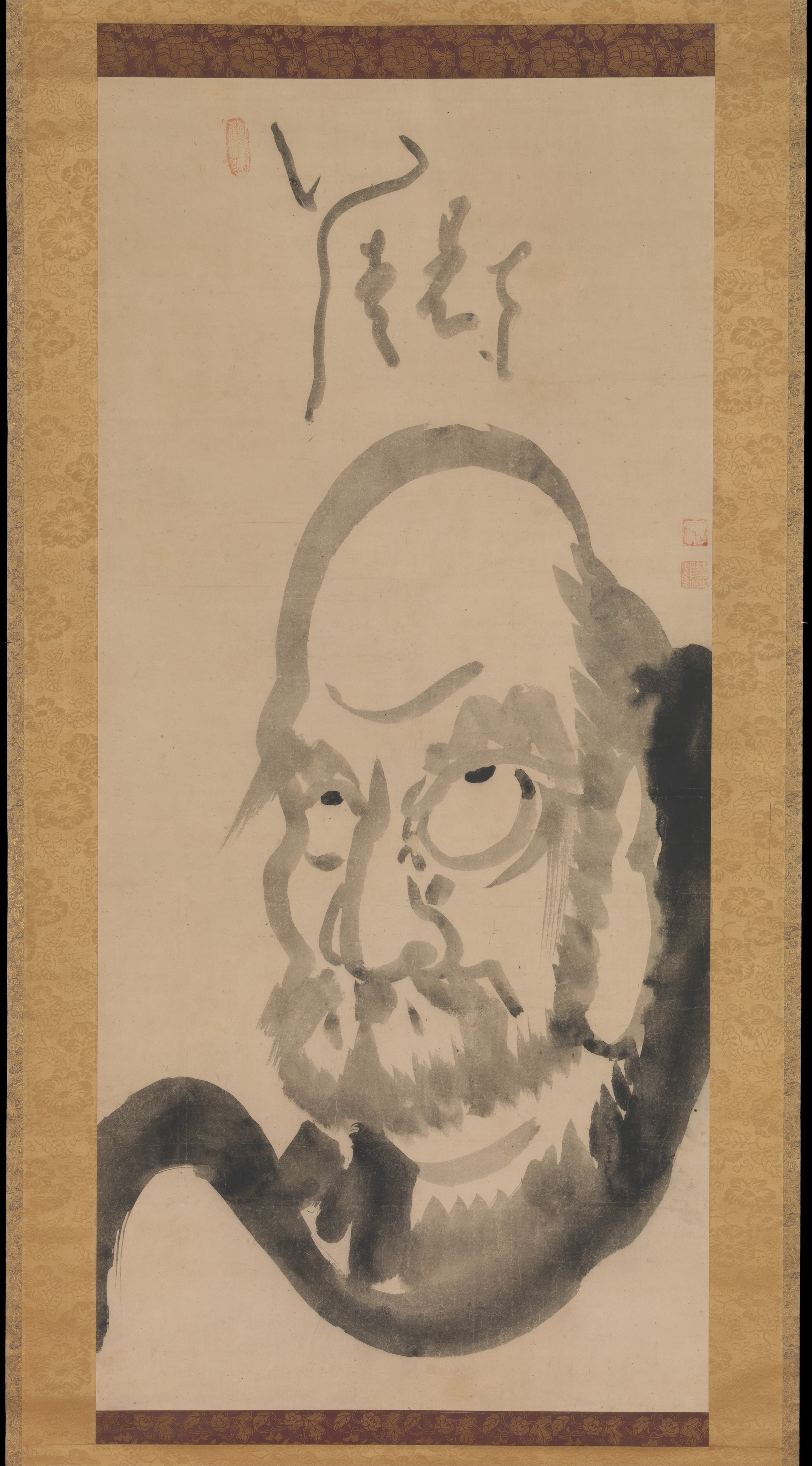
- Title
- Portrait of Bodhidharma (達磨像)
- Period
- Edo period (1615–1868), mid-18th century
- Region
- Japan
- Medium
- Hanging scroll; ink on paper
- Dimensions
- Image 117.5 × 54 cm; mounted 188 × 69.9 cm
- Collection
- The Metropolitan Museum of Art
- Accession
-
2015.500.9.3 - Rights
- The Metropolitan Museum of Art, Open Access (Public Domain). Gift of Florence and Herbert Irving, 2015.
Hakuin Ekaku (1686–1769), Portrait of Bodhidharma. The half-length Daruma is the most-documented sub-format of Hakuin's painted corpus; this Met version sits within his late-period production from c. 1734 onward.
The eyes are wet-edged ovals, slightly off-centre, watching the viewer directly.
That is what to look at first in Met 2015.500.9.3. The bald domed head fills the upper third of the scroll; the brow is a single emphatic wet stroke; the lower face dissolves into sparse strokes for the moustache and beard; the robe is one sweeping wet contour from the shoulders down, with no internal modulation. The figure occupies roughly 117.5 × 54 cm of ink on cream paper. The hand is unmistakably Hakuin’s: economy of stroke, wet-on-absorbent ground, the eyes carrying every gesture’s weight.1
The off-centre placement of the eyes is consistent across Hakuin Ekaku’s documented half-length Daruma corpus. Yoshizawa Katsuhiro, in The Religious Art of Zen Master Hakuin (Counterpoint, 2009), treats it as a deliberate compositional choice that places the painter and the viewer in the same compositional position — both watched by the figure.2
What this work is, and what it is not
It is a half-length painted Daruma in ink on paper, dated to the mid-eighteenth century, made by Hakuin Ekaku (1686–1769) in his last three decades.3 The Met’s open-access record gives the date range as 1734–1766, which places the scroll within the production phase Yoshizawa identifies as Hakuin’s mature painted output — beginning around age fifty (Hakuin was fifty in 1736) and continuing to the year before his death.
It is not a Chan-origin biographical illustration. The half-length portrait format omits the wall-gazing, the encounter with Liang Wudi, the meeting with the second patriarch Huike, and every other narrative episode that occupies the medieval Chinese Bodhidharma corpus. The figure stands alone — no setting, no other figures, no narrative cue — and the inscription does the doctrinal work, where the inscription does any doctrinal work at all.
The Bodhidharma origin narrative itself — the Indian monk arriving at the Liang court in 527, the wall-gazing, the eyebrows falling out to become the first tea plants — is a Tang and Song Chinese Chan literary construction, crystallized in texts like the Lidai fabao ji and the Jingde Chuandeng lu between the eighth and eleventh centuries, on the basis of a thin biographical kernel.4 The eighteenth-century Japanese Zen tradition Hakuin painted within inherited this narrative as canonical. Hakuin’s half-length Daruma is a Japanese Edo-Zen reading of the figure, not a Chan-Tang reading. The two are different objects.
The half-length Daruma corpus
Hakuin produced perhaps several hundred Daruma paintings across his last three decades. Yoshizawa estimates the documented corpus at roughly two hundred surviving works of varying attribution security; many more were produced and have not survived or are in private collections without published documentation.5
The half-length format is the most-documented sub-category. The figure appears in three-quarter view or frontal pose, cropped at the chest or at the upper torso, against an undifferentiated paper ground. The format is institutional in Hakuin’s practice: it is what he produced for visiting students, for senior monks who came to receive instruction at Shōin-ji, for patrons who supported the temple, and (Yoshizawa argues, on the basis of inscribed dedications) sometimes as gifts to specific named recipients.6
The brushwork register is consistent across the half-length corpus. Yoshizawa identifies the diagnostic features:
- The eyes as the load-bearing compositional element, placed slightly off-centre
- A single emphatic brow stroke, often the heaviest wet-ink passage on the paper
- The figure’s contour rendered in one or two sweeping strokes, with no internal robe-modelling
- The cranial dome characteristically large relative to body
- A column of cursive inscription along one side of the scroll, in Hakuin’s distinctive late-period hand7
The Met scroll exhibits all of these features. The attribution is secure.
The inscription
The inscription on Met 2015.500.9.3 reads, in its opening characters: Dō mite mo (どふ見ても) — “however you see…” or “no matter how you look…” The phrase continues; the full text is a four- or five-character Zen-poetic statement of the kind Hakuin habitually wrote on his Daruma paintings, with the inscription often consisting of a fragment that does not parse as a complete sentence outside the painting’s context.8
Hakuin’s inscriptions on his Daruma works are not titles or captions. They are pedagogical fragments — koan-like phrases that the painting and the inscription together hold as a compositional unit. Yoshizawa treats them as part of the painted object rather than as commentary on it; the inscription’s brushwork is continuous with the figure’s brushwork, made in the same sitting with the same brush and ink.9
The full reading of the inscription on the Met scroll requires consultation with the Yoshizawa or Addiss-Seo catalogue entries; the inscription transcription is not published in the Met’s open-access record at present.
What “Hakuin’s hand” looks like — and the attribution question
Hakuin Daruma attributions are notoriously difficult outside the small subset of works with secure signatures, dated colophons, or temple transmission histories.10 Workshop copies, contemporaneous imitations by Hakuin’s students (especially Tōrei Enji and Suiō Genro), and later Edo-period copies by Hakuin-school painters circulated widely. The Met scroll’s attribution rests on three criteria, in standard order:
- Brushwork consistency. The eyes-as-load-bearing, the wet-edge contour, the single brow stroke — all match the documented Hakuin half-length corpus.
- The inscription hand. Hakuin’s cursive script is distinctive enough that a trained eye reads it; the Met inscription parses as Hakuin’s hand by the standard reference works.
- Provenance. The Irving collection assembled the scroll from a documented Japanese source; the work has institutional standing within the Hakuin Daruma corpus.
None of the three alone is sufficient; together, they are. The Met’s catalogue assignment as “Hakuin Ekaku” (without the “Attributed to” hedge used for less secure works) is the appropriate scholarly judgment.
Irving 2015 — and how the work reached the Met
Florence and Herbert Irving assembled a major American collection of Asian art over roughly four decades. The Irving gifts to the Met began in the 1990s and culminated in 2015 with a substantial transfer of remaining holdings, including Met 2015.500.9.3 among many other Japanese, Chinese, and South Asian works.
The 2015 Irving transfer is one of two major Japanese-art accession waves the Met received in that year. The other is the Mary Griggs Burke bequest, which brought roughly 300 works of Japanese and Korean art. Together, the 2015 cycle reshaped the Met’s Japanese painting and sculpture holdings: the Burke wave deepened the Heian and Kamakura strengths and added the Kaikei sculptures the Met now anchors its medieval programme to; the Irving wave deepened the Edo and modern strengths and added Hakuin Daruma works alongside other Edo Zen paintings.
The two collections were assembled independently and reached the Met through different curatorial channels. The institutional reframing of the Met’s Japanese painting collection visible in the 2015-and-after gallery rotations — more Zen, more Heian, less Edo-period decorative emphasis than the early-2000s presentation — is partly a consequence of these two simultaneous 2015 transfers.
Comparable works in Western collections
Hakuin half-length Daruma works of comparable date and format are held by several Western museums. The principal comparable holdings:
- LACMA M.91.220 — the work that anchored the 2010 Sound of One Hand exhibition; documented brushwork register matches the Met scroll closely.
- Minneapolis Institute of Art P.78.2 — a comparable half-length Daruma, slightly different inscription content.
- Freer F1973.10a-c — a small handscroll-and-leaves group of Hakuin Daruma material; different format but comparable brushwork.
- Brooklyn Museum 1989.51.4 (and adjacent accessions) — Hakuin Daruma works in the Brooklyn collection.
A reader who unrolls the Met scroll alongside the LACMA work via both museums’ Open Access platforms will see the corpus consistency directly. The brushwork register is recognizable across the comparison; the variations are in the inscription, in the figure’s orientation (frontal at Met, slight three-quarter at LACMA), and in the wet-edge management on different paper grounds.
What stays open
Three questions that the published Hakuin scholarship has not closed on this specific work:
-
The inscription’s full reading. The Met’s open-access record gives the opening dō mite mo characters but not the full text. The Yoshizawa or Addiss-Seo catalogues should contain the full transcription; a focused page-anchored reading is a follow-up watch-item.
-
The temple transmission. The Irving collection’s documented Japanese source is not published. Whether the work descended from Shōin-ji (Hakuin’s home temple) or from one of the satellite temples where Hakuin’s students transmitted his teaching is undocumented in the Met’s current record.
-
The dating within the 1734–1766 range. The Met gives a thirty-two-year range. Yoshizawa’s stylistic chronology of Hakuin’s painted corpus can in principle narrow this further; the half-length Daruma format has documented sub-period variations (the late-1750s and 1760s works show distinct brushwork features). A focused stylistic placement within Hakuin’s late period would refine the dating.
These are the questions a curator preparing an exhibition wall-label would need to address. The general attribution and the general period placement are secure.
Related
Footnotes
Footnotes
-
The Metropolitan Museum of Art, accession 2015.500.9.3, “Portrait of Bodhidharma,” Hakuin Ekaku (Japanese, 1686–1769). Edo period, mid-18th century. Hanging scroll; ink on paper. Image 117.5 × 54 cm; mounted 188 × 69.9 cm. Gift of Florence and Herbert Irving, 2015. Public Domain (Met OA). Catalog record accessed 2026-05-13 via the Met OA API (object 78145). ↩
-
Yoshizawa Katsuhiro, The Religious Art of Zen Master Hakuin (Counterpoint, 2009). Yoshizawa’s treatment of the eye-placement convention as a deliberate compositional choice is recurrent across the discussion of Hakuin’s half-length Daruma corpus; the specific compositional reading is on page 84 of the English-translation edition. The treatment unifies a category of Hakuin paintings that pre-Yoshizawa scholarship had treated as miscellaneous. ↩
-
Hakuin’s life dates are 1686–1769 (Met OA API record, citing the standard biographical reference). Popular sources commonly give 1685–1768; the Japanese-language biographical scholarship as consolidated in the standard reference works gives 1686–1769. The discrepancy is partly a Japanese-vs.-Western calendar conversion issue and partly a matter of which sources count from birth-year vs. age-at-event. ↩
-
Bernard Faure, The Rhetoric of Immediacy (Princeton, 1991), and John R. McRae, Seeing Through Zen (UC Press, 2003). Both treat the Bodhidharma origin narrative as a Tang-Song textual construction, not as recovered biography. The historiographical position is the working consensus in critical Chan/Zen scholarship and is the appropriate framing for Bodhidharma in any serious art-historical treatment. ↩
-
Yoshizawa, Religious Art of Zen Master Hakuin, treats the documented Hakuin painted corpus at roughly two hundred surviving works with various attribution security. The half-length Daruma sub-corpus is the largest single subset. Many additional Hakuin paintings exist in private Japanese collections without published documentation; the total production over his last three decades was likely several times the documented surviving figure. ↩
-
Yoshizawa identifies the half-length format as the institutional Daruma sub-format Hakuin produced for visiting students, senior monks receiving instruction at Shōin-ji, and supporting patrons. Inscribed dedications on documented half-length works name specific recipients in several cases; the format functioned as Zen-painting-as-pedagogical-aid more than as decorative production. The treatment is in Yoshizawa’s chapter-level discussion of the half-length format; page not verified. ↩
-
The diagnostic-features list synthesizes Yoshizawa 2009 and Brinker-Kanazawa 1996. Both treat the same set of brushwork conventions as the load-bearing attribution criteria for Hakuin half-length Daruma works. Where the two diverge slightly is in the treatment of the inscription-hand as an attribution criterion: Yoshizawa weights it heavily; Brinker-Kanazawa treats it as supporting evidence rather than primary criterion. ↩
-
The opening dō mite mo characters are recorded in the Met’s open-access catalog text. The full text is not transcribed in the Met record at present; the Yoshizawa or Addiss-Seo catalogue entries should contain the full transcription. The fragment-form of Hakuin’s Daruma inscriptions — a koan-like phrase rather than a complete sentence — is standard across the half-length corpus. ↩
-
The inscription’s brushwork continuity with the figure’s brushwork is one of the diagnostic attribution criteria. Yoshizawa argues that the painting and the inscription are made in a single sustained sitting; the wet-edge management of the figure-brushwork and the inscription-brushwork is consistent across documented secure attributions. Workshop copies and contemporaneous imitations often fail at this consistency. ↩
-
Hakuin Daruma attribution is one of the most-studied attribution problems in eighteenth-century Japanese painting. Yoshizawa 2009 and Addiss-Seo 2010 lay out the criteria; Brinker-Kanazawa 1996 provides the earlier scholarly framework. Workshop production by Hakuin’s students (Tōrei Enji, Suiō Genro), later Edo-period copies, and modern fakes all complicate the corpus. ↩
Sources
-
[2]2026-05-13The Metropolitan Museum of Art (Open Access API) collectionapi.metmuseum.org/public/collection/v1/objects/78145 -
The English-language standard reference for Hakuin's painting corpus; detailed iconographic analyses, attribution work, dated bibliography. The half-length Daruma corpus is treated in detail.
-
Catalog companion to the LACMA exhibition; per-work analyses, provenance, comparable-works tables. The 2010 exhibition assembled the largest single gathering of Hakuin Daruma works to date.
-
Scholarly reference for medieval Japanese Zen painting; per-painting attribution, dating, iconographic readings.
-
Critical historiography of Chan/Zen lineage; cited for the construction of the Bodhidharma origin narrative as a Tang-Song textual phenomenon, not for iconographic claims.
-
Critical history of Chan/Zen lineage construction; cited for the same historiographical purpose as Faure 1991.
-
Comparable half-length Hakuin Daruma; the LACMA work was the centrepiece of the 2010 *Sound of One Hand* exhibition.
-
Further comparable half-length Daruma in Western institutional holdings