The Nine Luminaries and the Seven Stars descending at Kasuga
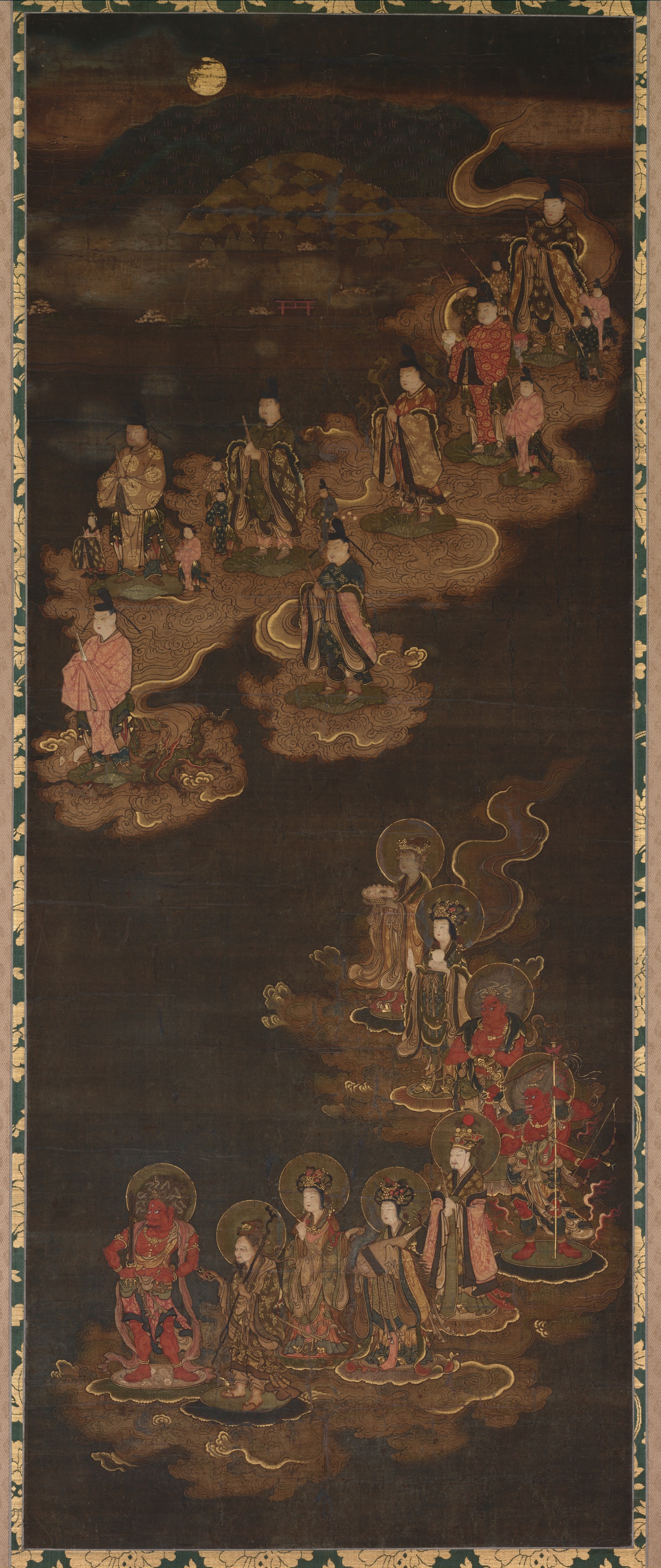
- Title
- Descent of the Nine Luminaries and the Seven Stars at Kasuga (北斗九曜春日降臨図)
- Period
- Japan, Nanbokuchō period (1336–92), mid- to late 1300s
- Region
- Japan
- Medium
- Hanging scroll; ink, color, gold and cut gold on silk
- Dimensions
- Painting only: 106 × 42 cm; mounted: 184.5 × 58.5 cm
- Collection
- Cleveland Museum of Art
- Accession
-
2015.63 - Rights
- Descent of the Nine Luminaries and the Seven Stars at Kasuga, Japan, Nanbokuchō period, mid- to late 1300s, hanging scroll; ink, color, gold and cut gold on silk. The Cleveland Museum of Art, Lillian M. Kern Memorial Fund, accession 2015.63. CC0.
Cleveland 2015.63 — two astral systems descending on Kasuga in one painting. The Hokuto (Big Dipper) above, the Kuyō (Nine Luminaries) below, on the *honjibutsu mandarazu* descent scheme. Reading them as one undifferentiated 'star deities' band is the standard browsing error.
Cleveland 2015.63 is a Nanbokuchō hanging scroll showing two distinct astral systems descending on Kasuga: the Kuyō (Nine Luminaries, Vedic-via-Mikkyō) below, the Hokuto (Big Dipper, Daoist-via-Onmyōdō) above. It fuses esoteric star worship with the Kasuga honji-suijaku “descent” format. The two registers are not interchangeable.
The work, and the title’s exact words
Cleveland 2015.63 is a tall Nanbokuchō hanging scroll, mid- to late 14th century, in ink, color, gold and cut gold on silk. The painting itself is 106 × 42 cm; mounted, it stands 184.5 cm. The Cleveland title translates the inscribed kanji, 北斗九曜春日降臨図, in the order the Japanese gives them: Hokuto, then Kuyō, then Kasuga, then descent-picture. It is CC0, acquired through the Lillian M. Kern Memorial Fund in 2015, with a documented provenance through a 2014 Paris sale (Piasa, lot 261) and the dealer Leighton R. Longhi.1
Read the title slowly, because it is doing taxonomic work. Hokuto (北斗) is the Big Dipper, the seven stars. Kuyō (九曜) is the Nine Luminaries. Kasuga (春日) is the Nara shrine. Kōrin-zu (降臨図) is a descent-picture. The painting is not “star deities at a shrine.” It is two named, separately-derived astral systems, arriving by the descent convention, at a specific honji-suijaku site. Each of those four words is a different scholarly literature, and the painting’s interest is that it holds all four in one silk.
What is in the upper register, and what is in the lower
The Cleveland record describes the composition with care, and it can be checked against the CC0 image. The uppermost portion carries the moon, the Kasuga mountain range, and a red shrine gate, a torii. Below that, in the upper register, figural representations of the seven Big Dipper stars descend from right to left on cloud banks. In the lower register, the Nine Luminaries descend in the same manner: the sun and moon; Jupiter, Mars, Saturn, Venus, Mercury; and personifications of the two fluctuating lunar nodes (Rāhu and Ketu).1
The single most useful observation a reader can make from the image is that the painter kept the two groups physically apart and stacked, not interleaved. Hokuto above, Kuyō below, each on its own cloud bank, each entering from the same side. That is not a decorative choice. It is the painter encoding the very distinction this article is about: these are two systems, and the picture refuses to merge them even while bringing them to the same shrine.
Kuyō is not Hokuto, and the difference is the article
The browsing reader’s reflex is to read a star painting as a single “celestial pantheon.” The Cleveland title resists that, and the iconography resists it harder. The two systems have different ancestries, different ritual literatures, and different jobs.
The Kuyō, the Nine Luminaries, are the navagraha: the sun and moon, the five visible planets, and the two invisible eclipse-points, Rāhu and Ketu, that mark where the moon’s path crosses the sun’s. The system is Indian, Vedic-derived, and it entered Japan inside the Mikkyō transmission, carried in esoteric astrological texts. Faure, in From Stars to Stones, treats the navagraha as part of the imported Buddhist astral apparatus rather than the native or Sinic stratum (Faure 2021).2 In painting, the Kuyō are often given the Sinicized iconographic forms the texts had already acquired in China. A wizened old man on a bull for Saturn is the example specialists cite, and the Cleveland record itself flags the “deities in descent” scheme as a China-originating convention.1
The Hokuto, the Seven Stars of the Big Dipper, are a different tradition entirely. They are the seven visible stars of Ursa Major, and their cult in Japan runs through Chinese astral religion and Onmyōdō, the yin-yang divination office, more than through the Buddhist sutras. Their characteristic ritual job is personal and calendrical: a person’s destiny is governed by which of the seven Dipper stars rules the month and day of their birth, the honmyō or birth-star. That is a different operation from the navagraha’s planetary reckoning, and the Hokuto’s standing mandala context, the Hokuto mandara, places the seven around Shaka Kinrin (also Ichiji Kinrin), the Buddha of the Golden Wheel, the ruler of the star realm.3
The genealogical split has a practical consequence the painting registers. The Kuyō reached Japan through Sukuyōdō, the Buddhist astral-calendrical discipline carried inside the Mikkyō transmission and worked by esoteric clerics, while the Hokuto cult was the working stock of Onmyōdō and the court yin-yang masters. Faure’s account in From Stars to Stones treats medieval Japanese astral religion as exactly this kind of layered import, the Sinic-Daoist Dipper stratum and the Indic-Buddhist planetary stratum coexisting and competing rather than fusing into a single system (Faure 2021).2 A painter who placed nine planetary figures and seven Dipper figures on one silk had to decide whether to treat them as one heavenly crowd or as two ordered systems. The Cleveland painter chose the second, and the choice is visible in the register break.
So the painting’s two stacked registers are two religious imports that converged in medieval Japan without dissolving into one another. The Cleveland picture is unusual precisely because it shows them converging on Kasuga while keeping their separateness visible in the composition. That is the load-bearing reading, and it is the one the casual “star deities at a shrine” gloss erases.
Why they descend on Kasuga at all
Kasuga is the Fujiwara clan shrine at Nara, paired with the clan temple Kōfuku-ji into a single cult body. Under honji-suijaku, the shrine’s kami were read as local traces (suijaku) of universal Buddhist deities (honji). The five Kasuga Daimyōjin deities were each given a Buddhist counterpart, and the shrine-mandala genre made that identification visible by painting the sacred Mikasa landscape with its Buddhist or kami figures arrayed within it. Tyler’s The Cult of Kasuga Seen Through Its Art is the standard account of how that visual theology worked at this specific shrine (Tyler 1992).4
The Cleveland painting uses the honjibutsu mandarazu format, the “original-Buddhist-form mandala,” the same scheme used across medieval Shinto-Buddhist painting to show a shrine’s true Buddhist identities.1 What is unusual is the content placed into that familiar shrine-mandala frame. The standard Kasuga shrine mandala descends, or arrays, the five Kasuga honji or the deer-borne mirror; this one descends the astral systems instead. The painting is asserting that the celestial bodies, too, arrive at Kasuga, that the shrine’s protective reach extends into the star realm, and it makes the assertion in the established grammar of Kasuga descent imagery rather than inventing a new one.
The departure from the standard type is the point worth holding onto. The familiar Kasuga shrine mandala, the kind bodhi has read at Cleveland and the Met, descends or arrays the five Kasuga honji, or sets the sacred deer bearing a mirror-disc against the Mikasa landscape; its subject is the identity of the shrine’s own kami with their Buddhist originals. Cleveland 2015.63 keeps that frame, the moon, the Mikasa range, the torii, the descent grammar, and pours a different content into it. It is asserting that the astral systems are themselves among the powers that come to Kasuga, an extension of the shrine’s reach upward into the star realm rather than a restatement of its five-deity core. Read beside an ordinary Kasuga deer mandala, the Cleveland scroll shows how elastic the shrine-mandala format was: the same pictorial theology could absorb the navagraha and the Dipper without abandoning its Kasuga identity.
This is where the museum record and the available scholarship are honest about a thin evidence base, and bodhi should be too. Vilbar’s 2018 Arts of Asia study, “A Celestial Landing,” is the one dedicated published treatment of this object, by the Cleveland curator who acquired it (Vilbar 2018), and the painting also appears in the 2019 Cleveland Shinto catalog (Vilbar and Carr 2019).56 The specific cultic occasion, who commissioned an astral Kasuga descent and for what rite, is not something the surviving record pins down with the precision the iconography itself shows. The painting is more legible than its history.
A note on rarity and what the picture is for
Star paintings of any kind are rare in the Japanese record. The standing Hoshi/Hokuto mandara survives in very few examples, the earliest extant ones dating to the late 12th century at Kumeda-dera (Osaka) and Hōryū-ji (Nara), and the genre has been studied by a small set of specialists, among them Tsuda Tetsuei and Takeo Izumi.3 An astral painting that is also a Kasuga shrine mandala is rarer still: it sits at the intersection of two thinly-attested genres. The Cleveland record notes one related object, a 19th-century copy in ink and light color at the Kyoto City University of Arts,1 which tells us the composition was thought worth copying centuries later but does not give the original a firmer medieval context.
Stand in front of the mounted scroll and the function is legible even where the history is not. At 184 cm the painting reads from across a room as a vertical fall of cloud and gold from the moon and the Mikasa range down past two banks of small descending figures. It is built to be looked up at, the celestial source high and the descent moving down toward the viewer’s level, the gold catching light the way star-ritual paintings were meant to in candle-lit halls. The picture’s argument is spatial before it is doctrinal: the heavens, in two named systems, are coming down, and they are coming to here, to Kasuga. The careful keeping-apart of Kuyō and Hokuto is the painter telling a viewer who knew the difference that the difference was being respected even as both were brought home to the shrine.
How to read this object in a collection
For a reader meeting an astral shrine painting in a museum, the practical sequence:
- Find the two groups before counting figures. Seven robed star-figures on one cloud bank is Hokuto; nine, including a sun, a moon, and the eclipse-points, on another is Kuyō. If they are stacked and not mixed, the painter is marking the distinction deliberately.
- Check for a central Buddha. A Hokuto mandara proper centers on Shaka Kinrin / Ichiji Kinrin. A descent painting like Cleveland 2015.63 has no such centre; it is organized by the descent scheme and the shrine landscape, not by a mandala’s concentric order.
- Read the landscape for the shrine. A torii, a recognizable mountain range, a moon over Mikasa: these locate the astral descent at Kasuga and put the object in the honji-suijaku shrine-mandala genre, not the abstract star-mandala genre.
- Treat the date and the cult separately. The Nanbokuchō dating (mid- to late 1300s) is the museum’s; the specific ritual occasion is not securely recoverable from the present record, and an honest reading says so.
Cleveland 2015.63 rewards the reader who refuses to flatten it. It is not a star mandala and not an ordinary Kasuga shrine mandala. It is the rarer thing: two distinct imported astral systems, kept distinct, descending by the Kasuga shrine-mandala grammar onto the Fujiwara shrine, in a Nanbokuchō painting whose iconography we can read more confidently than its commission.
Related
- Kasuga deer mandala, the standard Kasuga honji-suijaku type this one departs from
- Two Met Kasuga shrine mandalas, the genre baseline
- Cleveland 1987.39, a Heian esoteric mandala zuzō
- The Two-Worlds mandalas, Mikkyō’s mandala grammar
- Honji-suijaku (entity)
- Hoshi mandara, the star-mandala genre (entity)
- Kasuga cult (entity)
Footnotes
Sources
-
The primary published study of Cleveland 2015.63, by the Cleveland curator who acquired it. Cited at article level; specific page references have not been verified against the print issue.
-
Cleveland's Shinto catalog; 2015.63 exhibited and discussed in the honji-suijaku / shrine-mandala context. Cited at work level.
-
Standard English-language monograph on Kasuga visual culture and honji-suijaku theory; the Kasuga Daimyōjin five-deity / Buddhist-counterpart structure and the shrine-mandala 'descent' format. Cited at argument level.
-
Faure's volume on medieval Japanese astral deities; the Kuyō (navagraha) vs Hokuto (Big Dipper) systems and their distinct ritual genealogies. Cited at argument level.
-
Corroboration for the Hoshi/Hokuto mandara structure, Shaka Kinrin / Ichiji Kinrin centre, the earliest extant examples (Kumeda-dera, Hōryū-ji, late 12th c.), and named specialists (Tsuda Tetsuei, Takeo Izumi). Secondary.