Kaikei's An'ami style and the signature that secured it
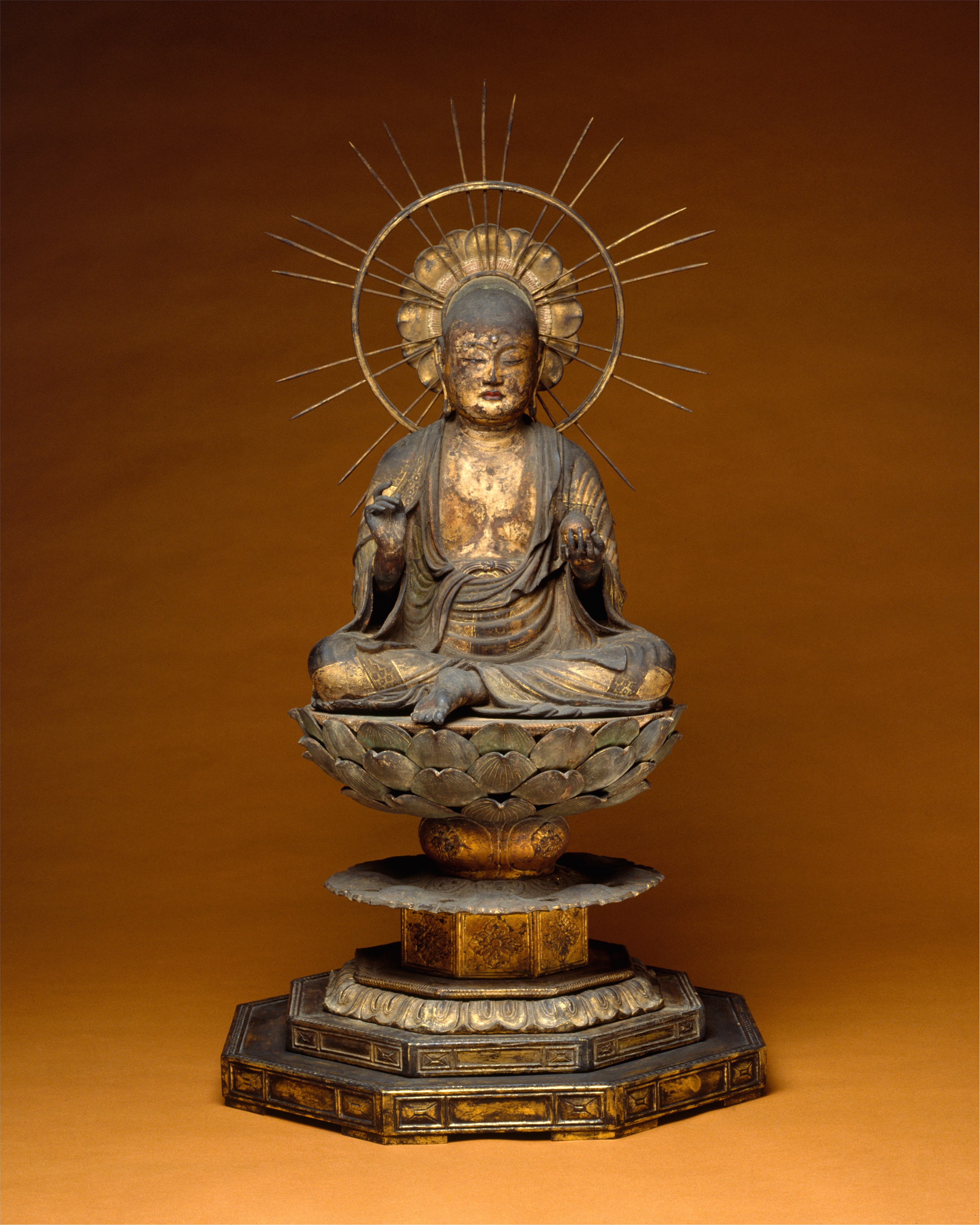
- Title
- Jizō, Bodhisattva of the Earth Store — The Metropolitan Museum of Art (acc. 1975.268.166a–d)
- Period
- Kamakura period (1185–1333), second half 13th century
- Collection
- The Metropolitan Museum of Art — Open Access
- Accession
-
1975.268.166a–d - Rights
- Public domain (Met Open Access). The Metropolitan Museum of Art, The Harry G. C. Packard Collection of Asian Art, Gift of Harry G. C. Packard, and Purchase, Fletcher, Rogers, Harris Brisbane Dick, and Louis V. Bell Funds, Joseph Pulitzer Bequest, and The Annenberg Fund Inc. Gift, 1975 (acc. 1975.268.166a–d).
Kaikei (active c. 1183–c. 1223) signed with the Buddhist name An Amida-butsu, the syllable an in Siddham, and sealed dedicatory documents inside the figures. That apparatus, not connoisseurship, secured his oeuvre and named the An’amiyō style. The Met’s anonymous Kamakura Jizō carries the style but none of the apparatus, which is what makes it the right object for reading the method.
An object with the style and none of the proof
The Metropolitan figure catalogued as Jizō, Bodhisattva of the Earth Store (acc. 1975.268.166a–d; object 42589) is a standing wooden Jizō, Japanese, Kamakura period, dated by the museum to the second half of the thirteenth century. The medium is wood with lacquer, pigment, and cut gold; the assembly is large (the lotus base alone is 61 cm wide, the halo nearly 73 cm tall) but the figure itself is small, about 49.5 cm. There is no artist name on the Met record. There is no published inscription, no recorded interior deposit, no attribution to a hand or a workshop. The museum gives a period and a medium and stops.
That blankness is the reason to put it here. This article is about how Kaikei’s oeuvre was secured: about what apparatus lets a particular thirteenth-century figure be called a Kaikei at all. The cleanest way to see the apparatus is to stand in front of a figure that has the style on its surface and none of the apparatus inside it. The Met Jizō is met best at close range, in a gallery case, at roughly chest height: small enough that the cut-gold tracery on the robe has to be looked for rather than seen across a hall, the lacquer gone dark, the head inclined a few degrees forward in the way the An’ami types incline. It looks like the thing. It cannot, on the public record, be shown to be the thing. The gap between those two sentences is the subject.
The Buddhist name as a signature
Kaikei was a Kei-school sculptor (busshi) active from about 1183, where his name appears in the postscript to a Lotus Sutra transcription associated with Unkei, to about 1223. Early in his career he signed plainly as the sculptor Kaikei. Then he took a Buddhist name, An Amida-butsu (安阿弥陀仏), and began signing instead as the artisan An Amida-butsu, writing the first syllable, an, not in kana or kanji but in Siddham, the Indic script used in Japan for sacred Sanskrit. The Japanese Wiki Corpus dates the change to the 1192 Miroku at Daigo-ji Sanbō-in and reports that he carried the An Amida-butsu inscription until 1203, when he received his first ecclesiastical rank (Japanese Wiki Corpus, “Kaikei”; specific folio/inscription transcriptions not verified against a primary cultural-property report). Onmark’s busshi study reports that the name itself came to Kaikei from the monk Chōgen, the Pure Land fundraiser who ran the Tōdai-ji reconstruction (Onmark Productions, “Kaikei Busshi”; claim level, pages N/A).
The name is not decoration. An Amida-butsu is a devotional name of the Amidist hijiri type, the kind of name a person took on entering the orbit of Pure Land practice, and Kaikei used it as his signature. From the contraction of An and Ami comes An’amiyō (安阿弥様), the An’ami style: the term art history uses for the figures that carry this signature and the manner that goes with it. The point worth holding is that the style-name is derived from the signature, not the other way round. The category exists because there was a mark to attach it to.
What the apparatus actually is
A signature on a thirteenth-century Japanese Buddhist figure is rarely a flourish on a visible surface. The Kaikei apparatus has three parts, and they reinforce each other.
- The inscription, placed where it is least seen. Kaikei’s signatures sit on the underside of the foot, in the joint where the figure meets its pedestal, or on the interior surfaces of the hollowed body: finished, hidden, structural. The placement is almost reticent: the mark is applied where the carving was last worked and where a worshipper will never look. It is a record of completion, not a display of authorship.
- The Siddham an. Writing the an in Siddham ties the maker’s mark to the sacred-script tradition and to Amida devotion specifically. It also makes the mark hard to fake casually and easy for a trained eye to read as Kaikei’s, which is part of why the corpus holds together.
- Zōnai nōnyū, what was sealed inside. Kamakura figures were routinely hollowed (the uchiguri cavity of joined-block construction) and objects were deposited in the cavity before it was closed: dedicatory texts, sutra fragments, relics, and, in the cases that matter most here, lists of the names of the people who had paid for or prayed toward the image. When such a figure is later opened, the deposit can carry a date, a patron, a dedicatory occasion, and a maker. The Japanese Wiki Corpus notes, as one instance of the evidentiary power of the practice, that a document found inside an Amida by Kaikei’s disciple Kōkai at Gokuraku-ji recorded that Kaikei was already dead by 1227, a biographical fact recovered not from a chronicle but from inside a statue (Japanese Wiki Corpus, “Kaikei”; the deposit’s full text not independently verified).
Together these make an oeuvre that is, by the standards of pre-modern sculpture, unusually secure. Kaikei is one of the very few Japanese sculptors before the early modern period of whom a substantial body of work can be assigned by documentary evidence rather than by eye. Britannica counts “20-odd extant works” and frames the An’ami manner as following directly from the An Amida-butsu name (Encyclopædia Britannica, “Kaikei”; survey level, pages N/A). The number is small, but it is anchored.
The rank progression, written into the signature
Because Kaikei kept signing, and because the form of the signature changed when his status changed, the signatures also date the work. He signed as the plain sculptor Kaikei, then as the artisan An Amida-butsu (from about 1192). In 1203, in the year of the Tōdai-ji Niō, he was awarded the ecclesiastical rank hokkyō (法橋, “bridge of the Law”); thereafter the rank enters the signature. Between 1208 and 1210 he was raised to hōgen (法眼, “eye of the Law”), the next rank up, and that too is recorded in the way he signed (Onmark Productions and Japanese Wiki Corpus concur on hokkyō 1203 and hōgen c. 1208–10; the precise hōgen year is given as a range in the secondary literature, not verified against a primary source). Neither source reports him reaching the highest rank, hō-in (法印, “seal of the Law”), which his contemporary Unkei did hold.
This is the part of the system that does the most work. A sculptor who signs, and whose signature carries his current rank, has built a relative chronology into his own corpus: a figure signed “artisan An Amida-butsu” without a rank is, on its face, before 1203; one signed “hokkyō An Amida-butsu” sits between 1203 and the hōgen elevation; one signed “hōgen” is after. The names are not only attribution; they are date-stamps. The Met Jizō, by contrast, can be placed only as “second half of the thirteenth century,” period and no further, precisely because it carries none of this.
What the An’amiyō style is, on the surface
Strip the apparatus away and there is still a manner, and it is describable. The literature is consistent on its markers, and the Met Jizō is a clean place to check them:
- Slender, ordered proportions. A tall, narrow body with little muscular swell and little sway; sloping unmuscled shoulders; the head inclined a few degrees forward rather than held level. The Japanese Wiki Corpus glosses the style as “the slim build body and the picturesquely curved robe” with an “intelligent facial expression.”
- The over-both-shoulders robe. The monastic robe worn across both shoulders (the tsūken wearing) rather than baring the right, falling in regular, shallow, closely spaced folds: an even drapery rhythm rather than the deep, agitated folds of the more vigorous Kei manner.
- Kirikane finish. Gilding applied not as flat leaf but as kirikane: hair-fine slivers of cut gold leaf laid in linear and geometric patterns over the lacquered robe, so the surface reads as patterned radiance. On the Met figure the cut gold survives as faint tracery in the fold-recesses; the programme it implies is mostly lost, which is the normal condition of these surfaces and is worth saying plainly rather than describing the figure as though it were still bright.
- A softened, drawn contour. Mōri Hisashi reads the An’ami manner as the point at which Kei-school realism is held but a new delicate, ordered grace enters: sharply but quietly carved drapery, a face built for poise rather than force. The general literature ties the softness to imported Southern Song Buddhist models (Mōri, Sculpture of the Kamakura Period, 1974, Kaikei / Kei-school chapter; no page numbers given).
All of these are present on the Met Jizō. None of them, individually or together, makes it a Kaikei. They make it An’amiyō, a figure in the manner the signature names, and the honest reading stops there.
The disagreement: is the An’ami style an aesthetic or a devotional technology?
The older and still common reading treats Kaikei as the refined court foil to Unkei’s force: the An’ami manner as an aesthetic category, a “delicate style,” Raphael to Unkei’s Michelangelo (the analogy is Onmark’s, and it is the survey default). On this reading the signature is a connoisseurial convenience and the style is the point.
Yoshiko Kainuma, in the dedicated English study of exactly this form (“Kaikei and Early Kamakura Buddhism: A Study of the An’amiyō Amida Form,” Ph.D. dissertation, UCLA, 1995; advisor Donald McCallum), argues the other way. In the abstract’s own terms, the An’amiyō Amida is not a conservative court product but an innovation answering contemporary religious and social needs, “particularly among the hijiri and common people,” and the name-lists enclosed within the figures connected them to nenbutsu practice (Kainuma 1995, abstract; only the published abstract was available, so no chapter pagination is given). On this reading the apparatus is the point: a Pure Land sculptor took an Amidist devotional name, signed with it, and sealed congregations of named devotees inside reproducible icons made for a widening lay public. The aesthetic refinement is in service of that, not the reverse.
bodhi reads with Kainuma, with a stated limit. The signature-and-deposit system is what the evidence actually shows doing the work: securing the oeuvre, dating it, and tying specific figures to named Pure Land patrons and Chōgen’s hijiri network. The “delicate style” reading is true at the level of the surface and incomplete at the level of the object. The residual uncertainty is real and worth naming: Kainuma’s social argument rests on the deposited name-lists in the documented figures, and the Met Jizō has no recovered deposit, so the social reading attaches to the type and the signed corpus, not to this object’s own history, which is blank. A future technical report on the Met figure could change what can be said about it; it cannot, on present evidence, be moved out of the anonymous penumbra and into the named core.
What the signature can and cannot do
The thing to take from Kaikei is not one beautiful figure but a method of being known. He made his religious name his maker’s mark, wrote its first syllable in sacred script, kept the mark current with his rank so that it dated the work, and let his workshop seal the names of the faithful inside the bodies of the icons. That apparatus is why the An’ami style has a name, why roughly twenty works can be called his with confidence, and why the relative chronology of his career can be read off the signatures themselves. The signature does two things at once: it secures authorship and it date-stamps the work. What it cannot do is reach across to a figure that does not carry it. The Met Jizō is one such figure — An’amiyō on every visible count, securable on none — a clean specimen of what the style produced once it had escaped the workshop that could prove its own work, the cut gold worn to a trace, the head still inclined the few degrees forward that the manner asks for.
Related
- The standing Amida in Kaikei’s An’ami style — the single-work close-read
- The Kei-school workshop genealogy — the lineage Kaikei signs into
- The Unkei attribution problem — the documented-core method beside Kaikei’s
- Gyokugan — the crystal-eye technique of the same workshops
- Tōdai-ji Niō (1203) — Kaikei alongside Unkei
- Kaikei (entity)
- Jizō (entity)
- Kei school (entity)
- An’ami style (entity)
- Kirikane (entity)
Sources
-
[1]— The Metropolitan Museum of Art — Open Access collectionapi.metmuseum.org/public/collection/v1/objects/42589 -
[5]— Penn State Libraries Open Publishing / UCLA openpublishing.psu.edu/ahd/content/kaikei-and-early-kamakura…