Gyokugan: the crystal eyes that changed the Kamakura icon
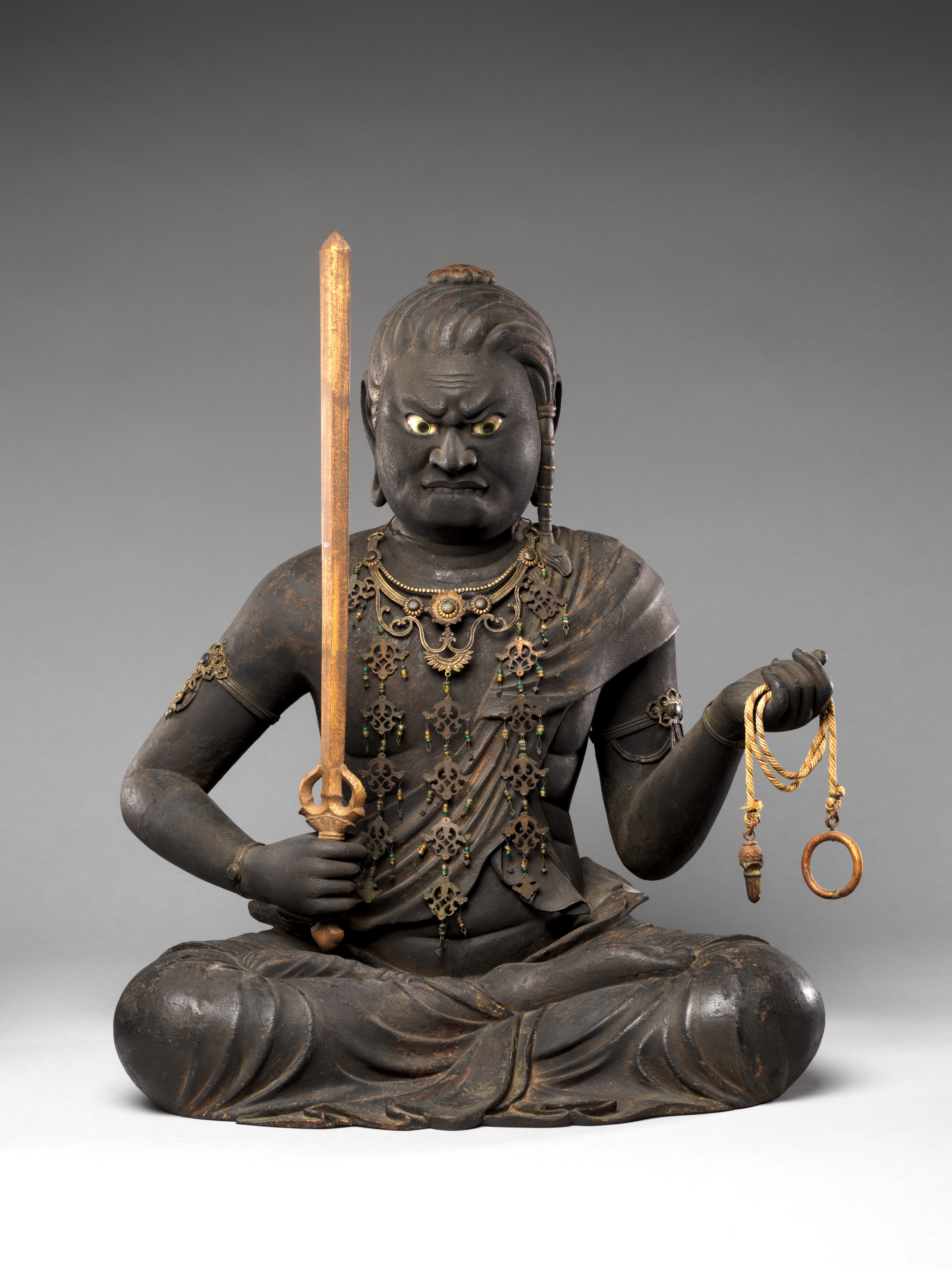
- Title
- Fudō Myōō, the Immovable Wisdom King (Achala Vidyaraja) — Metropolitan Museum of Art (acc. 2015.300.252a, b)
- Period
- Kamakura period (1185–1333), early 13th century
- Region
- Japan
- Medium
- Japanese cypress (hinoki) with lacquer, color, gold, cut gold leaf (kirikane), and inlaid crystal eyes
- Collection
- The Metropolitan Museum of Art — Open Access
- Accession
-
2015.300.252a, b - Rights
- CC0 1.0 (public domain). The Metropolitan Museum of Art, Mary Griggs Burke Collection, Gift of the Mary and Jackson Burke Foundation, 2015 (acc. 2015.300.252a, b). Met Open Access; public-domain status re-confirmed via the Met Collection API on 2026-05-16.
53.3 cm seated figure, hinoki, attributed by the Met to Kaikei of the Kei school. Read here not for its attribution but as the vehicle for a single technique: the inset crystal eye.
Gyokugan is the inset rock-crystal eye: a polished crystal lens, iris and pupil painted on the back, faced with white paper or silk, pinned from inside the hollow head with a bamboo peg. It appears by 1151 and becomes the Kei-school standard after Unkei’s 1176 Enjō-ji Dainichi, turning a carved gaze into one that catches the light. Read here on the Met’s Kei-school Fudō.
What the eye is
Stand close to the Met’s seated Fudō Myōō and the rest of the figure recedes. The carving is competent Kei-school work (taut shoulders, a fang biting the lower lip, the braided sidelock that marks the type), but the part that holds is the eyes. They are not carved. They are two discs of polished rock crystal set into the wood, lit from within the lens so that the white reads as wet rather than painted. In a dim hall this is the only part of the figure that moves when the viewer does.
That is the whole subject of this article. Not Fudō, not Kaikei, not the Kei school’s rise; those have their own pieces on bodhi. Gyokugan (玉眼, “jewel eye”) is one technique: a transparent crystal lens, shaped and polished, with the iris and pupil painted on its inner face, backed with white paper or silk for the sclera, and held in the head from behind. The Met Fudō is here because it is a cleared, public-domain Kamakura figure on which the technique can actually be read, not because the article is about it.
The contrast that defines gyokugan is with what came before. Heian wood icons have chōgan: eyes carved directly into the block and then painted, the iris and pupil rendered in pigment on a convex wood surface. A separate, older import existed too. Hitomi-kan’nyū, a continental technique using inset black stones applied from the front, was known in Japan from the Nara period but never went widespread. Gyokugan is neither. It is transparent, it is inserted from inside, and JAANUS treats it as a distinctively Japanese development that becomes possible only once the head is routinely hollow.1 The carved eye is read. The crystal eye is lit.
How it is made
The construction is exact and the same wherever it is documented.12 The head of a Kamakura figure is already hollow, the consequence of yosegi-zukuri, the joined-block method in which the head is split, the interior adzed out (uchiguri), and the shell reassembled. Gyokugan depends on that hollow. There is nowhere to fix a lens from behind unless the head opens.
The sequence runs as follows. A thin disc of rock crystal is ground to a shallow lens, its outer face convex like a real cornea. On the back of that lens the iris and pupil are painted in reverse, sometimes with the red inner canthus and fine vessels added at the corners. Behind the painted layer goes a backing of white paper or, in finer work, white silk floss, which supplies the sclera and throws light forward through the crystal. The eye-opening has been cut through the front of the hollowed head from the inside. The finished lens assembly is pressed into that opening from within the cavity, and a shaped wooden retaining block is set behind it and fixed with a bamboo pin (takekugi) driven into the surrounding wood. Lacquer-and-sawdust paste seals the seam. The figure’s head is then closed.
Two things follow from this. First, gyokugan is not a finishing touch added to the surface; it is structural, decided when the head is opened and unreachable once it is shut. Second, it is specialist work. By the early Kamakura period the name of the crystal-eye craftsman is sometimes recorded in dedicatory inscriptions alongside the busshi responsible for the whole figure, a division of labor that tells you the lens-grinding and reverse-painting were a distinct competence, not something every carver did.1 The eye is the one component of a Kamakura icon that the lead sculptor might not have made with his own hands.
When it appears
The earliest dated extant example is fixed. The Amida triad at Chōgaku-ji in Nara, with a recorded date of 1151, carries gyokugan and is the standard terminus from which the technique is counted.1 The figures sit at the very end of the late Heian period; the maker is not securely named, with the Chōgaku-ji group sometimes associated with the Nara busshi line around Kōjo, but the date is the anchor and the attribution is not load-bearing here.
What matters for the Kamakura story is the gap between 1151 and general adoption. For roughly a generation gyokugan is occasional. It becomes a standard with the Kei school, and the hinge work is Unkei’s seated Dainichi Nyorai at Enjō-ji in Nara, begun 1175 and completed 1176 on the evidence of its own pedestal inscription, Unkei’s earliest securely documented work.34 The Enjō-ji Dainichi has gyokugan, set into the open sockets from inside and held with bamboo pins. From the Kei school’s ascendancy after the Minamoto victory of 1185, the crystal eye is no longer an experiment; it is what a serious Kamakura figure has. Mōri reads the whole Kei program (the return to Nara-period solidity, the muscular naturalism, the rejection of late-Heian Jōchō-school smoothness) as a single push toward corporeal presence, and the crystal eye is the part of that push that operates on the viewer rather than on the silhouette.5
So the chronology is not “Kamakura invented crystal eyes.” It is narrower and more interesting: the technique exists by 1151, sits underused for a generation, and is then made canonical by one workshop because that workshop’s entire argument was about presence, and the crystal eye is the cheapest, most direct instrument of presence available in wood.
What it does to the icon
The reason the Kei school adopted gyokugan is visible the moment the lighting is right, and it is the reason this article exists. A carved-and-painted eye has a fixed highlight: the painter decides where the catch-light sits and it stays there from every angle, under every lamp. A crystal eye has no fixed highlight. The lens is a real refracting surface, so the bright point shifts as the viewer moves and as a flame moves. In a dark hall lit by oil lamps or candles, the only condition in which these figures were ever meant to be seen, the eyes alone track. The Covaci catalogue puts it plainly: crystal eyes “would strike viewers as alive when seen in dim temple interiors, lit by flickering candlelight.”4
This is not decoration and it is not, in the period’s own terms, illusionism for its own sake. Nedachi Kensuke’s work on the “living image” frames the Kamakura push toward realism as the production of icons understood to be animate: not depictions of a buddha but a present one, capable of interacting with the devotee.4 Read in that frame, gyokugan is the most economical possible move. It does not add a limb or a halo or an inscription; it adds the one feature by which humans involuntarily decide whether a face is looking back. The Met Fudō is a useful test case precisely because Fudō Myōō is a wrathful figure whose entire iconographic job is to fix and not release the practitioner with his stare. On a chōgan Fudō the glare is a painted convention. On this figure the glare is optically real: the crystal catches the room. The wrath is no longer asserted by the carving — it is delivered by the eye.
It is worth being precise about the limit of the claim. The crystal does not make the figure lifelike in any general sense; the proportions, the formalized flame-hair, the frozen mudra are all conventional and untouched by the technique. Gyokugan is local. It works on one square centimeter of each side of the face and nowhere else. That locality is the point — the Kei school found that presence could be installed at a single site rather than diffused across the whole figure, and they installed it at the site the human eye cannot ignore.
Reading it on the Met figure, honestly
The figure used here is the Metropolitan Museum’s seated Fudō Myōō, accession 2015.300.252a, b, Japanese cypress with lacquer, color, gold, cut gold leaf, and inlaid crystal eyes, 53.3 cm high, Kamakura period, attributed by the Met to Kaikei.6 It is Public Domain under Met Open Access, re-confirmed via the museum’s collection API. Three honest qualifications belong on the record.
First, this is a comparandum, not a fresh hero. The same Met Fudō appears as a comparative object in bodhi’s close reading of the Heian Fudō Met 44842, where it serves the Kaikei-attribution discussion. It is brought forward here for a different and narrower purpose, to carry the gyokugan technique, and it is not the hero of any existing article. That reuse is stated openly rather than disguised.
Second, the Kaikei attribution is the Met’s, and the museum’s own catalog text hedges it: Kaikei ran a large workshop, and the figure has been discussed in relation to a Kaikei-signed Fudō dated 1203 at Sanbōin, the Daigo-ji sub-temple, with the disciple Shinkai named as a workshop alternative. None of that matters to the eye. The crystal lens is a Kei-workshop product whether the hand on the body is Kaikei’s or an assistant’s, and the article’s argument does not rest on the attribution. Where bodhi commits is narrow: the eyes on this figure are gyokugan of the standard Kamakura construction, and they do the work this article describes. The residual uncertainty (which hand, which workshop year, whether the present crystals are original to circa 1200 or a later re-set) is real and is not closed here; museum condition reports, not the open record, would settle it.
Third, the observations in this article are made from the Met’s high-resolution Open Access image and the museum’s catalog data, not from handling the figure. The hollow head, the bamboo pin, the reverse-painted iris, the paper backing: none of those is visible from the front. They are described from JAANUS and the consistent technical literature, which agree on the construction, and they are stated as the documented method rather than as something observed on this specific cavity. The seam where the head closes, if it survives, is on the back of the skull and is not legible in the front view. That gap is named, not papered over.
What can be said from the object itself is the part that matters: at conversational distance the crystal eyes are the brightest thing on a dark, late-lacquered figure, and they are the only part of it that changes as the viewer moves. That is gyokugan working, eight centuries on, in a museum case under even gallery light, which is far less kind to the technique than the flame it was designed for.
Related
- The Kei school as a genealogy — the workshop that made gyokugan standard
- Yosegi-zukuri — the hollow head gyokugan depends on
- Met 44842 — the Heian Fudō, where this Kei Fudō is the comparandum
- Gyokugan (entity)
- Yosegi-zukuri (entity)
- Kei school (entity)
- Unkei (entity)
- Kaikei (entity)
Footnotes
-
JAANUS, “gyokugan (玉眼),” aisf.or.jp/~jaanus (accessed 2026-05-16): transparent crystal lenses painted with pupils on the reverse, backed with white paper or cotton, fixed in perforated sockets of a hollowed head with wood pieces and bamboo pegs; the Chōgaku-ji Amida triad of 1151 is named as the earliest dated extant example; the older imported hitomi-kan’nyū (external inset black stones, Nara-period) is distinguished from gyokugan; early-Kamakura inscriptions sometimes record the crystal-eye craftsman separately from the busshi. Page-level pinning N/A (single web reference entry); claim-level citation. ↩ ↩2 ↩3 ↩4
-
Carving the Divine, “11. Gyokugan: The Windows to the Soul” (accessed 2026-05-16): construction sequence (crystal lens, reverse-painted iris/pupil, paper backing, wooden retaining piece with peg, uchiguri hollowed head); the contrast with chōgan (eyes carved into the block and painted); the technique “made more famous by the Kei school about 30 years later” than 1151. Secondary practitioner source corroborating JAANUS on construction; not used for any dating claim beyond what JAANUS independently supports. ↩
-
Enjō-ji seated Dainichi Nyorai, attributed to Unkei, pedestal inscription recording commencement 1175 and completion 1176, treated as Unkei’s earliest securely documented work; the figure carries gyokugan set from inside the sockets and held with bamboo pins (accessed 2026-05-16). Cited for the dated-work anchor; the inscription itself is reported via secondary literature, not transcribed here. ↩
-
Ive Covaci (ed.), Kamakura: Realism and Spirituality in the Sculpture of Japan (Asia Society Museum / Yale University Press, 2016), with essays by Samuel C. Morse (the Kei school after 1185), Nedachi Kensuke (the “living image” / replicas of miraculous statues), and D. Max Moerman; specific claim borrowed: crystal eyes register as alive in dim, flame-lit temple interiors, and Kamakura realism aimed at the animate icon rather than the lifelike depiction. Cited at chapter/argument level via the review record; specific page numbers not verified against the print catalogue. ↩ ↩2 ↩3
-
Mōri Hisashi, Sculpture of the Kamakura Period (Heibonsha / Weatherhill, 1974); specific claim borrowed: the Kei-school program (Nara-period solidity, muscular naturalism, rejection of late-Heian Jōchō smoothness) reads as a single drive toward corporeal presence, of which the crystal eye is the component acting on the viewer. Cited at argument level; page numbers not verified against the print volume. ↩
-
The Metropolitan Museum of Art, “Fudō Myōō, the Immovable Wisdom King (Achala Vidyaraja),” acc. 2015.300.252a, b, object 53176: Japan, Kamakura period, early 13th century; Japanese cypress with lacquer, color, gold, cut gold leaf (kirikane), and inlaid crystal eyes; H. 53.3 cm; Mary Griggs Burke Collection, Gift of the Mary and Jackson Burke Foundation, 2015; public-domain status re-confirmed via the Met Collection API 2026-05-16. The Kaikei attribution and the Sanbōin-1203 / Shinkai workshop hedge are the museum’s catalog text (HTML 429 on 2026-05-16; attribution and hedge cross-confirmed against bodhi’s existing met-44842 reading, which records the same catalog language); object data above are API-authoritative. ↩