How bodhi reads an image
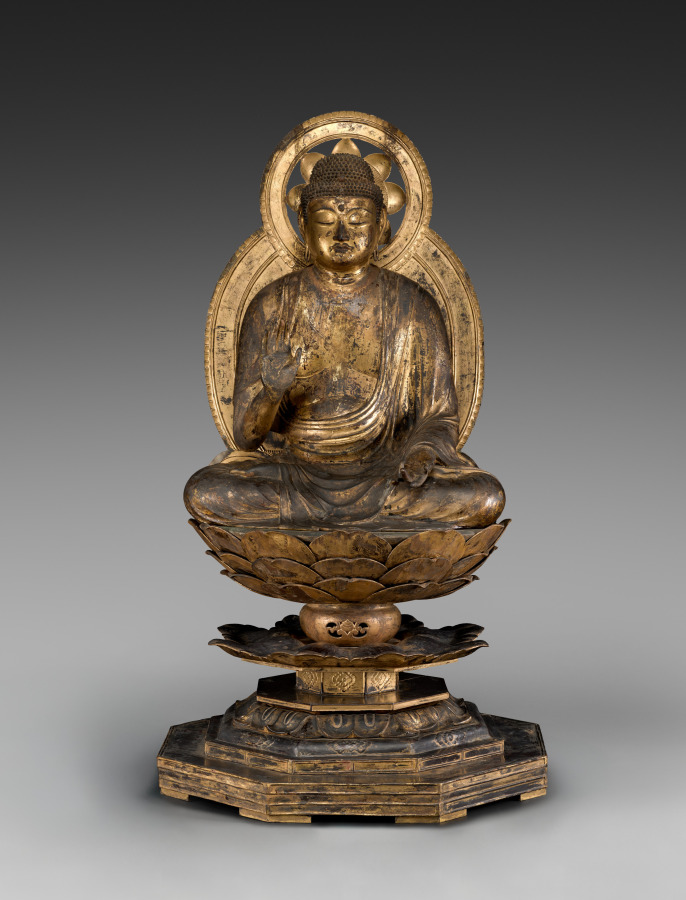
- Title
- Seated Buddha
- Period
- Heian period (794–1185), 12th century
- Region
- Japan
- Medium
- Gilded wood
- Collection
- Cleveland Museum of Art
- Accession
-
1973.85 - Rights
- Cleveland Museum of Art (CC0). Gift of Takako Setsu and her husband, Iwao, in memory of her father-in-law, Inosuke Setsu, and his long friendship with Sherman E. Lee.
Provenance: from a sub-temple of Kōfuku-ji in Nara; a 1906 photograph at Kōfuku-ji shows the figure without halo or left hand. Cleveland's catalog hedges the identification: abhaya right hand + lotus-position-with-exposed-left-foot is consistent with Yakushi (Medicine Buddha) or Shakyamuni; the replacement left hand has lost the diagnostic. Used here as a methodological exhibit, not as the subject of an iconographic argument.
A short methodological piece: useful as a reading frame for the rest of the site, and as a statement of what bodhi will not do.
The four registers
Every bodhi article tries to read its image at four levels:
- Iconography: what is depicted, by canonical name, with the conventional attributes located. (This is Byakue Kannon. The white robe and the single ink-circle halo behind the head are the diagnostics. Compare Suigetsu Kannon, who looks down at the moon’s reflection.)
- Materials and technique: how it is made, in workshop terms. (Yosegi-zukuri joined-block construction. Cypress core, lacquer ground, gold leaf with kirikane along the robe edges. Rock-crystal inlaid eyes (gyokugan), a Kamakura innovation.)
- Transmission history: where the type came from and how it changed. (The half-lotus contemplative posture is Northern Wei Chinese, transmitted through Three Kingdoms Korea (especially Paekche) to the Asuka workshops in the late 6th century.)
- Provenance: collection, accession number, rights status, image source. Every image on the site carries a metadata block. No image without sourcing.
What the site refuses
Three things, deliberately:
- Connoisseurship without sources. Statements like “the work exhibits a serene Buddhist sensibility” are common in English-language Buddhist art writing and mean nothing. bodhi articles try to anchor every iconographic claim in a named primary source (a sutra, a workshop document, a temple register) or a named secondary scholar (Mori Hisashi, Donald McCallum, Ten Grotenhuis, Yukio Lippit). If a claim cannot be sourced, it is not made.
- Mystification without referent. The Western Buddhist art literature has a long, embarrassing tradition of calling Buddhist images “transcendent” or “ineffable” in lieu of saying what the image is. The images are not ineffable. They have names, attributes, doctrinal positions, workshop techniques, and dates. bodhi names them.
- Decorative writing about non-decorative objects. A Buddhist image was made for ritual use: installation in a temple, consecration, reception of offerings, deathbed companionship. Writing about it as if it were pure visual culture (a “design object,” a “beautiful artifact”) misses what the object was for. bodhi tries to keep the ritual function in view, even when the image is now in a museum case.
What is left
What is left, after those refusals, is iconographic reading grounded in workshop technique and primary sources. It is a narrower way of writing about Buddhist art than the typical museum catalogue. It is also, the site believes, more useful: for artists, scholars, conservators, collectors, and curious readers who want to actually see what they are looking at.
On the rights line
Every image on bodhi includes its institutional rights line. The site uses three categories:
- Public domain / CC0 (Met Open Access, Cleveland Open Access, Wikimedia PD-art): used freely, attributed to source.
- Permissive editorial use (ColBase, e-Museum): used under the institution’s stated terms, attribution and link required.
- Cleared by request (loaned individual permissions): used per granted scope.
The site launched with a tranche of articles in which some images
were still flagged as uncleared in their frontmatter. Clearance is
proceeding article-by-article as each is revised; once an
article’s image is cleared, it lives at
/public/images/cleared/<institution>/<accession>-<descriptor>.jpg
with a complete rights-line in frontmatter and is deployed to the
public site.
Sources
-
Foundational distinction between *iconography* and *iconology* still organizes how bodhi reads images
-
[3]— Robert Sharf, On the Allure of Buddhist Relics in Representations 66 (1999): 75–99 print referenceOn the difference between describing a religious object and ventriloquizing it