Kyōzō: the incised Buddhist mirror, read through a Bishamonten
- Title
- Bishamonten Ritual Mirror (毘沙門天鏡像)
- Period
- Japan, Heian period (794–1185), 11th–12th c.
- Region
- Japan
- Medium
- Silvered bronze with incised (kebori) design; cast disc mirror
- Dimensions
- Diameter 15.3 cm (6 in.)
- Collection
- Cleveland Museum of Art
- Accession
-
1977.32 - Rights
- Bishamonten Ritual Mirror (毘沙門天鏡像), Japan, Heian period, 11th–12th c., silvered bronze with incised design, Cleveland Museum of Art, accession 1977.32. CC0 (Cleveland Open Access).
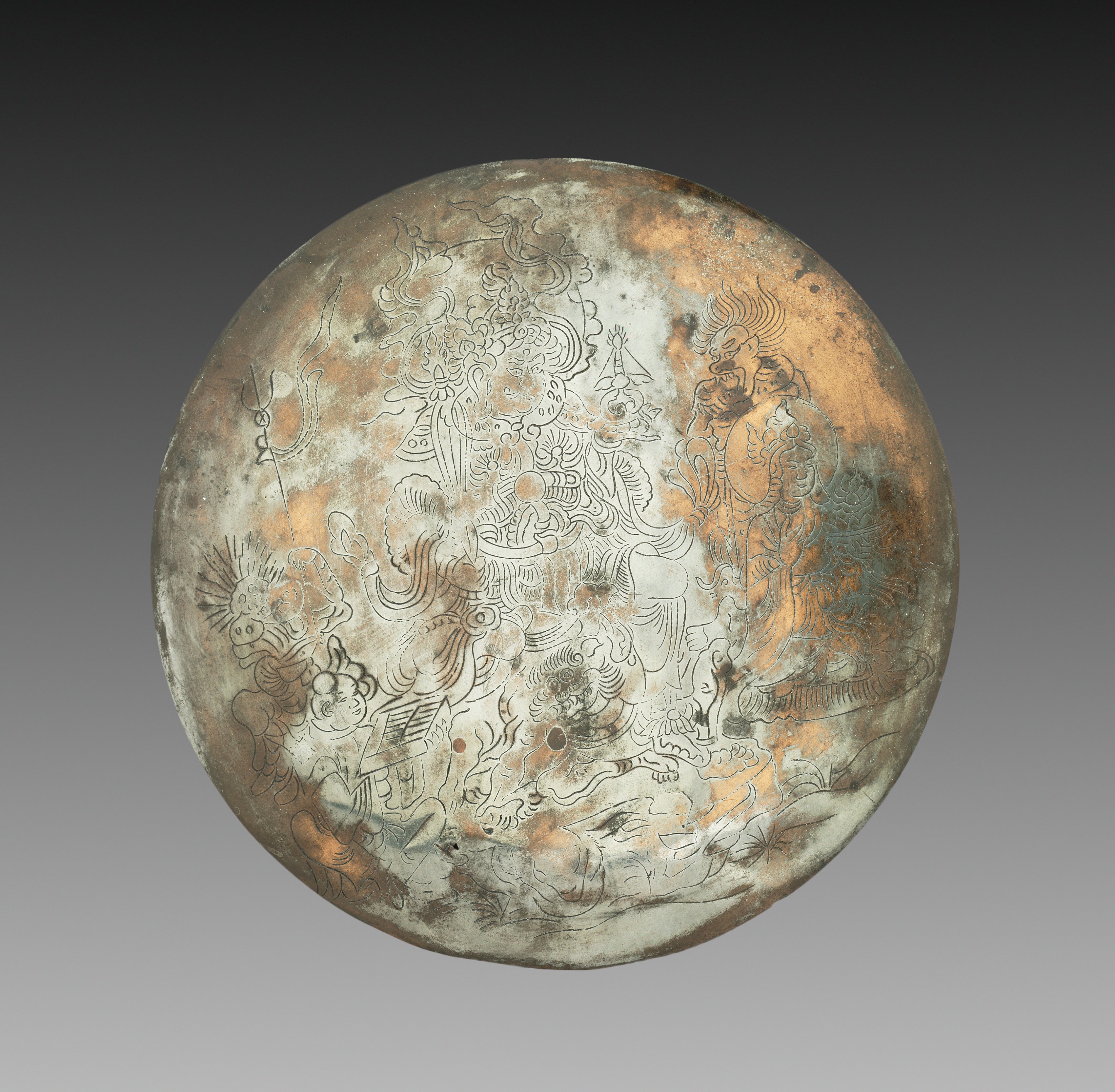
The Cleveland Bishamonten kyōzō (1977.32), diameter 15.3 cm. Bishamonten engraved in kebori line on the mirror's reflecting face, an entourage around him, a demon twisting beneath his feet. Heian, 11th–12th c. CC0.
A kyōzō is a cast bronze mirror with a Buddhist deity line-engraved on its reflecting face. The Cleveland Bishamonten mirror (1977.32, Heian, 11th–12th c.) shows the technique at its sharpest, and is the cleanest object on which to fix the kyōzō / mishōtai / kakebotoke distinction that most writing on these objects blurs.
What a kyōzō is
A kyōzō (鏡像, “mirror-image”) is a finished bronze mirror with a Buddhist figure incised on the side that was meant to reflect. The technique is the whole object: a deity drawn in line, not cast in relief, onto a surface already polished to throw back a face. The Cleveland Museum of Art holds one of the sharpest surviving examples, accession 1977.32, a Bishamonten engraved on a silvered bronze disc 15.3 cm across, dated by the museum to the 11th–12th century.1
Three Japanese terms attach to objects in this family, and the distinction is the reason this article exists. Kyōzō is the engraved or painted mirror itself: a deity worked onto a mirror’s reflecting face. Mishōtai (御正体, “honorable true form”) names the same kind of object by its function: the kami’s true form revealed, the Buddhist deity disclosed as what the native god actually is. The word describes a role, not a manufacture. Kakebotoke (懸仏, “hanging buddha”) is the later, three-dimensional descendant, a disc carrying a deity in cast or repoussé relief rather than in line, hung before an altar or a shrine. The Tokyo National Museum states the progression plainly: incised mirror images become gradually more three-dimensional across the Heian period, and the kakebotoke becomes the dominant form from the Kamakura period onward.2 A kyōzō can be a mishōtai when it is used as one; a kakebotoke is a different object reached at the end of that development.
The Cleveland disc is a kyōzō and not yet a kakebotoke. Nothing on it is raised. The figure is held entirely in the cut line, and the surface behind the line is still the mirror.
How the technique works
The blank is a standard cast bronze mirror. The Cleveland record specifies silvered bronze, which is the expected late-Heian recipe: a high-tin bronze given a bright reflecting face. The engraving is kebori, hairline incision: a chased line drawn into the finished metal with a graver, the same family of technique used on sword fittings and sutra-box lids. The line does not displace metal into a ridge the way repoussé does. It removes a thread of it. Read against the light, a kebori figure on a mirror is a drawing that catches a shadow where the polished ground does not.
That is the constraint the technique imposes and the reason these objects reward looking. The engraver had one value, line on a mirror, and no modeling, no relief, no color in the metal itself. Bishamonten’s armour on the Cleveland disc is built from lamellar hatching; the halberd is a single confident stroke with the blade opened in two; the entourage is compressed into the field around the central figure with the economy of someone working a small circular plate and unwilling to crowd the god. The most telling passage is at the bottom. The Cleveland catalog notes, in a separate line from its main description, that Bishamonten “sits on a demon who struggles beneath his weight.”1 On the disc the demon is not a footnote creature. It is twisted, one shoulder driven down, the whole small body torqued under the standing god. The engraver spent line on a figure most of the iconography would let him abbreviate, and the torsion is the one place the flat technique is made to carry weight.
A second technical fact decides how a kyōzō was seen. The image is on the reflecting side. The decorated back of a Japanese bronze mirror is the side the metalworker normally treats; here the maker has gone to the face. An object built to return a viewer’s reflection has had a deity cut into the exact surface where the reflection would form. The image and the mirror occupy one plane. Christine Guth Kanda’s study of Japanese kami imagery from the ninth through the fourteenth centuries reads this class of object within the larger development of shinzō, the visualized form given to native deities under Buddhist influence;3 the mirror-icon is one of the surfaces on which that development is legible, because the mirror was already the kami’s vessel before anything was cut into it.
When the form appears and why
The kyōzō belongs to the late Heian period and to a specific religious situation. The Cleveland mirror’s 11th–12th-century dating places it in the centuries when honji-suijaku thought, the doctrine that the native kami are local traces of buddhas and bodhisattvas, was hardening into the standard frame for the relationship between the two religious systems. The mirror was the obvious object for that doctrine to be worked out on, because the mirror was already a kami’s body: a shrine’s shintai, the thing the god was present in. Incising a Buddhist deity onto the kami’s mirror is the doctrine made into an object. The Cleveland catalog gives both readings current in the scholarship and commits to neither: one, that kyōzō arose with combinatory Shinto-Buddhist thought, sacred kami-mirrors coming to be engraved with the Buddhist deities held to be their true ground; the other, that they developed inside Esoteric Buddhist ritual practice.1
The disagreement is real and worth stating cleanly rather than splitting. The honji-suijaku reading makes the kyōzō a shrine object: the kami’s mirror disclosing the Buddhist honji behind the god. The Esoteric-ritual reading makes it a temple object, a mirror used as a contemplative support or an installed icon within Mikkyō practice, where the bright reflecting disc has its own meanings independent of any shrine. The two are not exclusive: late-Heian religious practice ran the shrine-temple complex as one institution, and an engraved mirror could move between an altar and a shrine. bodhi’s reading follows the museum in not forcing the choice, but the object itself tilts the question. A Bishamonten, a Buddhist guardian deva, one of the Four Heavenly Kings, is not a figure with a strong single kami pairing in the standard honji-suijaku tables, and is a more natural subject for a ritual or devotional mirror than for a specific shrine’s true-form disclosure. The residual uncertainty is which institution this particular disc served, and the engraving does not record it.
What the period frame does establish is direction of travel. The kyōzō is the early, two-dimensional member of a sequence. Through the Heian period the engraved line gives way to low relief, and by the Kamakura period the kakebotoke, the disc with a figure raised off it, fitted with a suspension loop and hung, has taken over the function. The Cleveland Bishamonten sits near the start of that line, where the whole image is still carried by incision on a working mirror.
Representative works
The kyōzō and its kakebotoke descendants survive across Japanese temple and shrine holdings and in a small number of Western museum collections that acquired them as metalwork. A short comparative set fixes the type.
| Object | Collection | Date | Form | What it shows |
|---|---|---|---|---|
| Bishamonten Ritual Mirror, acc. 1977.32 | Cleveland Museum of Art | Heian, 11th–12th c. | Kyōzō (incised mirror) | Bishamonten in armour with entourage; demon beneath his feet |
| Votive Mirror with Eleven-Headed Kannon, acc. 1975.268.157 | The Metropolitan Museum of Art | 12th c. | Kyōzō (incised mirror) | Jūichimen Kannon on a lotus, holding a hanging rosary |
| Votive Plaque (Kakebotoke), acc. 1985.12 | The Metropolitan Museum of Art | 12th c. | Transitional plaque | Bronze plaque, relief deity; the form moving off the flat |
| Mirror with Image of Jūichimen Kannon (Important Cultural Property) | Tokyo National Museum | Heian, dated 1159 | Kyōzō, dated | Eleven-headed Kannon; a firmly dated point in the sequence |
Sherry Fowler’s study of the Six Kannon cult tracks the same mirror-and-plaque category across the Kannon corpus, where incised mirrors and hung kakebotoke recur as a recognized devotional object-type rather than a marginal curiosity;4 the Eleven-Headed Kannon disc sits inside that documented Kannon material. The Met’s Eleven-Headed Kannon mirror is the most useful direct comparandum. The Met catalog dates it to the 12th century and reads it as a kyōzō whose incised Kannon “merges visual and symbolic attributes of both Shinto and Buddhist religions,” sitting on a lotus and holding a hanging rosary.5 Set beside the Cleveland Bishamonten, it shows the range the technique covered with one tool: a seated, attribute-laden bodhisattva treated with the same hairline economy as a standing armoured guardian, both worked on a disc small enough to hold in two hands. The Tokyo National Museum’s dated 1159 Jūichimen Kannon mirror anchors the same form to a fixed year and to Important Cultural Property status, which is why it functions as the calibration object for everything in the corpus that is dated only by style.2
Why the distinction matters
Most general writing on these objects uses kakebotoke as a catch-all and lets the engraved mirror disappear into it. That collapses a fifty-to-a-hundred-year technical development into a single label and loses what the Cleveland disc is for. The kyōzō is the moment the image is still inside the mirror: line on a reflecting face, nothing raised, the deity and the viewer’s vanished reflection sharing one plane of metal. The kakebotoke is the moment the image has come off the surface and is hung in front of an altar as a thing in its own right. Between them is the whole question of how a Japanese devotional object stopped being a mirror that carried a god and became a god-disc that no longer reflected anything.
Donald McCallum’s study of the Zenkōji Amida and its replications treats medieval Japanese gilt and cast bronze as a tradition of icons that proliferate by being copied;6 the mirror-icon belongs at the early, intimate end of that same metalworking culture, before the devotional disc industrialized into the hung relief. The Cleveland Bishamonten is small, undramatic in its materials, and almost entirely carried by a single cut line and one twisted demon. It is also the clearest object on which to see why three Japanese words are needed where English keeps reaching for one.
Zenkōji and Its Icon_ | book | Princeton University Press, 1994; medieval gilt/cast-bronze icon tradition |
Related
- Keman: the openwork gilt-bronze altar pendant
- Kanshitsu: the Tenpyō dry-lacquer technique
- Yosegi-zukuri: the joined-block construction
- Bishamonten (entity)
- Honji-suijaku (entity)
- Kyōzō (entity)
- Kebori, hairline incision (entity)
Footnotes
Sources
-
Standard study of the stylistic and iconographic development of Japanese kami imagery 9th–14th c.; the framing reference for the kami-mirror / honji-suijaku context. Cited at work level; page numbers not verified.
-
Treats kakebotoke and incised-mirror imagery within the Six Kannon corpus; cited for the mirror-form devotional object as a category. Cited at work level; page numbers not verified.
-
Cited for gilt/cast-bronze devotional metalwork as a medieval Japanese icon tradition; comparandum framing, not the mirror corpus directly. Cited at work level; page numbers not verified.