The Besson zakki and the zuzō-shō compendium tradition
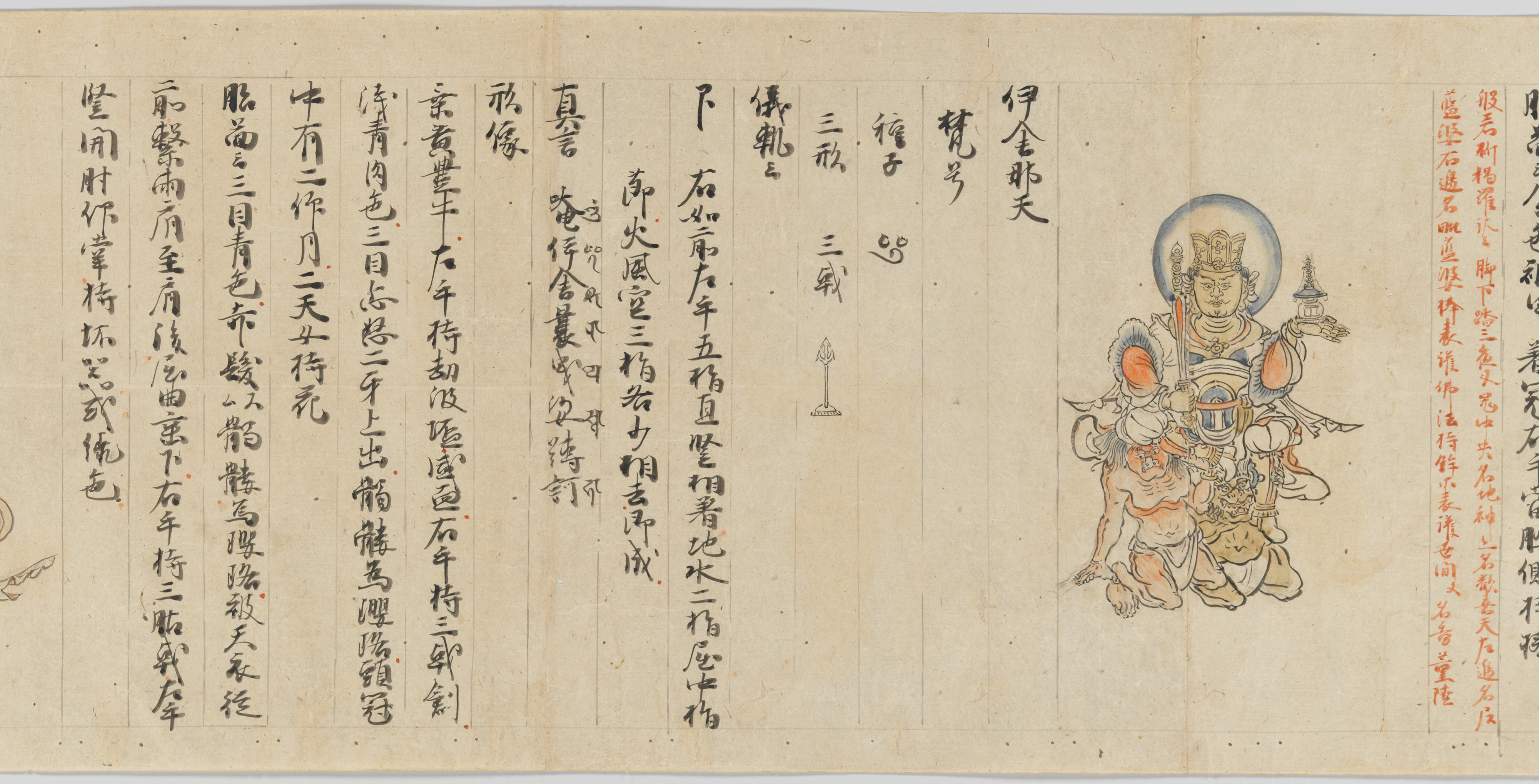
- Title
- Scroll 9 of Collected Iconography (Zuzōshō): Ten (Devas)
- Period
- Kamakura period (1185–1333), 13th century
- Region
- Japan
- Medium
- Handscroll; ink and color on paper
- Dimensions
- 30.5 × 1623.3 cm (12 in. × 53 ft. 3 1/8 in.)
- Collection
- The Metropolitan Museum of Art
- Accession
-
1975.268.7 - Rights
- Public domain (CC0, Met Open Access). The Metropolitan Museum of Art, The Harry G. C. Packard Collection of Asian Art, Gift of Harry G. C. Packard, and Purchase, Fletcher, Rogers, Harris Brisbane Dick, and Louis V. Bell Funds, Joseph Pulitzer Bequest, and The Annenberg Fund Inc. Gift, 1975; accession 1975.268.7; object 45615. Public-domain status confirmed via the Met Collection API 2026-05-16.
Met 1975.268.7 — Scroll 9 of the Zuzōshō, the Ten (devas) section, Kamakura 13th c., 30.5 × 1623.3 cm. A sibling object in the same zuzō-shō compendium tradition as Shinkaku's Besson zakki; used here as the legible vehicle because no openly licensed image of a Besson zakki volume is available. Met Open Access (CC0).
The Besson zakki (別尊雑記), compiled by the monk Shinkaku (1117–1180), is a late-Heian esoteric iconographic compendium. It belongs to the zuzō-shō genre that transmitted Mikkyō iconography as a documentary corpus for ritual fidelity. No openly licensed image of a Besson zakki volume is available, so it is read here through the Met’s CC0 Zuzōshō scroll, a sibling object the Besson zakki itself cites.
What the Besson zakki is, and what stands in for it here
The Besson zakki, whose title parses as “miscellaneous records (zakki) of the separate honored ones (besson),” is a fifty-to-fifty-seven-chapter compendium of esoteric Buddhist iconography compiled by the painter-priest Shinkaku (1117–1180) during the Jōan era, between 1171 and 1175.1 It is not a picture book. It is a deity-by-deity reference apparatus: for each besson (an individually venerated honored one set up as the focus of a discrete rite), Shinkaku gathered the iconographic prescription, the mudrās, the mantras and seed-syllables, the altar diagram, and the textual authorities, with the oral commentary of his lineage interlined. The JAANUS lexicon counts 309 illustrations in the surviving structure, sorted into Shinkaku’s own divisions: six chapters on nyorai (buddhas), three on butchō, seven on sutras, eight on Kannon, seven on bosatsu, eight on the wrathful deities, and eight on the heavenly beings.1
No openly licensed image of a Besson zakki volume is available. The Met and Cleveland CC0 corpora do not include a Besson zakki leaf; Harvard holds Besson zakki volumes, but their rights status is unconfirmed and no Harvard image is used here.2 The vehicle for the reading is therefore a sibling object in the same genre: the Metropolitan Museum’s Zuzōshō scroll, accession 1975.268.7 (object 45615), the ninth scroll of the Collected Iconography, the Ten (devas) section, Kamakura 13th century, ink and color on paper.3 The Zuzōshō is the older and more basic of the two compendia, and the Besson zakki cites it by name as one of its sources.1 Reading the genre off a Zuzōshō scroll is reading the Besson zakki’s documentary world through its own cited authority: a proxy, stated here and again at the close, but a true one rather than a substitute.
What was transmitted, and why it had to be written down
Esoteric Buddhism (Mikkyō) entered Japan in the early ninth century with Kūkai’s and Saichō’s returns from Tang China, and it arrived as a problem of accuracy. A rite is efficacious, in the doctrinal logic, only if it is performed correctly: the deity invoked must be the right deity, summoned with the right mudrā, the right mantra, the right altar arrangement, in the right sequence. A misremembered attribute is not a stylistic variant; it is, in the tradition’s own terms, a failed rite. Kūkai understood this and brought back from China not only translated texts but iconographic sketches to perform the rituals from; the Cleveland zuzō for the Benevolent Kings Sutra mandala notes the same point in its own catalogue, that Kūkai returned with “Buddhist iconographic sketches to perform the rituals.”4
What had to be transmitted, then, was not a doctrine that could survive paraphrase but a body of exact specification, the kind of knowledge that degrades with every uncontrolled copy. The five scroll-sets of copies after Kūkai’s imported sketches, preserved at Daigo-ji and Tō-ji, are the root of the tradition.4 From the eleventh century the Shingon clergy began consolidating that scattered material into ordered compendia. The Zuzōshō was presented to the emperor in 1140; the Besson zakki followed Shinkaku’s compilation in the 1170s; the Kakuzenshō, by the Shingon monk Kakuzen, ran past a hundred fascicles across the late-Heian-into-Kamakura decades; the Tendai-side Asabashō came in the thirteenth century.56 The genre name used here, zuzō-shō, is descriptive rather than a period term: zuzō, “iconographic drawing,” plus shō, the gathering or selection that turns loose drawings into a corpus.
The receiving context: a lineage problem, not a library problem
The compendia were not assembled to fill a reference shelf. They answered a specific institutional pressure. Esoteric transmission in Japan ran through kanjō initiation, master to disciple, lineage by lineage, and each lineage held its own readings: its own variant of an altar, its own oral gloss on an ambiguous attribute. By Shinkaku’s generation the Shingon establishment had multiplied into competing transmission lines whose iconographic readings did not always agree.
A compendium in this setting does institutional work. It fixes a lineage’s readings in a citable form, names the textual and oral authorities behind each one, and makes the disagreements legible by recording where the sources diverge. The Besson zakki is built from named predecessors: JAANUS lists the Shugyōshō, the Jōrenshō, and the Zuzōshō among Shinkaku’s sources, with oral-legend excerpts and sutra commentary worked in.1 That apparatus is the point. The compiler is not illustrating the pantheon; he is adjudicating it, and showing his work. Bogel’s argument in With a Single Glance bears directly here: she treats the esoteric icon as something that instantiates rather than merely depicts, and presses against the assumption that the image is ancillary to the text.7 On that reading the zuzō-shō corpus is not a set of footnotes to the sutras; it is itself a canonical register, the place where the tradition’s visual knowledge is held to account.
What the surviving record looks like, read off the scroll
The Met Zuzōshō scroll makes the genre’s working logic visible the moment it is unrolled. The object is sixteen metres long and thirty centimetres high, 30.5 × 1623.3 cm, which already tells the reader what it is for.3 A devotional image is made to be hung and faced. This is made to be opened in arm-span sections on a low desk, read across, advanced, and rolled shut: a document, handled the way one handles a reference, not the way one handles an icon.
Two features carry the argument. First, the line does the work and the color does not. Across the Ten (devas) section the deities are set down in ink contour, recording the proportions, the count and disposition of arms, the attributes in the hands, and the structure of the seat, with color present, where it is present at all, as a thin diagrammatic indication of which area takes which hue rather than as a built, sealed surface. What is being transmitted is the drawing, not the painting; the finished icon would be made later, elsewhere, from exactly this. Second, the running-script columns are not captions. They are the prescription itself, the textual authority and the mudrā-and-mantra notation and the lineage gloss, set beside the figure so that drawing and specification travel as one object. A finished icon is completed once. A compendium is a thing kept current, and the genre’s surviving copies show it being kept current: the Cleveland zuzō for the Benevolent Kings mandala carries figural deities on the recto and the same deities reduced to their samaya symbols on the verso, the iconography recorded twice in two registers so neither reading can be lost.4
The survival pattern is itself part of the record. None of the great compendia survives as its compiler left it. The Zuzōshō original is lost; what exists is a family of copies, the earliest the 1193 Daigo-ji manuscript, some plain and some with added color.5 The Besson zakki survives dispersed across temple and museum holdings, Harvard’s volumes among them, rather than as one intact set.2 The Kakuzenshō comes down as scattered fascicles; the Nara National Museum’s Gōsanze Myōō ritual section is one such piece, designated an Important Art Object and dated to the copying generations after Kakuzen rather than to his own hand.6 This is the genre’s signature condition: the corpus was made to be copied, and copying is exactly what dispersed it.
How the corpus is misread
The standard misreading treats the zuzō-shō material as sketchbooks: preparatory artists’ studies, the working scraps behind finished paintings, interesting for what they reveal about a painter’s hand. The error is understandable, because a zuzō does look provisional next to a sealed gold icon, and the line-and-thin-wash surface of the Met scroll reads at first glance like a draft. But a draft is discarded once the finished work exists; the zuzō-shō corpus was preserved, copied forward, cross-checked and annotated for centuries precisely because it was not provisional. It was the canonical specification, and the finished icon was the derivative. Bogel’s reframing, image as instantiation, not illustration, is the corrective: the compendium is not the residue of the icon-making process but its authority.7
A second, narrower error is conflation. The Besson zakki, the Zuzōshō and the Kakuzenshō are routinely treated as interchangeable “Heian iconographic compendia,” and they are not the same kind of object. The Zuzōshō (1140, 142 illustrations, also called Jikkanshō) is the early consolidating reference, organized by iconographic type.5 The Besson zakki (Shinkaku, 1170s, 309 illustrations) is organized by besson, by the individual honored one as the unit of a discrete rite, which is a different filing logic, ritual rather than taxonomic.1 The Kakuzenshō is the maximalist accumulation, over a hundred fascicles, less an edited selection than a near-exhaustive dossier. They are three solutions to one transmission problem, not three copies of one book. Bodhi’s reading follows JAANUS and Bogel here: the compendia are distinct documentary genres within a single canonical project, and the residual uncertainty is one of authorship, since the Zuzōshō’s compiler is given as Byōdōbō Yōgon by one tradition and Shōjōbō Ejū by another, and that attribution has not been settled.5 (Shinkaku’s neighbour in this corpus, the Kakuzenshō, is the subject of its own bodhi treatment; the scope here stays on the Besson zakki and the compendium genre as a whole.)
The long effect on Japanese Buddhist art
The compendium tradition is why a thirteenth-century Japanese painter could produce an iconographically exact Fudō or Aizen without having seen a Tang original: the specification had been written down, ordered, and made copyable. The eshi (painter-monk) workshops organized their transmission around custody of exactly these patterns, and bodhi treats that mechanism directly on a Met Zuzōshō section in a separate article; the dispersed Kontai butsugajō album pages at the Met are the same documentary instinct in painted-album form rather than scroll form.3 The corpus also fixes a long-running scholarly methodology: because each compendium names its authorities, an attribution argument about a surviving icon can be run against the documentary record rather than on style alone, which is the move the Cleveland zuzō makes possible and which Bogel’s iconology-of-vision argument formalizes.74
The hero used here remains a proxy, and the limits of the proxy should be stated plainly. The Met scroll is a Zuzōshō, not a Besson zakki; it shows the genre’s working logic (line as carrier, prescription beside figure, document not icon) but it does not show Shinkaku’s distinctive besson-by-besson filing, which is the Besson zakki’s specific contribution and which a reader would need an actual Besson zakki volume (Harvard’s, or a Japanese temple set) to study at first hand.2 What the Zuzōshō scroll demonstrates is the thing the two compendia share: that in esoteric Buddhism the iconography was transmitted as a documentary corpus, kept honest by citation, and that the surviving record is the trail of its copying.
Footnotes
Related
- The Kontai butsugajō Tametō album fragments, the painted-album form of the same documentary instinct
- Reading the eshi workshop off a Zuzōshō scroll, the transmission mechanism
- Cleveland 1987.39, a Heian zuzō for the Benevolent Kings mandala
- Met 1975.268.6, the Godai Myōō iconographic handscroll
- Zuzō (entity)
- Shinkaku (entity)
- Shingon (entity)
Footnotes
-
JAANUS, “Besson zakki 別尊雑記” (accessed 2026-05-16): compiler the painter-priest Shinkaku (1117–80); compiled in the Jōan era (1171–75); 57 chapters, also called the “Selection of 50 Chapters”; 309 iconographic illustrations divided six nyorai / three butchō / seven sutras / eight Kannon / seven bosatsu / eight wrathful / eight heavenly; drawn from Shingon treatises including the Shugyōshō, Jōrenshō, and Zuzōshō, with oral-legend and sutra-commentary excerpts. JAANUS is a fixed lexicon entry; cited at entry level (no page in a print volume). ↩ ↩2 ↩3 ↩4 ↩5
-
Harvard Art Museums, “Iconographic Drawing (Besson zakki) in 57 vols. selected by Monk Shinkaku” (object 211500) and “Iconographic Drawing (Besson zakki) 1 vol.” (object 200873), accessed 2026-05-16. Cited by accession to corroborate the 57-volume structure and Shinkaku compilership; no Harvard image is used (image rights status unconfirmed). ↩ ↩2 ↩3
-
The Metropolitan Museum of Art, Collection API object 45615 (accession 1975.268.7): Scroll 9 of Collected Iconography (Zuzōshō): Ten (Devas), Japan, Kamakura period 13th c. (objectBeginDate 1200 / objectEndDate 1299), handscroll, ink and color on paper, 30.5 × 1623.3 cm, classification Paintings, public domain (CC0); confirmed live 2026-05-16. The Met catalogue page could not be retrieved (the API is authoritative for object facts), so the catalogue is cited at record level only. ↩ ↩2 ↩3
-
The Cleveland Museum of Art, accession 1987.39, Iconographical Sketch (Zuzō) for the “Benevolent Kings Sutra Mandala”, Heian 1100s, ink on paper, 122.2 × 112.2 cm, Public Domain (CC0); curatorial text (accessed 2026-05-16): Kūkai “brought back from China a new translation of the text as well as Buddhist iconographic sketches to perform the rituals,” and the work records deities figurally on the recto and as samaya symbols on the verso. Treated at length in bodhi’s own single-work study of 1987.39. ↩ ↩2 ↩3 ↩4
-
JAANUS, “Zuzōshō 図像抄” (accessed 2026-05-16): presented to the emperor in Hōen 6 (1140); compiler given as Byōdōbō Yōgon (d. 1151) of Tō-ji by one tradition and as Shōjōbō Ejū by another; 142 illustrations of sacred images and mandalas arranged by iconographic type; also titled Jikkanshō (“Selections in Ten Chapters”) and Son’yōshō; original lost, earliest extant copy the 1193 Daigo-ji manuscript, some copies coloured. Entry-level citation. ↩ ↩2 ↩3 ↩4
-
Nara National Museum, “Iconographic Drawings, Kakuzenshō (Notes by Kakuzen), Ritual of Gōsanze Myōō (Trailokyavijaya) Section” (accessed 2026-05-16, via search; museum catalogue page could not be retrieved): Important Art Object; the Kakuzenshō compiled late-Heian to early-Kamakura by the Shingon monk Kakuzen, over one hundred fascicles, surviving in scattered copying-generation fascicles rather than as Kakuzen’s autograph. Record cited at catalogue level; inventory number not confirmed. ↩ ↩2
-
Cynthea J. Bogel, With a Single Glance: Buddhist Icon and Early Mikkyō Vision (University of Washington Press, 2009). The borrowed claim: that the esoteric icon instantiates rather than merely depicts, and that the visual record is canonical to Mikkyō rather than ancillary to its texts. This is the argument bodhi uses to read the zuzō-shō corpus as a canonical register rather than as artists’ working scraps. Cited at work level with the specific claim named; no page numbers given. ↩ ↩2 ↩3
Sources
-
[1]2026-05-16The Metropolitan Museum of Art (Open Access API) collectionapi.metmuseum.org/public/collection/v1/objects/45615objectID 45615; acc. 1975.268.7; Kamakura 13th c. (objectBeginDate 1200 / objectEndDate 1299); handscroll, ink and color on paper, 30.5 × 1623.3 cm; classification Paintings; public domain (CC0). The catalogue page could not be retrieved; the API is authoritative for object facts.
-
[3]2026-05-16JAANUS (Japanese Architecture and Art Net Users System) aisf.or.jp/~jaanus/deta/b/bessonzakki.htmAuthoritative English iconography-lexicon entry: compiler Shinkaku (1117–80); compiled Jōan era (1171–75); 57 chapters ('Selection of 50 Chapters'); 309 iconographic illustrations; draws on Shugyōshō, Jōrenshō, Zuzōshō.
-
[4]2026-05-16JAANUS (Japanese Architecture and Art Net Users System) aisf.or.jp/~jaanus/deta/z/zuzoushou.htmCompiler attribution: Byōdōbō Yōgon (d. 1151) presented to the emperor Hōen 6 (1140); alternative editor Shōjōbō Ejū; earliest extant copy 1193 (Daigo-ji); 142 illustrations; also Jikkanshō / Son'yōshō.
-
Argues for the visual efficacy of esoteric icons — that the image instantiates as well as represents — and treats the iconographic record (drawings, copybooks) as canonical rather than ancillary to text. Cited at chapter level, without page numbers.
-
Harvard holds Besson zakki material; record corroborates the 57-volume structure and Shinkaku compilership. image rights status not confirmed, so no image is used from Harvard; cited by accession only.
-
Important Art Object; Kakuzenshō compiled late-Heian to early-Kamakura by the Shingon monk Kakuzen; over one hundred fascicles. The museum page could not be retrieved; record cited at catalogue level.
-
Heian 1100s zuzō, ink on paper, 122.2 × 112.2 cm; CC0; recto figural, verso samaya-symbolic; treated in its own bodhi single-work study.
-
[10]2026-05-16Culture and Cosmos, vol. 10 cultureandcosmos.org/pdfs/10/10_Tsuda_Tetsui_complete_2016…Surveys the zuzō star-deity material and the compendium tradition's role in transmitting astral iconography; cited without page numbers.