Miroku Bosatsu: the future Buddha as a painted icon
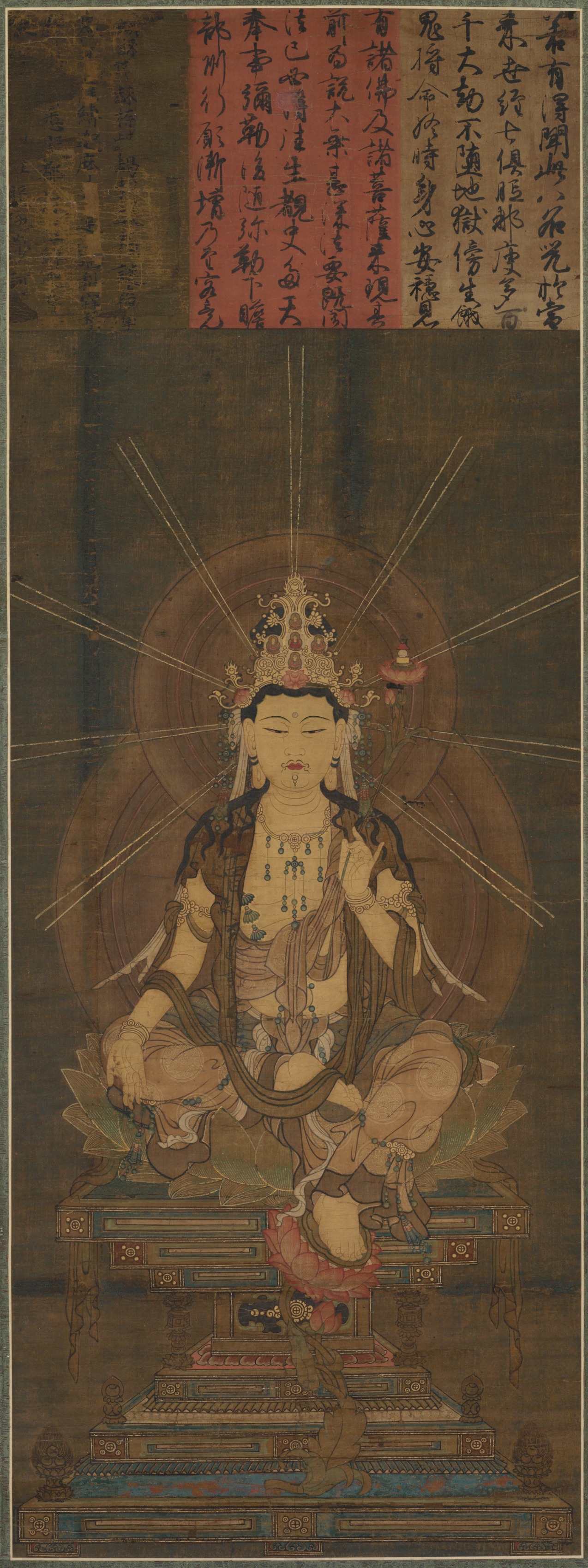
- Title
- Miroku (Maitreya)
- Period
- Japan, Nanbokuchō period (1336–92), 14th c.
- Region
- Japan
- Medium
- Hanging scroll; ink, color, gold, and cut gold (kirikane) on silk
- Dimensions
- Painting only: 110.6 x 40.7 cm (43 9/16 x 16 in.); mounted 197 x 58.7 cm
- Collection
- Cleveland Museum of Art
- Accession
-
1999.195 - Rights
- Cleveland Museum of Art (Public Domain / CC0); credit line: Gift of Rosemarie and Leighton Longhi in memory of Robert P. Bergman, 1999.195
Miroku (Maitreya), 14th c., Cleveland Museum of Art 1999.195. CC0. The jewels and the gauzy silk are the argument: the future Buddha shown as a bodhisattva, before the descent.
Cleveland 1999.195, a 14th-century Nanbokuchō hanging scroll, paints Miroku as a richly adorned bodhisattva (gauzy silks, jewels, a gold crown of five seated Buddhas) not the future Buddha he becomes. The ornament fixes him as Miroku-as-Bosatsu in Tuṣita before the descent, not Miroku-as-Nyorai. Three inscriptions carry a Miroku text; pigment loss exposes writing on the silk’s back.
The work
The jewels are the argument. Cleveland 1999.195 paints Miroku, Maitreya, the buddha-to-come, and the single decision that governs the whole image is that he is shown adorned. The museum’s description is exact: “richly adorned with gauzy fabrics, opulent jewels, and an intricate gold crown containing five seated Buddhas.”1 That ornament is not surface decoration. It is the iconographic statement that this is the future Buddha before he becomes a Buddha, held in the bodhisattva state rather than the Buddha state. The catalog says so without hedging: Miroku is “represented as a bodhisattva, a being who has attained enlightenment but has chosen to postpone becoming a Buddha to help others.”1
The scroll is a hanging scroll, ink, color, gold, and cut gold on silk, Japan, Nanbokuchō period (1336–92), the catalog dating it to the 14th century CE.1 The painted surface is 110.6 × 40.7 cm, a narrow vertical; with the mount it reaches 197 cm. The proportion matters for how the object reads: a tall, slender field forces a single standing figure to fill nearly the whole width, so the eye has nowhere to go except across the ornament. The silk is worked with kirikane, the cut-gold-leaf technique in which hairline strips of gold are laid into the textile patterning rather than painted as a wash. Where the gold survives it catches raking light differently from the painted color around it, and the figure’s robes resolve into fine geometric gold against the darkened ground.
Above the figure are “three inscriptions present[ing] portions of a sacred text related to Miroku.”1 The inscriptions belong to the icon’s program rather than being a later addition or a collector’s label: a Miroku scripture set over a Miroku image, text and figure meant to be read together. An icon that carries its own scripture on its face is built for use, addressed in ritual, not contemplated as a picture.
The one detail no reproduction shows is on the reverse. Where the more fragile pigments have fallen away on the bodhisattva’s right side, the loss has exposed writing on the back of the silk, text that, in the catalog’s phrasing, the mounters “never expected to be seen.”1 Writing on the verso, applied before the silk was mounted, is a real fact about how the object was made and what it was for; a dedicatory or votive text hidden inside the mounting is a strong sign the scroll was a commissioned devotional object rather than a display piece. As of the public catalog entry that verso text is undeciphered and unpublished, and that is stated here as a gap rather than filled with a guess about what it says.
Iconographic reading
What fixes this as Miroku-as-Bosatsu rather than Miroku-as-Nyorai is a small, hard set of markers, and they have to be separated from the canonical biography to do any work. The canonical fact, that Miroku waits in Tuṣita heaven and will descend as the next Buddha when Śākyamuni’s teaching has decayed, is one clause, and the entity page carries it.2 The article’s job is the part the database does not do, which is showing which painted features carry the bodhisattva-not-Buddha identification on this silk.
A Buddha (Nyorai) is shown stripped of ornament: a plain monastic robe, an uncrowned head, the cranial protuberance, the simple drape of one who has renounced the world. A bodhisattva is shown as a prince: jewelry, a crown, layered fine fabrics, the dress of one who has not yet given the world up. The Cleveland figure is unambiguously the second. The gauzy fabrics, the heavy jewels, and above all the crown are the markers; remove them and the figure would read as a Buddha. The painter’s choice to keep Miroku in princely dress is the choice to paint him in Tuṣita, in the long pre-descent interval, not at the moment he attains buddhahood. This is the distinction the catalog draws, and it is the distinction the iconography itself enforces, independent of any label.12
The crown’s contents complicate the simple story in a precise and instructive way. It carries “five seated Buddhas.”1 A crown of five Buddhas is the Five-Wisdom-Buddha (Godai Nyorai) device of esoteric iconography, the same set that organizes the esoteric mandala, and its presence pulls the figure toward the esoteric pictorial idiom rather than a plain Hossō or narrative Miroku. The more frequently cited single identifier of Maitreya in the general iconographic literature is different: a stūpa or small caitya set in the crown, holding a relic.2 The Cleveland scroll does not use the stūpa-crown. It uses the five-Buddha crown instead. Both crown types occur for Miroku across the corpus, so the five-Buddha form here is not an anomaly to be explained away; it is the marker that tells you this painter was working in an esoteric-inflected register. It does not make the figure anything other than Miroku. The misreading runs the other way: taking the heavy ornament plus a five-Buddha crown as evidence of a different deity altogether, an esoteric Buddha or a generic crowned bodhisattva. The fixed point that closes that door is the inscribed Miroku text set directly above the figure, which removes the identification from doubt regardless of how richly the figure is dressed.1
The text the inscriptions carry is, on the catalog’s account, a “sacred text related to Miroku,” not named in the public entry.1 The relevant scriptural field is the Maitreya rebirth-and-descent literature, the sūtras on rebirth in Tuṣita and on Maitreya’s eventual coming, which sits adjacent to the Pure Land corpus without being identical to it. Inagaki’s translation work on the Pure Land sūtras marks that boundary clearly: the three Pure Land sūtras center on Amida and Sukhāvatī, and aspiration to Maitreya’s Tuṣita is a related but separate destination, with its own scriptural basis and its own logic of rebirth.3 A Miroku icon with its own scripture written over it belongs to that adjacent devotional field, the hope of rebirth in Tuṣita to hear Maitreya and then to descend with him at the renewal of the teaching. The precise sūtra quoted on the Cleveland scroll is, in the literature consulted here, not yet pinned, and the article does not guess at it; identifying the three inscriptions is the obvious next research step and it is flagged rather than papered over. There is no scholarly disagreement to adjudicate on the identification itself, because the figure is securely Miroku; the open question is textual, the specific sūtra, and bodhi’s reading is that the painting is a Tuṣita-aspiration icon of the standard adorned-bodhisattva type whose exact scriptural anchor remains to be read off the silk.
Comparanda
The instructive comparison is held in one other collection. The Metropolitan Museum’s Miroku Bosatsu (acc. 29.100.462) is the same thing in the same medium: a 14th-century Kamakura hanging scroll, ink, color, and gold on silk, the future Buddha as adorned bodhisattva, public-domain.4 Two near-contemporary painted Miroku of comparable format and identification, one in Cleveland and one in New York, establish that the standing jeweled Miroku scroll is a recognized type of the period rather than a one-off invention. The Met scroll is the natural object to set beside Cleveland 1999.195 to read the type’s range. The points where the Cleveland scroll carries information the Met example may not are its exposed verso writing and its five-Buddha crown, and those are the features a comparative study would isolate.
The harder comparison is across material rather than medium, and it runs inside bodhi’s own coverage. Cleveland also holds an Asuka gilt-bronze Miroku in the pensive hanka shiyui posture, the seated finger-to-cheek thinking pose that is the early sculptural language for the future Buddha’s contemplation in Tuṣita. The painted Nanbokuchō scroll and the cast Asuka bronze are seven centuries apart and they answer different questions. The bronze stages the thinking, the slow deliberation of the bodhisattva who could become a Buddha and has not yet. The scroll stages the waiting in adornment, the prince in Tuṣita surrounded by his own scripture. They are the same figure rendered in two iconographic grammars, and bodhi’s existing single-work study of the Asuka bronze is the direct sculptural counterpart to this painted one. The painted Miroku record is the lesser-covered half of the figure’s corpus, so this scroll is offered as a securely documented entry into it rather than as its representative.
Ten Grotenhuis’s mandala typology supplies the wider frame for why a 14th-century Miroku would carry a five-Buddha crown and a scripture cartouche on the same surface: the period’s devotional painting routinely fused Pure Land aspiration, esoteric iconographic devices, and inscribed text into single icons meant to be used rather than only viewed.5 Dobbins’s account of the medieval icon as a living salvific presence, a figure engaged through ritual and scripture rather than read as art, is the reading that makes sense of a Miroku scroll with its own sūtra written across its face and a dedicatory text concealed on its back.6 Brock’s work on Kamakura-period Buddhist narrative painting and its audiences is the adjacent scholarship on how such icons functioned for the people who commissioned and used them; it is cited here at work level as context for the devotional setting and not as the basis for any claim about this specific scroll.7
Provenance and history
The recorded history is short and recent. The scroll was owned by Rosemarie and Leighton R. Longhi, New York, and given by them to the Cleveland Museum of Art in memory of Robert P. Bergman; it is accession 1999.195.1 The Cleveland catalog lists two pieces of literature for the object: Leighton R. Longhi’s own Forty-Five Years in Asian Art (2019), the donor-dealer’s volume, and Dobbins’s Behold the Buddha (2020).1 There is no recorded Japanese temple lineage and no named owner before the Longhis. The object enters the verifiable record with the donor. For a painting whose verso carries an unread dedicatory text, the absence of any earlier provenance is the central limit: the rite or temple the scroll served cannot be named from anything published, and the verso text that might name it has not been read.
No Wikidata item exists for the object at the time of writing. The subject figure, Miroku / Maitreya, is Wikidata Q193461, carried here as wikidata_subject in place of a work-level QID; a later work item should point reciprocally back to this article. The catalog dates the scroll to the Nanbokuchō 14th century on style and material. There is no dated colophon or technical report cited in the public entry that would tighten the date within that span, and the dating is taken here as the museum gives it. The object’s own unresolved questions are concrete and worth stating as the research agenda: read the three face inscriptions to fix the sūtra, read the exposed verso text to recover the dedication, and a technical study of the kirikane and pigment would place the scroll more precisely inside the Nanbokuchō painting workshops than style alone allows.
Related
- Miroku in the act of thinking: the Asuka bronze at Cleveland 1950.86
- Red Amida: the crimson-bodied Buddha of Infinite Life
- Byōdō-in’s Amida by Jōchō: the canonical Heian image
- Miroku Bosatsu (entity)
- Tuṣita heaven (entity)
- Kirikane: cut-gold-leaf (entity)
Footnotes
-
Cleveland Museum of Art, accession 1999.195, Miroku (Maitreya) (弥勒菩薩像), Japan, Nanbokuchō period (1336–92), 14th c.; hanging scroll, ink, color, gold, and cut gold on silk; CC0. Catalog records the five-Buddha crown, three inscriptions, exposed verso writing, and the Longhi gift. clevelandart.org/art/1999.195. ↩ ↩2 ↩3 ↩4 ↩5 ↩6 ↩7 ↩8 ↩9 ↩10 ↩11
-
Mark Schumacher, “Miroku,” Digital Dictionary of Japanese Buddhist Deities, onmarkproductions.com. Miroku in Tuṣita; bodhisattva (adorned) vs Buddha (unadorned) representation; stūpa-in-crown as the frequent identifier. ↩ ↩2 ↩3
-
Hisao Inagaki (trans.), The Three Pure Land Sutras, BDK English Tripiṭaka (Berkeley: Numata Center, 2003), establishing the Amida/Sukhāvatī focus of the Pure Land sūtras as distinct from Tuṣita aspiration. Page not verified. ↩
-
The Metropolitan Museum of Art, accession 29.100.462, Miroku Bosatsu, Japan, Kamakura period, 14th century; hanging scroll, ink, color, and gold on silk; public domain (CC0). metmuseum.org/art/collection/search/45597. ↩
-
Elizabeth ten Grotenhuis, Japanese Mandalas: Representations of Sacred Geography (Honolulu: University of Hawai‘i Press, 1999), on the fusion of Pure Land, esoteric, and inscribed devotional painting. Page not verified. ↩
-
James C. Dobbins, Behold the Buddha: Religious Meanings of Japanese Buddhist Icons (Honolulu: University of Hawai‘i Press, 2020). Listed in the Cleveland catalog’s literature for 1999.195; cited at work level on the living-icon argument, specific page not verified. ↩
-
Karen L. Brock, “Chinese Maiden, Silla Monk,” Columbia University Media Center for Art History (digitized). Cited at work level for context on Kamakura Buddhist painting and audience; relevance to Miroku iconography not confirmed from the digitized scan. ↩
Sources
-
[4]2026-05-16Columbia University, Media Center for Art History projects.mcah.columbia.edu/asianhum2/pdf/brock.pdf