Hōitsu's Willow Kannon: a Rinpa Buddhist scroll
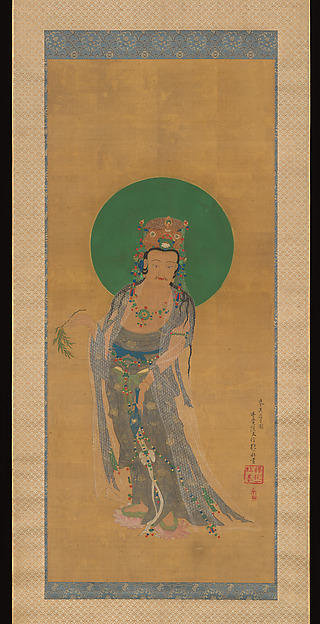
- Title
- Willow Kannon (楊柳観音)
- Period
- Edo
- Medium
- Hanging scroll; ink, color, and gold leaf on silk
- Dimensions
- Image: 82.9 × 35.9 cm. Overall with mounting: 193 × 47.3 cm.
- Collection
- The Metropolitan Museum of Art
- Accession
-
2019.419.2 - Rights
- Public domain (Met Open Access, CC0). The Metropolitan Museum of Art, accession 2019.419.2. Fishbein-Bender Collection, Gift of T. Richard Fishbein and Estelle P. Bender, 2019.
Sakai Hōitsu (1761–1828), Willow Kannon, probably 1810s. Hanging scroll, ink, color and gold leaf on silk, 82.9 × 35.9 cm (image). The Metropolitan Museum of Art, Fishbein-Bender Collection, Gift of T. Richard Fishbein and Estelle P. Bender, in celebration of the Museum's 150th Anniversary, 2019. Accession 2019.419.2. Public domain (Met Open Access).
A Buddhist scroll from a Rinpa painter
Sakai Hōitsu (1761–1828) is the painter through whom the Rinpa school survived into the nineteenth century. He was born into the Edo branch of the Sakai family — daimyō rank, Himeji domain — and trained across the standard Edo painting-academy programme (Kanō, Tosa, ukiyo-e) before discovering the work of Ogata Kōrin (1658–1716) in his thirties and reorienting his practice around its recovery. The 1815 Kōrin hyakuzu — Hōitsu’s anniversary publication on the hundredth year of Kōrin’s death — is the document by which Hōitsu canonised Kōrin for the Edo audience and named himself as Kōrin’s institutional successor.
The Rinpa repertoire Hōitsu inherited and extended was, in the conventional account, a secular repertoire. Kōrin’s most-reproduced compositions are screens of flowering plums, irises, autumn grasses, fans, deer, cranes. Buddhist subjects do not form a large part of the inherited Rinpa programme. What the Met’s 2019.419.2 establishes — and what the museum’s pairing of the Hōitsu work with the Suzuki Shūitsu White-Robed Willow Kannon (2023.753) makes explicit — is that the Edo Rinpa lineage did operate inside the Buddhist iconographic register, on a smaller scale, and that the engagement is now legible to anyone reading the late-Hōitsu output as a whole.
This scroll dates, on stylistic grounds, to the 1810s — Hōitsu’s mature decade, contemporary with his major Rinpa-recovery output. The figure is a Willow Kannon (Yōryū Kannon), one of the canonical Thirty-Three Manifestations of Kannon: the form associated with healing, with the warding-off of disease, and iconographically marked by a willow branch held in one hand and a small water vessel at the side. The composition is vertical, single-figure, on silk; the ground is gold-leaf.
Reading the figure
Kannon sits on a rocky outcrop along the lower-right diagonal of the composition. The pose is the māhārājalīla-āsana — the “royal-ease” cross-leg, the right knee raised, the left leg folded under, the right hand resting lightly on the raised knee. The robes are pale and soft, executed in the ink-and-pigment vocabulary the Rinpa school is most associated with: edge-bleed boundaries, mineral-blue and cream tonal contrasts, gold-leaf interruptions across the textile pattern. The willow branch rests in the figure’s right hand. The small water vessel (suibyō) sits on the rock beside the figure’s left side.
The face is inclined slightly downward. The eyes are nearly closed. The Amida-image in the headdress that the canonical Pure Land Kannon-types carry is present — Hōitsu has rendered it small but legible, in line with the iconographic obligation. The halo behind the head is a thin gold ring, almost decorative rather than radiant. Around and behind the figure the gold-leaf ground holds the air in suspension; there is no landscape beyond the rocky outcrop, and the figure floats in a non-spatial gold envelope rather than sitting in a particularised scene.
The Rinpa-school decorative vocabulary is doing most of the visual work. The rocky outcrop is a tarashikomi surface — wet-on-wet ink pooled into mineral-pigment ground to produce a marbled, organic texture — the technique Sōtatsu had invented and Kōrin had codified. The robe’s folds are not drawn with brush-line so much as edge-bled with diluted ink. The willow’s leaves are arranged in the Rinpa flat-pattern logic rather than in modelled botanical realism.
The Rinpa lineage operating on Buddhist subjects
What the painting does, as a category mover, is to establish that the Rinpa decorative vocabulary — Sōtatsu’s tarashikomi, Kōrin’s flat-pattern compositional logic, the gold-leaf ground, the edge-bled textile rendering — could be operated on Buddhist subjects without forcing them into either the Kanō devotional mode or the Tosa narrative mode. The Yōryū Kannon iconographic register is fully respected: the willow, the vessel, the royal-ease pose, the Amida-in-headdress are all canonically correct. But the visual handling is Rinpa.
This is not, in the literature on Hōitsu, the move he is best known for. The Edo Rinpa survey publications — Carpenter (2012), Yoneyama (2018) — treat the painter’s secular Rinpa-recovery output (Kōrin reproductions, the Edo-flora screens, the Picture Album of the Twelve Months) as the canonical centre and treat the Buddhist works as marginal in the larger lineage account. The Met’s 2019 acquisition shifts the marginal-vs-central reading: by placing a signed and sealed Hōitsu Buddhist scroll in a major public collection alongside the museum’s holdings of Kōrin, Kiitsu, Hōchū, and the school’s other principals, the Rinpa-school Buddhist register becomes legible as a continuous side-stream rather than as an exception.
Reading 2019.419.2 against the Suzuki Shūitsu White-Robed Willow Kannon (Met 2023.753)
The Met holds a second Rinpa-lineage Willow Kannon: Suzuki Shūitsu’s White-Robed Willow Kannon (2023.753), mid- to late nineteenth century, hanging scroll, ink, color, gold and silver on silk, 178.4 × 41.8 cm. Suzuki Shūitsu (1823–1889) was the son and pupil of Suzuki Kiitsu (1796–1858) who was Hōitsu’s principal pupil and the painter through whom Edo Rinpa carried into the second half of the nineteenth century. The lineage line runs Hōitsu → Kiitsu → Shūitsu, three generations of the Edo Rinpa branch.
Read together, the two Willow Kannon scrolls show the lineage’s internal iconographic conversation. Hōitsu, c.1810s, paints the figure in the royal-ease seated pose, gold-leaf ground, willow branch in right hand. Shūitsu, mid-to-late 1800s, paints the same iconographic figure in a white-robe variant (the Byakue Kannon overlap is doctrinal — the Yōryū and Byakue registers can pair) on a vertical scroll with a similar gold-leaf and edge-bled visual handling. The compositional armature is conserved; the iconographic detail shifts within the Yōryū-Byakue Kannon adjacency.
What the two works also show is that the Met has — through the Fishbein-Bender 2019 gift and the Sue Cassidy Clark 2023 purchase — assembled a small but coherent Rinpa-Buddhist holding within the institution. The 2019 Hōitsu and the 2023 Shūitsu are not paired by donor or by acquisition occasion; they are paired by the museum’s continuing acquisition discipline.
What stays open
The first thing is the dating window. The Met carries “probably 1810s” and the literature has not, to current published knowledge, narrowed it further. Hōitsu’s output is dense across that decade and the stylistic markers — the tarashikomi technique, the Rinpa flat-pattern logic, the signature form — are present across the full decade rather than concentrated in one half of it. Yoneyama (2018) is the likeliest source for a tighter date.
The second is the question of patronage. The provenance line is documented from the Fishbein-Bender Collection back into the twentieth-century art market but not back to the original commission. Hōitsu’s Buddhist works are smaller than his secular output and tend, in the sub-corpus where commission histories survive, to be donor-commissions for memorial or healing-rite use within the patron’s family. Whether 2019.419.2 has such a commission history is unknown from the open record.
The third is the Yōryū Kannon iconographic register’s specific 19th-century vitality. The Hōitsu and Shūitsu Willow Kannon scrolls suggest that the register was an active part of Rinpa-school production across the lineage’s late phase. Whether that is true more generally — whether Buddhist scrolls form a recognisable percentage of the Edo Rinpa branch’s output, or whether the Willow Kannon specifically was an internal-lineage workshop subject — is a question for a longer survey that the present article does not undertake.
Sources
-
Met OA CC0; confirmed via the Met API for object 705791.
-
Comparandum in §5: Rinpa-lineage Willow Kannon by Hōitsu's pupil Suzuki Kiitsu's pupil Suzuki Shūitsu; mid-to-late 19th century.
-
Standard English-language source on Rinpa; Hōitsu treated as the Edo branch's principal continuator.
-
Context for the Edo painting-academy ecology against which Rinpa positioned itself.
-
Japanese-language monograph on Hōitsu; standard reference for the Edo Rinpa lineage. Cited at work level; page numbers not verified.
-
Internal cross-reference to bodhi article 'yoryu-kannon-willow-and-moon' for the broader iconographic programme.