The Chōmeiji pilgrimage mandala: a temple seen by walking
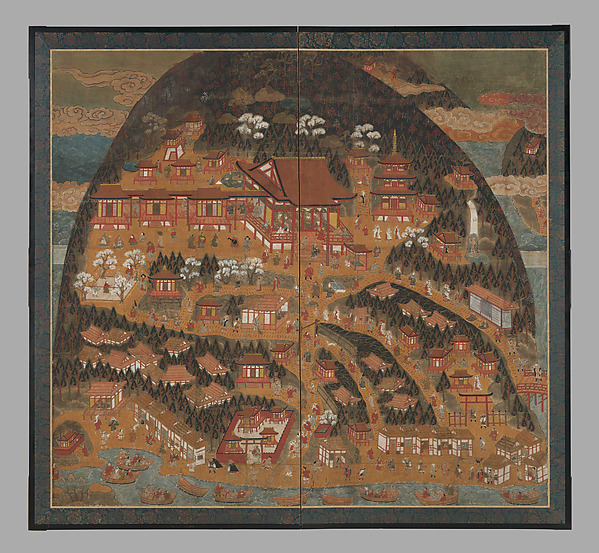
- Title
- Chōmeiji Temple Pilgrimage Mandala (長命寺参詣曼陀羅)
- Period
- Muromachi
- Medium
- Hanging scroll remounted as a two-panel folding screen; ink, color, gofun (ground shell pigment), and gold on paper
- Dimensions
- Image: 148.3 × 161 cm
- Collection
- The Metropolitan Museum of Art
- Accession
-
2016.517 - Rights
- Public domain (Met Open Access, CC0). The Metropolitan Museum of Art, accession 2016.517. Purchase, Sue Cassidy Clark Gift, in honor of D. Max Moerman, 2016.
Chōmeiji Temple Pilgrimage Mandala. Japan, Muromachi period (1392–1573), second quarter 16th century. Hanging scroll remounted as a two-panel folding screen; ink, color, gofun, and gold on paper, 148.3 × 161 cm. The Metropolitan Museum of Art, Purchase, Sue Cassidy Clark Gift, in honor of D. Max Moerman, 2016. Accession 2016.517. Public domain (Met Open Access).
The genre this work belongs to
A sankei mandara (参詣曼陀羅 — “pilgrimage mandala”) is a sub-genre of Japanese religious painting that flowered in the Muromachi and early Edo periods and that does something a Pure Land mandala or a Womb/Diamond taizōkai-kongōkai mandala does not do: it depicts a specific physical place. The compositions are not iconographic schemata of Buddhist cosmology in the strict mandala sense. They are devotional panoramas — bird’s-eye views of pilgrimage sites, rendered in workshop hand, with vignettes of pilgrim activity scattered through the topographic ground.
The genre had a job. The sankei mandara were carried by itinerant religious specialists — etoki (絵解き), “picture-explainers,” who were often itinerant nuns affiliated with the host temple — and used in oral storytelling performances away from the temple itself. The performer would point at the cliff, the harbour, the staircase, the inner hall, the Kannon icon in the inner hall, and narrate the route, the legend, the miracle, the rewards-of-pilgrimage. The painting served as a map and as a trigger for the narration. A donor in Kyoto or Edo who would not travel to Lake Biwa could see Chōmeiji here, in the painting, and could be persuaded to make a donation or to plan a future pilgrimage.
Met 2016.517 is one of the surviving Muromachi-period works of this kind. The Met catalogue assigns it to the second quarter of the sixteenth century, dating it stylistically rather than by inscription. The composition was made as a hanging scroll and was later remounted as a two-panel folding screen, which is how it currently presents. The pictorial information — the temple, the lake, the staircase, the pilgrim cohort, the gold-leaf cloud bands — has not been changed by the remounting.
Reading the panorama
The composition holds Chōmeiji on its mountainside above the southwestern shore of Lake Biwa. The lake-shore enters the painting along the bottom edge: a curve of harbour with small boats at anchor, two or three pilgrim figures stepping off the boats onto the strand. A stone staircase ascends from the harbour up the wooded mountainside in a long diagonal — 808 steps in the historical record, though the painting does not count them — and the staircase is the panorama’s central pictorial axis.
Pilgrims in groups of two and three walk the staircase upward. Their robes are pale ink-and-light-colour against the green of the hillside; their figures are small but legible at each step of the way; the workshop has given them the standing-walking attitude of pilgrim figures in the genre’s standard vocabulary. At the staircase’s summit the temple complex unfolds along the ridge: the main hall (Hondō, housing the eleven-headed Senju Kannon honzon), the three-storied pagoda, the bell tower, the various sub-halls and gateways, all in the Muromachi-period architectural rendering convention with gabled roofs and visible eave brackets.
The gold-leaf cloud bands organise the composition. They are the workshop convention for separating registers in the bird’s-eye view: the lake-shore register at the bottom, the staircase-and-hillside register in the middle, the temple-complex register at the top, and additional cloud-bands inserting themselves between vignettes the workshop wanted the viewer’s eye to rest on. The clouds are not naturalistic atmosphere. They are a spatial logic — the painting’s grammar for how the eye should move through the panorama.
The ink, the colour, and the gofun (ground shell pigment, the workshop’s white) are applied in the standard Muromachi vocabulary. Edges of the painted forms are crisply outlined in ink; mineral pigments fill the wooded hillside in textured green and the harbour in flat blue; gofun heightens the temple’s white plastered walls and the pilgrims’ robes; gold-leaf carries the cloud bands and accents the ridges of the architecture.
Chōmeiji as the 31st of 33
The Saigoku Sanjūsansho (西国三十三所 — “Thirty-Three Places of the Western Provinces”) is the Kannon pilgrimage that links thirty-three temples across central and western Japan, each housing a Kannon honzon, in a route the pilgrim follows in a continuous circuit. The institutional history of the route is layered: the tradition of pilgrimage to thirty-three Kannon-housing temples is documented from the eleventh century onward, but the specific thirty-three-temple Saigoku route as canonised today (with Seigantō-ji at Nachi as the first station and Kegon-ji as the thirty-third) takes its modern form across the Muromachi and early Edo centuries.
Chōmeiji is the 31st temple in the route. It sits on the southwestern shore of Lake Biwa in present-day Ōmihachiman city, Shiga prefecture, and its honzon is the eleven-headed Senju Kannon (Eleven-Headed Thousand-Armed Kannon). The temple’s foundation tradition attributes the establishment to Prince Shōtoku (574–622), placing it within the foundational-Asuka legendary register the Japanese temple-history tradition uses for its oldest institutions.
What the painting does is make Chōmeiji legible to a viewer who has not been there. The pilgrim who has walked the staircase reads the panorama as a memorial of the actual climb; the donor or future-pilgrim who has not walked the staircase reads it as an aspirational map; the etoki uses it as the visual armature for the narration she has memorised. The painting works on all three audiences at once.
What the sankei mandara genre records
The sankei mandara are not, as a corpus, an aesthetic genre in the way the Kanō academy or the Rinpa school are aesthetic genres. They are an operational genre — paintings made to do a specific institutional work (donor solicitation, pilgrimage promotion, oral-storytelling triggering) — and their visual conventions are determined by that work rather than by the painters’ atelier-internal preoccupations. They are anonymous in their authorship, formulaic in their composition, and remarkable individually for the site each one records rather than for the workshop signatures the genre rarely carries.
What the genre records, taken as a corpus, is the late-medieval Japanese pilgrimage economy. Across the Muromachi and early Edo centuries the etoki nuns travelled with their sankei mandara across the regional networks of provincial Japan, raising donations for the host temples and recruiting pilgrims for the routes. The paintings circulate; the routes draw revenue; the temples build infrastructure (staircases, hostels, gates); the etoki return to the temple with the contributions; the cycle repeats. The Chōmeiji painting in the Met sits at one moment in this economy: it was made by the temple, carried out by an etoki cohort, used in narration for some number of decades or generations, retired or sold or transferred, eventually entered the late-modern Japanese art market and from there the Sue Cassidy Clark collection and finally the Met.
Reading Met 2016.517 against the broader Saigoku corpus
There are surviving sankei mandara for several of the thirty-three Saigoku temples — Hasedera, Kiyomizu-dera, Ishiyamadera among them — and the Met’s Chōmeiji painting sits inside this distributed corpus. What the corpus, when read together, makes visible is the commonality of the genre’s compositional vocabulary across temples: the bird’s-eye armature, the ascending route as central axis, the gold-leaf cloud-band registers, the pilgrim figures in groups, the temple complex at the upper register. The format is portable. Each temple receives a workshop variation of the standard compositional convention adapted to the specific topography of the site.
What changes from one painting to the next is therefore the site, not the visual grammar. Chōmeiji’s identifying mark is the long staircase from Lake Biwa harbour; Hasedera’s is the long covered staircase up the mountainside; Kiyomizu’s is the wooden stage cantilevered over the valley; Ishiyamadera’s is the rocky outcrop along the river. The sankei mandara are site-specific paintings using a site-portable grammar. The genre’s visual vocabulary’s stability is what makes the corpus legible across temples; each temple’s topographic particularity is what makes a particular sankei mandara legible at all.
What stays open
The first is the question of which etoki cohort, or which itinerant religious-specialist register, originally circulated this specific painting. The sankei mandara genre’s operational history is documented at the genre-level (Moerman 2005 establishes the etoki-system framework) but the individual circulating histories of surviving works are mostly not recoverable. Met 2016.517’s circulation history before its late-20th-century entry into the art market is unknown.
The second is the dating window’s precision. The Met carries “second quarter, 16th century” — c.1525–1550. The stylistic markers — the gold-leaf cloud-band convention, the architectural-vignette mode, the pilgrim-figure rendering vocabulary — are consistent with that window. Tighter dating would require workshop-specific iconographic analysis or technical conservation evidence that the open record does not include.
The third is the relationship between the painting’s original hanging-scroll format and its current two-panel folding-screen mounting. The remounting was done before the work entered the Met; when exactly, by whom, for what occasion is unspecified in the open record. The remounting is significant because it transposes the work from one viewing-context (hanging in a temple sub-hall or a domestic setting) to another (folding screen in a wider room), and the transposition affects how the painting is encountered. The temple-context retainer or remounting tradition that produced the screen version has not been identified.
Sources
-
Met OA CC0; confirmed via the Met API for object 688517.
-
Foundational English-language source on the sankei mandara genre and on pilgrimage cartography as a devotional category. Moerman is the scholar in whose honor the Met's acquisition was made.
-
On the Saigoku 33-temple Kannon pilgrimage as institutional category; cited at work level.
-
Standard Japanese-language reference for the Saigoku Kannon pilgrimage history.
-
The temple is the 31st station of the Saigoku Sanjūsansho 33-temple Kannon pilgrimage. Tendai foundation tradition attributes the founding to Prince Shōtoku.
-
Background scaffolding for the pilgrimage economy of the Muromachi period.