The hell scroll: reading the Jigoku-zōshi tradition
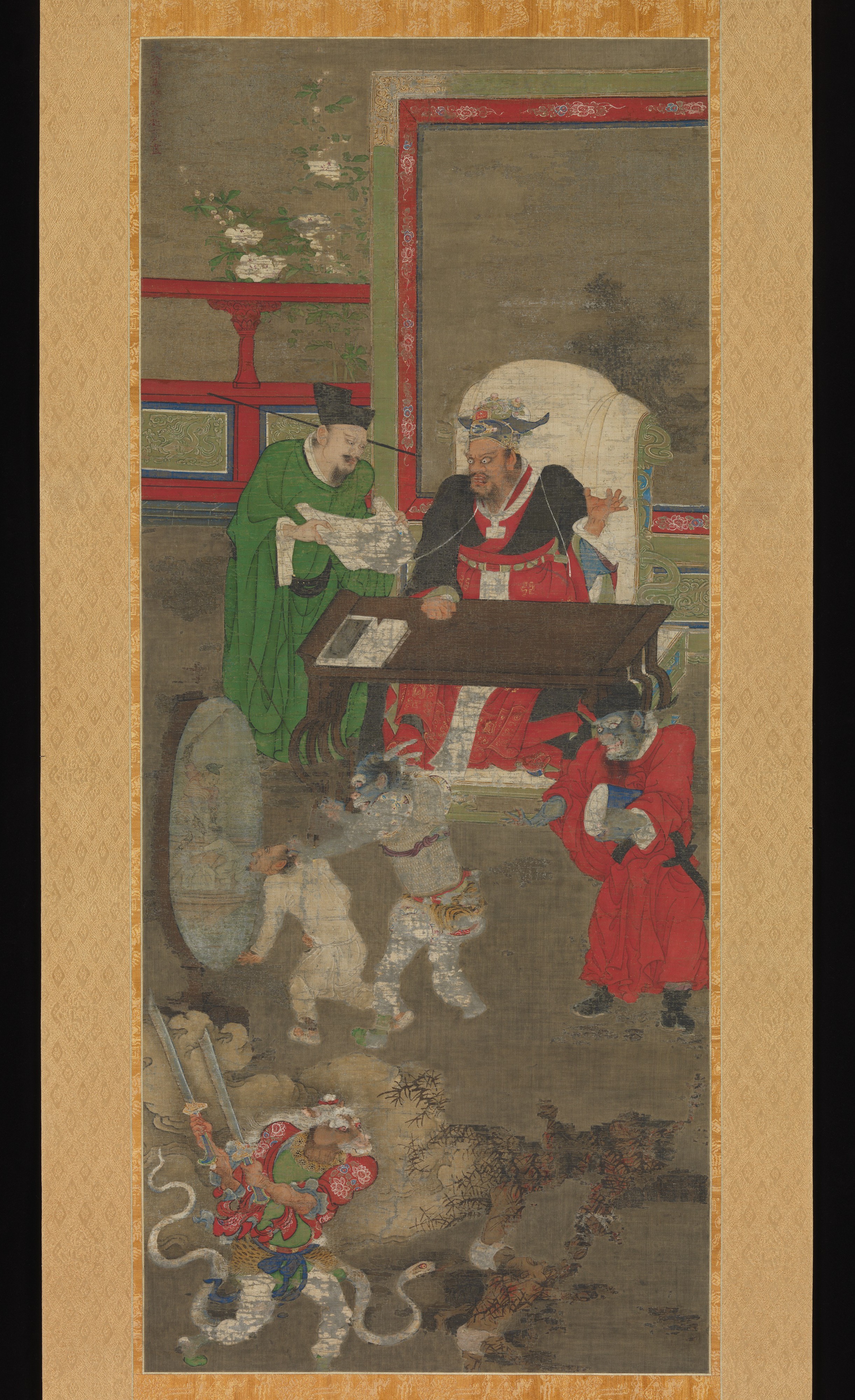
- Title
- Ten Kings of Hell (one scroll of a set of ten)
- Period
- Chinese, Song dynasty, before 1195
- Region
- China (Mingzhou / Ningbo)
- Medium
- One of a set of ten hanging scrolls; ink and color on silk
- Dimensions
- Image 129.5 × 49.5 cm; overall with knobs 203.2 × 69.9 cm
- Collection
- The Metropolitan Museum of Art, New York
- Accession
-
30.76.293 - Rights
- The Metropolitan Museum of Art, Rogers Fund, 1930 (30.76.293). Public domain (Met Open Access, CC0, re-confirmed 2026-06-05).
The late-Heian Jigoku-zōshi paint the sixteen lesser hells as a deterrent supplement to Genshin’s Ōjōyōshū. Their pictorial economy descends from the Chinese Ten Kings of Hell, read here through the Met’s dated Jin Chushi set (before 1195, Ningbo), the continental engine the Japanese scrolls reworked into rokudō.
What this scroll is, and why a Chinese one
The Japanese hell scroll has a name, Jigoku-zōshi (地獄草紙), four surviving handscrolls, and an institutional home: the Rokudō-e, the “Paintings of the Six Paths,” recorded in the treasure house of Rengeō-in, the Kyoto hall the cloistered emperor Goshirakawa built and that is better known as Sanjūsangen-dō.1 None of those four scrolls is in a Western public-domain collection. The two National Treasures sit at the Tokyo and Nara national museums; the Masuda-family scrolls are dispersed across the Gotoh, Seattle, and MIHO holdings and private hands.1 A Jigoku-zōshi article that waits for a cleared Japanese scroll waits forever.
So this study reads the tradition through its engine rather than its Japanese endpoint. The hero is the Metropolitan Museum’s Ten Kings of Hell, one scroll from a set of ten by the studio of Jin Chushi, painted at Mingzhou (the port that became Ningbo) before 1195.2 This is not a substitute dressed up as the subject. It is the specific pictorial machine the Heian painters were working from. Song Buddhist export painting from Ningbo is the documented channel by which the bureaucratic-underworld image reached Japan; most surviving Song and Yuan Buddhist paintings of this kind were in fact preserved in Japanese temples, carried back by the merchants and pilgrims who used that port.2 The Japanese scrolls did something distinct with the material, and naming that difference is the work of this article. But the grammar (the seated magistrate, the clerk with the register, the demon-officers, the punished body in the lower register) is the grammar of the Met scroll, and it is legible there with a clarity the abraded Japanese fragments rarely allow.
Standing in front of the Met scroll
Stand close to the lower third of the scroll, below the bench, where the silk darkens. The eye is pulled first to the top: a king in a black outer robe over vermilion, behind a plain wooden bench, his scalloped white chair-back rising like a shell behind his head. A clerk in green leans in from the left holding an unrolled document, the register of the dead’s deeds, the ledger the whole system runs on. A demon-officer in red, a sword slung at his hip, stands at the right with the posture of a bailiff waiting for an order. This upper zone is an office. There is even a vase of white blossom on a red lacquer stand in the corner, the kind of refined still-life detail a Song court painter would put in a portrait of a living official.
Then the lower register, and the register is the right word twice over. A naked man, bound, is being hauled across the ground by a small spotted beast with a striped hide and by a red wrathful demon swinging two short swords. A white serpent loops at the bottom edge. The painter has not raised his voice. The flesh tones in the punished body are the same controlled palette as the king’s robe; the violence is stated, not performed. What carries the dread is the join: the office and the abattoir are one continuous space, separated by nothing but a band of ground. The judgment and its execution are the same event, and the scroll states them in one breath rather than two.
That continuity is the iconographic claim. The Met catalogue puts the historical point plainly: the theme “transforms the Indian Buddhist view of judgment after death into a typically Chinese bureaucratic process,” in which a soul “is tried by a different king each week for seven weeks,” then sent to an eighth king on the hundredth day, a ninth after a year, a tenth in the third year.2 Ten kings, ten courts, a calendar. The painting’s spatial logic, court above and sentence below, is that calendar made visible at one of its ten stations.
The bureaucratic underworld, and the text under it
The text the Met scroll illustrates is not a sūtra in the canonical sense. It is the Scripture on the Ten Kings, an apocryphal work that grew up in late-Tang China and survives in more than thirty tenth-century copies among the Dunhuang manuscripts.3 Stephen Teiser’s study of it argues that the scripture is the document of a process: the medieval Chinese assimilation of Indian Buddhist rebirth doctrine into a recognisably Chinese magistracy, complete with courts, clerks, dossiers, and the possibility of intercession by the living through donations and merit transfer.3 The pains of the passage from death to rebirth, in Teiser’s reading, can be eased by the survivors’ contributions; the dead are defendants whose families can still file on their behalf.
This is why the Met scroll looks like an office. The bureaucratic underworld is not a stylistic flourish; it is the doctrine. The clerk’s register is the soteriological instrument: the case is decided on documented deeds, and the painter gives the document as much pictorial weight as the king. The demon with the sword is an enforcement officer, not a monster of the imagination. The Indian inheritance is still there in the punishments, but the framing apparatus around them is Chinese statecraft, and Jin Chushi’s studio painted it as statecraft.
One inscription survives on the set, recorded from the companion scroll: “Painted by the household of Jin Chushi, Carriage Bridge West, Mingzhou [Ningbo], in the Great Song dynasty.”4 That single line carries the dating (Mingzhou was renamed Qingyuanfu in 1195, so the work predates that year), the workshop attribution (a lay Buddhist painting household, not a single master’s hand), and the geography (a Ningbo export studio) in one breath. It is the kind of evidence the Japanese scrolls lack and the reason a dated Chinese example anchors the tradition better than an undated Japanese one.
What the Japanese scrolls did with it
The Jigoku-zōshi are not copies of the Ten Kings type, and the difference is the point of the comparison. The Nara National Museum scroll, a National Treasure, 26.5 by 453.9 cm, twelfth century, shows seven of the sixteen lesser hells: the Hell of Excrement, the Hell of Measures, the Hell of the Iron Mortar, the Hell of the Flaming Rooster, the Hell of the Black Sand Cloud, the Hell of Pus and Blood, the Hell of Foxes and Wolves.51 Its accompanying texts, in the standard description, each open with the formula “There is yet another hell,” then specify the sin that lands a soul there.5 The Tokyo National Museum scroll, also a National Treasure, color on silk, 26.9 by 249.3 cm, takes a different textual base and shows four subsidiary hells within one of the Eight Great Hells: murderers, thieves, and adulterers burning in the Hell of Cloud, Fire, and Mist, “in agony as they burn in an enormous fire,” the flames rendered “with concise lines and black and vermilion tones.”6
Two things have shifted from the Met scroll. First, the textual source. The Nara scroll’s hells derive from the Kisekyō (“Sutra of the World Arising”); the Tokyo scroll’s from the Shōbōnenjokyō (the Sūtra of Mindfulness of the True Dharma).1 These are catalogues of torment, not a procedural manual; the apparatus of kings, clerks, and courts that organises the Met scroll has largely fallen away. The Japanese painters kept the lower register, the punished body, and dropped the office above it. Second, the framing institution. Where the Chinese scrolls served the funerary-merit economy of the Ten Kings cult, the Jigoku-zōshi belong to the Rokudō-e, the Six Paths programme: hell is one of six destinations, and the scroll is a single station in a cosmological circuit that runs through the hungry-ghost and animal realms as well.
The bridge between the two is Genshin. (The strong claim is that Genshin’s Ōjōyōshū supplies the deterrent armature the Heian hell pictures answer to; the overreach would be that the scrolls illustrate Genshin chapter by chapter, which the museum records do not assert and this article does not.)
Genshin’s deterrent vision
Genshin (942–1017), the Tendai monk of Yokawa on Mount Hiei, opened his Ōjōyōshū (“The Essentials of Rebirth in the Pure Land,” 985) with a long, systematic tour of the realms a soul should fear, the Eight Great Hells foremost.7 Robert Rhodes’s study reads the work as the text that constructed Pure Land discourse in Heian Japan around a single hinge: the vividness of the hells is the argument for the nenbutsu. You are shown the Hell of Repetition, the Black-Rope Hell, the Crushing Hell, the Screaming Hell, the Avīci Hell of unremitting pain, in order to be moved to the one practice that escapes them: calling on Amida.7 The deterrent and the devotional are a single mechanism, terror the premise and the Pure Land the conclusion.
The Jigoku-zōshi are the visual half of that mechanism. They do not need to quote Genshin to belong to his moment: the late-Heian appetite for the sixteen lesser hells, the formulaic “there is yet another hell,” the careful specification of which sin earns which torment: this is a culture catechised by the Ōjōyōshū and supplying its eye with images to match its dread. This is also where the cluster sibling sits: the article on Genshin’s text and its later printed afterlife reads the same machine from the side of the book; this one reads it from the side of the picture, and through the Chinese source the picture inherits. The deterrent function is not a side effect of these scrolls. It is their commission. The Rokudō-e were not decoration for a hall; they were instruments for producing the fear that the nenbutsu resolves.
Where the museum record and the scholarship pull apart
The honest gap runs along the attribution of the Japanese scrolls to the Goshirakawa Rokudō-e. The standard museum framing, repeated by both national museums, is that the Jigoku-zōshi are “thought to be” or “considered likely” part of the Six Paths set commissioned by Goshirakawa for Rengeō-in.65 That hedging is doing real work. The reconstruction of a single twelfth-century Rokudō-e programme from the surviving Jigoku, Gaki (hungry-ghost), Yamai (disease), and Hekija (exorcist) scrolls is a scholarly hypothesis built on style, format, and the Rengeō-in inventory, not a documented commission record tying these specific silks to that hall. bodhi follows the museums’ careful “likely”: the Rokudō-e attribution is the best available framework and the most economical explanation of why these scrolls cluster as they do, but it is a reconstruction, and the residual uncertainty is which surviving scrolls belong to the original set and which are near-contemporary cousins. The Masuda second-edition scroll, redesignated from a hell scroll to an exorcist scroll once its subject was reread, is the standing reminder that the corpus boundaries are still being drawn.1
A second divergence is closer to the hero. The Met set is catalogued as Jin Chushi’s, but the inscription names a household, a lay painting workshop, not an autograph master.42 Suzuki Kei and Wen C. Fong are the scholarly anchors the museum cites for the set; the precise division between Jin Chushi’s hand and his studio’s, and the original sequence of the ten scrolls, is not resolved at the object level here. What is secure is the dating, the place, and the function. The Met scroll is a Ningbo export product of the Ten Kings funerary economy, made before 1195, and it is the documented kind of object from which the Japanese hell-scroll tradition built its own, differently-framed, deterrent pictures.
Why read the tradition this way
Reading the Jigoku-zōshi through the Met’s Jin Chushi scroll is not a workaround forced by image rights, though it is also that. It is the more honest order of explanation. The Japanese hell scroll is usually presented as a Heian invention, sprung from Genshin’s text and Goshirakawa’s patronage. It is better understood as a Heian selection from a Chinese pictorial economy already two centuries old by the time the Rokudō-e were painted, a selection that kept the punished body, dropped the bureaucratic court, swapped the textual source, and re-tasked the whole apparatus to the Pure Land’s deterrent logic. The Met scroll lets a reader see the part that was kept and infer the part that was dropped, with a dated object in front of them rather than an undated National Treasure behind glass in Nara.
The thing the database cannot supply is the join in the lower third of the silk, where the office and the punishment share one ground without a frame between them. That continuity is the Chinese contribution: judgment and sentence as one administrative event. The Japanese scrolls cut the judgment away and left the sentence, and that cut, not the flames, which both traditions paint well, is where the Jigoku-zōshi becomes its own thing.
Related
- Genshin’s Ōjōyōshū, the deterrent vision pictorialised
- The Jūsan Butsu, the Ten Kings turned into Buddhas
- Jizō Bosatsu, the saviour who works the six realms
- Rokudō (entity)
- Jigoku (entity)
- Enma (entity)
- Scripture on the Ten Kings (entity)
Footnotes
-
Japanese Wiki Corpus, “Jigoku Zōshi (Scroll of the Hells),” accessed 2026-05-16: the four scrolls (Tokyo NM / Nara NM National Treasures; Masuda-family first edition dispersed to Gotoh, Seattle, MIHO and private hands; Masuda second edition redesignated as the Hekija-e exorcist scroll); the Nara scroll’s Kisekyō source and the Tokyo scroll’s Shōbōnenjokyō source (Taichirō Kobayashi identifying the Masuda-version source); Rokudō-e of Rengeō-in / Goshirakawa framing. Tertiary aggregator, used for corpus structure and corroborated against the two e-Museum records; not a primary source. ↩ ↩2 ↩3 ↩4 ↩5
-
The Metropolitan Museum of Art, Ten Kings of Hell, Jin Chushi (Chinese, active late 12th century), accession 30.76.293, objectID 44509; Rogers Fund, 1930; “one of five of a set of ten hanging scrolls; ink and color on silk,” image 129.5 × 49.5 cm. Met Open Access, public domain (CC0), re-confirmed via the Met Collection API 2026-06-05 (objectID 44509: exact tombstone match — “before 1195,” Song, Jin Chushi, “one of five of a set of ten hanging scrolls; ink and color on silk,” 129.5 × 49.5 cm, Rogers Fund 1930, isPublicDomain true, objectWikidata Q78852540). The bureaucratic-transformation and seven-weeks/100-day/year/three-year sentencing description is the Met catalogue’s, captured via the Met record and its Open Access mirrors; the Met’s full curatorial prose has not been consulted. ↩ ↩2 ↩3 ↩4
-
Stephen F. Teiser, The Scripture on the Ten Kings and the Making of Purgatory in Medieval Chinese Buddhism, University of Hawai‘i Press (Studies in East Asian Buddhism 9), 1994. Cited at argument/work level for the claim that the scripture documents the assimilation of Indian rebirth doctrine into a Chinese magistracy, the >30 tenth-century Dunhuang copies, and the living-intercession mechanism. Page numbers not verified. ↩ ↩2
-
InscrChArt, Miami University Libraries, record for Ten Kings of Hell 十王圖 (Met 30.76.290–294), accessed 2026-05-16: artist’s inscription “Painted by the household of Jin Chushi, Carriage Bridge West, Mingzhou [Ningbo], in the Great Song dynasty”; cites Suzuki Kei and Wen C. Fong as the scholarly references for the set. The Jin-Chushi-hand vs studio division and the original ten-scroll sequence are not resolved at object level here and remain to be checked against Suzuki Kei and Fong. ↩ ↩2
-
Nara National Museum, Hell Scroll (Jigoku-zōshi), National Treasure, Heian period, 12th century, color on paper, 26.5 × 453.9 cm; e-Museum (National Institutes for Cultural Heritage), accessed 2026-05-16. Seven of the sixteen lesser hells (Excrement, Measures, Iron Mortar, Flaming Rooster, Black Sand Cloud, Pus and Blood, Foxes and Wolves); accompanying texts open “There is yet another hell”; “considered likely” part of the Goshirakawa Rokudō-e at Rengeō-in. ↩ ↩2 ↩3
-
Tokyo National Museum, Hell Scroll (Jigoku-zōshi), National Treasure, Heian period, 12th century, color on silk, 26.9 × 249.3 cm; e-Museum, accessed 2026-05-16. Four subsidiary hells within one of the Eight Great Hells; Hell of Cloud, Fire, and Mist; flames “rendered with concise lines and black and vermilion tones”; “thought to be part of the Paintings of the Six Paths stored in the treasure house of Rengeō-in.” ↩ ↩2
-
Robert F. Rhodes, Genshin’s Ōjōyōshū and the Construction of Pure Land Discourse in Heian Japan, University of Hawai‘i Press (Pure Land Buddhist Studies), 2017. Cited at argument/work level for the reading that the Ōjōyōshū (985) builds Pure Land discourse on the deterrent vividness of the Eight Great Hells, terror as the premise for the nenbutsu. Eight-hells sequence drawn from the work’s framing and corroborating reference summaries; page numbers not verified. ↩ ↩2
Sources
-
[4]2026-05-16Nara National Museum / e-Museum (National Institutes for Cultural Heritage) emuseum.nich.go.jp/detail -
[6]2026-05-16InscrChArt, Miami University Libraries inscrchart.lib.miamioh.edu/s/InscrChArt/item/1641