The Shingon eight-patriarch siddhaṃ mandala at the Met
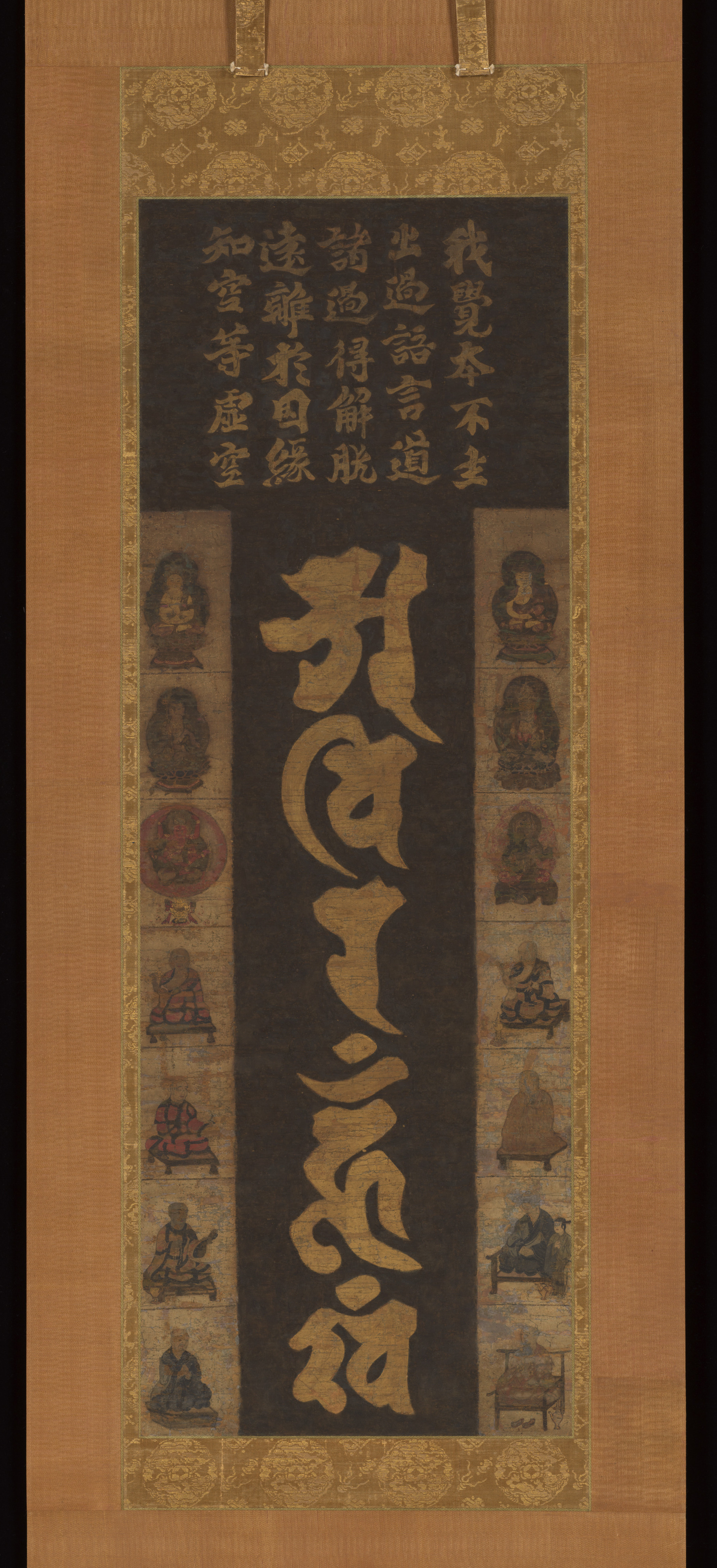
- Title
- Mandala in Sanskrit with Buddhas, Bodhisattvas, and Eight Patriarchs of the Shingon Sect (Gorin goji mandala)
- Period
- Kamakura period, 13th–14th century
- Region
- Japan
- Medium
- Hanging scroll; ink, colors, and gold on silk
- Dimensions
- Image: 101 x 34.9 cm
- Collection
- The Metropolitan Museum of Art
- Accession
-
2024.410 - Rights
- Mandala in Sanskrit with Buddhas, Bodhisattvas, and Eight Patriarchs of the Shingon Sect, Japan, Kamakura period, 13th–14th c. The Metropolitan Museum of Art, New York, accession 2024.410. CC0 (public domain).
Gorin goji mandala, Kamakura period, 13th–14th c. The Metropolitan Museum of Art, accession 2024.410. CC0.
Met 2024.410 is a Kamakura gorin-goji mandala: a gold column of five siddhaṃ syllables (a vi ra hūm kham) flanked by Buddhas, bodhisattvas, and the eight Shingon patriarchs ending in Kūkai. The script is not decoration, each syllable is the deity. The patriarch set is the denji-hasso, not the fuhō-hasso the title implies.
The work
The object is small and narrow: a hanging scroll, image 101 × 34.9 cm, ink, colors, and gold on silk, that the Met catalogs as Mandala in Sanskrit with Buddhas, Bodhisattvas, and Eight Patriarchs of the Shingon Sect, with the Japanese title 五輪五字曼荼羅, Gorin goji mandala, “five-wheel five-syllable mandala,” Kamakura period, 13th–14th century, purchased in 2024 and released CC0 as public domain.1 The Met acquired it as accession 2024.410, a recent purchase made through the Sue Cassidy Clark Gift in memory of Koichi Yanagi.
A reader looking at the scroll head-on sees a single vertical spine of five large gold characters running down the center of a dark ground, with two close columns of much smaller seated figures pressed against it, left and right, and a band of gold Chinese verse across the top. The proportions are unusual for a mandala. The Two-World mandalas of Shingon are square diagrams meant to be hung over an altar at scale; this is a tall, thin scroll built to be read like a column of text, which is the first signal that the object’s logic is scriptural rather than diagrammatic.
The five central characters are siddhaṃ (Japanese shittan), the Indic script in which esoteric Buddhist seed-syllables were transmitted to Japan. The Met reads them as the mantra a vi ra hūṃ khaṃ, the five elements (godai): earth, water, fire, wind, and the void, the syllables Dainichi (Mahāvairocana) is said to have uttered when subduing Māra and which articulate the “omniscient wisdom” of the Cosmic Buddha.1 Across the top, in gold, runs a passage lifted piecemeal from the Mahāvairocana (Dainichi) Sūtra: “My awakening is originally unborn, and transcends ordinary language. From all transgressions awakening is achieved, far removed from all causes-and-conditions, knowing emptiness to be conterminous with empty space” (Chinese; trans. adapted from Daniel B. Stevenson, per the Met catalog).1
How the script is read
The single most common misreading of an object like this is to treat the siddhaṃ as ornament: exotic calligraphy framing the “real” content, which is taken to be the little painted figures. The esoteric reading inverts that. In the Shingon shuji (種字, “seed-syllable”) system the syllable is not a label for the deity; it is the deity in graphic form, a body the same way the painted icon is a body. Abé, The Weaving of Mantra (1999), is the standard treatment of why this is not metaphor in Kūkai’s system: Kūkai’s theory of language makes the written and spoken syllable an actual locus of the Buddha’s reality rather than a sign pointing at it, which is the doctrinal ground that lets a column of five characters function as a complete object of ritual practice.2 On this scroll the painted Buddhas and patriarchs are the gloss; the gold syllables are the icon.
The practice the object served names itself. The gorin-kan (五輪観), the meditation on the five elements, works the realization that self and environment are composed of the same five elements and embody the five aspects of the Buddha’s wisdom; the Met notes the scroll could also have stood in for a full set of Two-World mandalas in a private chamber too small for the altar-scale diagrams, the mantra and the figures meant to be present as living entities for the rite to be efficacious.1 Ten Grotenhuis, Japanese Mandalas (1999), places objects of this kind in the broader Japanese pattern in which the mandala is not only a wall diagram but a portable sanctified field, the practitioner entering it rather than viewing it.3
The lineage on the silk
The figures flanking the syllable column are a transmission document. Read top to bottom, the Met identifies them as: on the left, Dainichi of the Diamond Mandala, Jizō (Kṣitigarbha), Aizen Myō-ō (Rāgarāja), then the patriarchs Ryūmō (Nāgārjuna, India, ca. 250), Ryūchi (Nāgabodhi, India, ca. 500), Kongōchi (Vajrabodhi, India, 671–741), Fukū (Amoghavajra, India, 705–774); on the right, Dainichi of the Womb Mandala, Eleven-headed Kannon, Fudō Myō-ō (Acalanātha), then Zenmui (Śubhakarasiṃha, India, 637–735), Ichigyō (Yi Xing, China, 683–727), Keika (Huiguo, China, 746–805), and Kūkai (posthumously Kōbō Daishi, Japan, 774–835).1 The two Dainichi heads at the top fix the doctrinal frame: the Diamond and Womb mandalas, the two halves of the Shingon cosmos, with the human masters descending below them and the lineage closing in Japan with Kūkai.
This is the article’s load-bearing point, and it is a museum-versus-scholarship divergence the Met’s own title obscures. Shingon recognizes two ordered sets of eight patriarchs, and they are not interchangeable. The fuhō-hasso (付法八祖), the eight Dharma-transmission patriarchs, runs Dainichi, Kongōsatta (Vajrasattva), Ryūmō, Ryūchi, Kongōchi, Fukū, Keika, Kūkai; it begins with two transcendent Buddha-figures and traces the unbroken transmission of the teaching. The denji-hasso (伝持八祖), the eight patriarchs who transmitted-and-maintained the teaching, replaces the two transcendent figures with the historical translator-masters Zenmui (Śubhakarasiṃha) and Ichigyō (Yi Xing): Ryūmō, Ryūchi, Kongōchi, Fukū, Zenmui, Ichigyō, Keika, Kūkai. The scroll’s roster includes Zenmui and Ichigyō and omits Kongōsatta. Measured against the two canonical sets, the eight historical masters on this silk are the denji-hasso, not the fuhō-hasso the English title’s phrase “Eight Patriarchs of the Shingon Sect” leaves ambiguous. The distinction is not pedantic: the two sets encode different theories of what a lineage is, one a chain of Dharma-essence reaching back to the Cosmic Buddha, the other a chain of historical persons who taught and translated. Snodgrass, The Matrix and Diamond World Mandalas in Shingon Buddhism (1988), sets out the two-set structure and why Shingon needs both; this scroll commits to the historical-masters reading and pairs it with the two Dainichi to supply the cosmic frame the denji set otherwise lacks.4
The portrait tradition behind these figures is concrete. Bogel, With a Single Glance (2009), on the early-Mikkyō visual culture Kūkai imported, works from the fact that Kūkai’s return cargo from Tang China in 806 included a set of patriarch portraits painted at the Tang court, the visual prototypes from which the Japanese patriarch image descends; the small seated patriarchs on a Kamakura scroll like this one are the far end of that imported portrait lineage, compressed from full devotional portraits into thumbnail attendants of the syllable column.5
What the close looking shows
Three observations the catalog entry does not record. First, the figures are tiny and the gold is not. On the scroll the patriarch portraits are reduced almost to the size of the siddhaṃ strokes’ terminals, so that at arm’s length the eye reads the five gold characters as the work and the sixteen flanking figures as a fringe; the hierarchy of scale enacts the doctrine that the syllable is the icon and the painted deity the commentary, which is rare to see executed so literally. Second, the gold of the syllables and the gold of the top inscription are doing different jobs: the syllable gold is laid as solid form, the inscription gold as line, so the mantra reads as body and the sūtra passage as speech, a distinction in handling that maps onto the Shingon split between the syllable-as-deity and scripture-as-teaching. Third, the format is a confession of scale: at 101 × 34.9 cm this is a private object, the substitute the Met catalog describes for a chamber that could not hold the altar-scale Two-World pair, and the compression of an entire Shingon cosmos onto a strip narrower than a forearm is the object’s actual subject.
A reader standing in front of 2024.410 in the Asian galleries is looking at a complete Shingon ritual field rendered at the scale of a sūtra column, the kind of object that did its work in a small room rather than over an altar, which is most of why so few survive.
Rarity and comparanda
The Met’s curatorial entry states that, to the museum’s knowledge, only one other Sanskrit mandala in this exact configuration is known, preserved at Hōshōji Temple in Yokohama and likewise dated by specialists to the Kamakura period.1 That is the closest comparandum and the one to check against any attribution claim about 2024.410. Within the Met itself the entry names two adjacent Sanskrit-syllable mandalas: the Amida Triad in the Form of Sacred Sanskrit Syllables (13th century, Packard Collection, accession 1975.268.22) and Monju Bosatsu with Eight Sacred Sanskrit Syllables (14th century, Rogers Fund, accession 12.134.15).1 Both are shuji mandalas in the same script-as-deity logic but neither carries the patriarch lineage; they establish the type while 2024.410 and the Hōshōji scroll are the two known examples of the type extended into a transmission document. The dating rests at present on the Met’s “13th–14th century” and the parallel Kamakura dating of the Hōshōji scroll by unnamed specialists; no published technical study of 2024.410 is yet available, which is expected for an object acquired in 2024 and is the open question a future scholarly catalog entry will close.
Related
- Jūniten: the twelve directional guardian devas
- The Five Wisdom Kings: disambiguating the wrathful directional set
- Fudō Myō-ō: iconographic markers
- Kūkai (entity)
- Dainichi Nyorai (entity)
- Shuji / seed-syllables (entity)
- Shingon (entity)
Footnotes
-
The Metropolitan Museum of Art, accession 2024.410, Mandala in Sanskrit with Buddhas, Bodhisattvas, and Eight Patriarchs of the Shingon Sect (五輪五字曼荼羅, Gorin goji mandala), Japan, Kamakura period, 13th–14th century; hanging scroll, ink, colors, and gold on silk, image 101 × 34.9 cm; Purchase, Sue Cassidy Clark Gift, in memory of Koichi Yanagi, 2024; Public Domain (CC0). Curatorial entry (the a-vi-ra-hūm-kham mantra, the gorin-kan practice, the eight-patriarch identification, the Stevenson-adapted Mahāvairocana Sūtra passage, the Hōshōji comparandum, the two other Met Sanskrit mandalas) verified via Met catalog page, archived snapshot 2026-03-06; API record objectID 912998, public domain (CC0), verified 2026-05-16. ↩ ↩2 ↩3 ↩4 ↩5 ↩6 ↩7
-
Ryūichi Abé, The Weaving of Mantra: Kūkai and the Construction of Esoteric Buddhist Discourse (Columbia University Press, 1999), Kūkai’s theory of language and the syllable as a locus of the Buddha’s reality rather than a sign of it. Pages not pinned; cited at work level pending operator pass. ↩
-
Elizabeth ten Grotenhuis, Japanese Mandalas: Representations of Sacred Geography (University of Hawai’i Press, 1999), the mandala as portable sanctified field entered rather than viewed. Pages not pinned; cited at work level pending operator pass. ↩
-
Adrian Snodgrass, The Matrix and Diamond World Mandalas in Shingon Buddhism (Aditya Prakashan, 1988), the two patriarch sets (fuhō-hasso and denji-hasso) and the structure of the Shingon transmission. Pages not pinned; cited at work level pending operator pass. ↩
-
Cynthea J. Bogel, With a Single Glance: Buddhist Icon and Early Mikkyō Vision (University of Washington Press, 2009), the patriarch portraits in Kūkai’s 806 return cargo and the early-Mikkyō visual prototypes. Pages not pinned; cited at work level pending operator pass. ↩