Jūniten: reading the twelve directional guardian devas
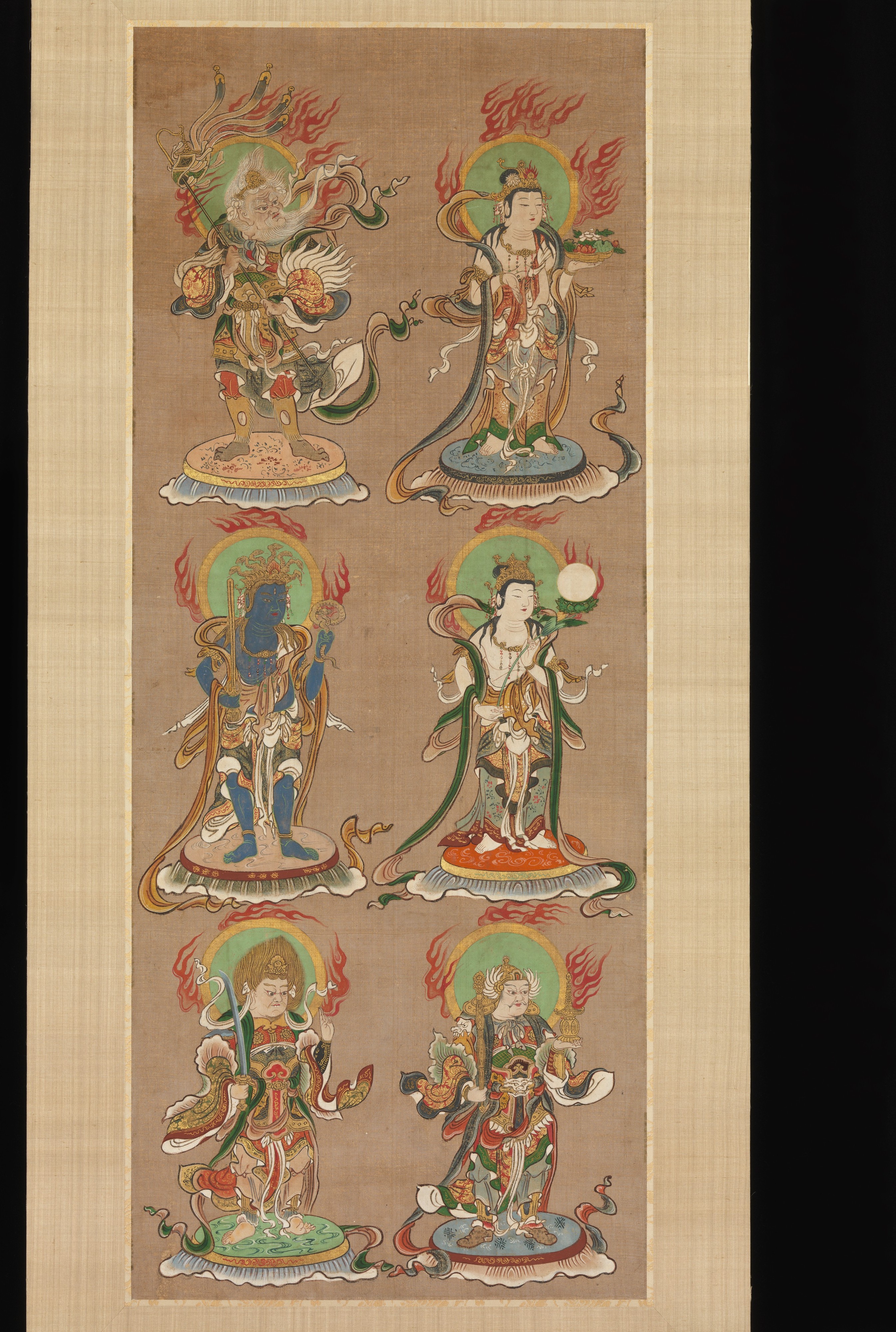
- Title
- Twelve Deva Kings (Jūniten)
- Period
- Muromachi period, 16th century
- Region
- Japan
- Medium
- Pair of framed paintings; ink, color, and gold on silk
- Dimensions
- Image: 67.3 x 42.5 cm each; framed: 120.3 x 59.1 cm each
- Collection
- The Metropolitan Museum of Art
- Accession
-
X.87a, b - Rights
- Twelve Deva Kings (Jūniten), Japan, Muromachi period, 16th c. The Metropolitan Museum of Art, New York, accession X.87a, b. CC0 (public domain).
Twelve Deva Kings (Jūniten), Muromachi period, 16th c. The Metropolitan Museum of Art, accession X.87a, b. CC0.
The Jūniten are twelve devas posted to the twelve directions of esoteric ritual space: eight at the compass points, Bonten and Jiten at zenith and nadir, Nitten and Gatten as sun and moon. They are read as a perimeter, not a pantheon, the boundary guard of the kanjō hall, fixed by the Tō-ji ritual sets and the Met paired screens (X.87a, b).
What the set is
The Jūniten (十二天, “twelve devas”) is not a pantheon assembled for worship. It is a perimeter. Twelve Indian gods, absorbed into the esoteric Buddhist system, are assigned one each to the twelve directions that bound a consecrated ritual space, and the iconographic question the set answers is positional before it is theological: which deva stands at which edge, facing which way, so that the space inside is sealed.
Ten of the twelve hold compass and axis. The eight directional devas take the four cardinal and four intercardinal points: Taishakuten (Indra) at the east, Katen (Agni) at the southeast, Enmaten (Yama) at the south, Rasetsuten (Nirṛti) at the southwest, Suiten (Varuṇa) at the west, Futen (Vāyu) at the northwest, Bishamonten (Vaiśravaṇa) at the north, Ishanaten (Īśāna) at the northeast. Bonten (Brahmā) takes the zenith and Jiten (Pṛthivī, the earth goddess) the nadir. The last two are not directions but lights: Nitten (Sūrya) the sun and Gatten (Candra) the moon. Snodgrass, The Matrix and Diamond World Mandalas in Shingon Buddhism (1988), reads this as the outer-court logic of the mandala extended into the room itself; the devas who occupy the perimeter registers of the Two-World mandalas are the same devas hung around the hall when the mandala is performed rather than painted.1
That is the leave-out. The Sanskrit-source biographies of Indra, Agni, and Yama are available in any reference and are not the article. The article is that these twelve are read as a closed circuit of bearings, and that the iconography exists to make each bearing legible at a glance from the center of the room.
Reading the twelve
Each deva carries an attribute set that fixes the identification independent of any label, which matters because in ritual use the figures are seen from across a hall, in low light, by a celebrant who needs the direction read in a single glance. The markers Faure, Protectors and Predators (2016), and the Kyoto National Museum dictionary entry give, cross-checked against the Met paired set:23
- Taishakuten (east) rides a white elephant and holds a single-pronged vajra. He is the most reliably elephant-mounted figure in the set.
- Katen (southeast) is an ascetic with a flame halo or a fire-ring behind the head, often white-bearded, sometimes triple-faced.
- Enmaten (south) carries a human-headed staff (the danda, head of office) and rides a water buffalo. The staff is the single most decisive marker in the set.
- Rasetsuten (southwest) is armored, sword in hand, the martial figure of the eight.
- Suiten (west) holds a serpent-rope or a snake coiled at the hand and is associated with the nāga; the snake is unique to him.
- Futen (northwest) holds a banner that reads the wind, a streaming pennant on a staff, the attribute drawn so the cloth moves.
- Bishamonten (north) is the only fully armored treasure-bearer, a stūpa or jewel on the palm; he doubles as Tamonten of the Shitennō and is the figure most likely to be mistaken for a guardian king rather than a deva.
- Ishanaten (northeast) carries a trident and a blood-cup, the Śaiva inheritance left visible.
- Bonten (zenith) sits or stands four-faced on a goose or lotus, lord of the heavens above the space.
- Jiten (nadir) is the earth goddess, frequently a vessel or a flowering branch held low, the only female-coded figure in many sets.
- Nitten (sun) holds a disc, often with three birds, mounted on horses.
- Gatten (moon) holds a lunar disc, frequently with a hare or a crescent, the quietest figure in the set and, in the surviving Tō-ji Shōga material, the one that happens to survive complete.4
The repeated trap in Western references is to read the Jūniten as a smaller version of the Shitennō, the Four Heavenly Kings. They overlap at exactly one figure: Bishamonten, who is Tamonten of the north in the Shitennō and the north deva in the Jūniten. The Shitennō are armored warrior-kings trampling demons, four of them, guarding a Buddha hall’s four corners. The Jūniten are twelve devas of mixed register, ascetic, martial, female, animal-mounted, guarding a ritual perimeter, and ten of the twelve are not warriors at all. Conflating the two collapses the directional logic that is the whole point of the set.
How the set is deployed in ritual
The Jūniten exist in two physical formats, and the format encodes the rite. The first is the hanging-scroll set: twelve individual scrolls, one deva each, hung around the altar during the Goshichinichi no mishihō (後七日御修法), the Latter Seven Days rite performed at the start of the year for the protection of the sovereign and the realm. The canonical surviving example is the Tō-ji set painted by Takuma Shōga in Kenkyū 2 (1191), a National Treasure; the Kyoto National Museum dictionary entry notes that the Tō-ji set replaced an earlier set lost when fire took the originals in 1127, and that the surviving paintings hung alongside a central mandala in the rite.3 The second format is the folding screen (byōbu): paired six-panel screens, the twelve devas distributed across the panels, used to enclose the platform during the kanjō (灌頂, abhiṣeka), the esoteric initiation in which a disciple is consecrated. Ten Grotenhuis, Japanese Mandalas (1999), reads the screen format as doing spatially what the scroll format does ritually: the devas are the wall of the consecration, the literal edge between the initiated interior and the unconsecrated outside.5
The Met paired set, accession X.87a, b, is the screen lineage in its later, reduced form. The Met catalogs it as Twelve Deva Kings (Jūniten), Japan, Muromachi period, 16th century, a pair of framed paintings in ink, color, and gold on silk, each image roughly 67 × 43 cm, acquired by museum accession and released CC0 as public domain.6 It is not the Tō-ji Shōga set and should not be read as it; it is a Muromachi-period working of the same iconographic program, the kind of paired set a temple of middling means would have owned for kanjō use rather than the imperial-rite scrolls. The companion Met object, accession 45612, a single One of the Twelve Celestial Guardians of the Nanbokuchō period, is the more common survival pattern: the set broken up, single devas drifting into collections detached from their eleven partners.
What the Met pair shows on close looking
The Met pair rewards the kind of attention the ritual function did not require. Across the two framed silks, the twelve are not given equal weight. The armored figures, Bishamonten and Rasetsuten, carry the densest gold, cut-gold (kirikane) lines laid into the armor lames so the metal reads as metal, while the ascetic Katen and the earth figure Jiten are worked in thinner pigment with the silk left to do more of the modeling. The hierarchy of finish is not iconographic; it is a workshop decision about where the expensive labor goes, and it tracks martial register rather than directional rank, which the directional logic of the set does not predict.
A second observation concerns the mounts: they are drawn small. Taishakuten’s elephant and Enmaten’s buffalo are tucked under the figures at a scale that reads almost as footnote rather than vehicle, the deva’s body dominating the panel and the mount compressed into the lower register. This is a screen-format compression, the panel being tall and narrow and the standing deva claiming the height, and it is a useful diagnostic. Where a Jūniten figure has a full-scaled mount, the source is more likely a hanging scroll or a mandala register; where the mount is vestigial, the source is more likely a screen, drawn for a format that had no room for the animal.
The third observation is conditional and worth flagging: the Met set is framed, not mounted as a screen, and the framing is a later museum intervention. The original screen joinery, how the panels folded and which devas faced which way when the screen stood around a platform, is not recoverable from the object as it now exists. A reader standing in front of the Met pair is looking at the iconography intact and the deployment lost.
The disagreement worth naming
The open scholarly question on the Jūniten is not the iconography, which is stable from the Heian sets onward, but the relationship between the twelve-deva ritual perimeter and the deva registers of the Two-World mandalas. Snodgrass treats the Jūniten as the outer-court devas of the Womb and Diamond mandalas lifted out and re-deployed as a freestanding ritual boundary, the room rebuilt as mandala.1 Faure, working from the medieval ritual record rather than the mandala diagram, reads the deva sets as a more independent and more unstable category, the “three devas” and the twelve-deva groupings forming and reforming across temple traditions rather than descending cleanly from a single mandala source.2 The evidence favors a softer version of Snodgrass: the directional assignments are demonstrably continuous with the mandala outer courts, but the ritual-use history Faure documents shows the set was treated as a working liturgical kit that absorbed local variation faster than the mandala-derivation model predicts. The residual uncertainty is the screen format specifically, whether the byōbu Jūniten is a kanjō-driven invention or a portable substitute for the scroll set, a question the surviving objects, the Met pair included, cannot settle because the early screen examples do not survive in their original mountings.
The canonical Japanese holdings are the Tō-ji Shōga scrolls of 1191 (Kyoto National Museum / Tō-ji, National Treasure), the earlier Saidai-ji Jūniten scrolls of the late Heian period, and the Kyoto National Museum’s National Treasure screen set.3 The Tō-ji set is the reference standard against which later Jūniten are read; the surviving Gatten scroll is the most-reproduced single figure and the one to start from for Takuma-school brushwork.4 In Western collections the iconography is best read against the Met pair (X.87a, b) for the complete twelve in screen format and the Met single guardian (45612) for the more typical broken-set survival.6 The Jūniten sits adjacent to two other Mikkyō iconographic systems documented on bodhi: the Godai Myō-ō (Five Wisdom Kings), which guard the directions of the wrathful register rather than the ritual perimeter, and the Two-World mandala outer courts, where the same devas appear as painted registers rather than hung figures.
Related
- The Five Wisdom Kings: disambiguating the wrathful directional set
- The Shingon eight-patriarch siddhaṃ mandala: the lineage in pictorial form
- Fudō Myō-ō: iconographic markers
- Bonten (entity)
- Taishakuten (entity)
- Bishamonten (entity)
- Jūniten (entity)
- Kanjō (entity)
Footnotes
-
Adrian Snodgrass, The Matrix and Diamond World Mandalas in Shingon Buddhism (Aditya Prakashan, 1988), outer-court deva registers and the directional logic of the Two-World mandalas. Pages not pinned; cited at work level pending operator pass. ↩ ↩2
-
Bernard Faure, Protectors and Predators: Gods of Medieval Japan, Volume 2 (University of Hawai’i Press, 2016), the deva sets in the medieval ritual record; the “three devas” and twelve-deva groupings as working liturgical categories. Pages not pinned; cited at work level pending operator pass. ↩ ↩2
-
Kyoto National Museum, “The Twelve Devas” dictionary entry, the Tō-ji set, the 1127 fire and replacement, the Goshichinichi no mishihō deployment alongside a central mandala. Accessed 2026-05-16. ↩ ↩2 ↩3
-
e-Museum / National Institutes for Cultural Heritage, “The Twelve Devas” (Tō-ji, Takuma Shōga, Kenkyū 2 / 1191), the surviving Gatten (moon) scroll and the Takuma-school brushwork. Accessed 2026-05-16. ↩ ↩2
-
Elizabeth ten Grotenhuis, Japanese Mandalas: Representations of Sacred Geography (University of Hawai’i Press, 1999), the screen format as the spatial wall of the consecration. Pages not pinned; cited at work level pending operator pass. ↩
-
The Metropolitan Museum of Art, accession X.87a, b, Twelve Deva Kings (Jūniten), Japan, Muromachi period, 16th century; pair of framed paintings, ink, color, and gold on silk; Museum Accession; Public Domain (CC0). API record objectID 45611, public domain (CC0), verified 2026-05-16. ↩ ↩2