Shingon's own shrine mandala: the Four Deities of Mt. Kōya
- Title
- Mandala of the Four Deities of Mt. Kōya, 高野四所明神像
- Period
- Muromachi period (1392–1573), 1500s
- Region
- Japan
- Medium
- Hanging scroll; ink, color, and cut gold foil on silk
- Dimensions
- Painting only 97.5 × 39.3 cm; overall 178.6 × 56.3 cm
- Collection
- The Cleveland Museum of Art
- Accession
-
1999.262 - Rights
- The Cleveland Museum of Art, Gift of Rosemarie and Leighton Longhi, 1999.262. CC0 (Creative Commons Zero).
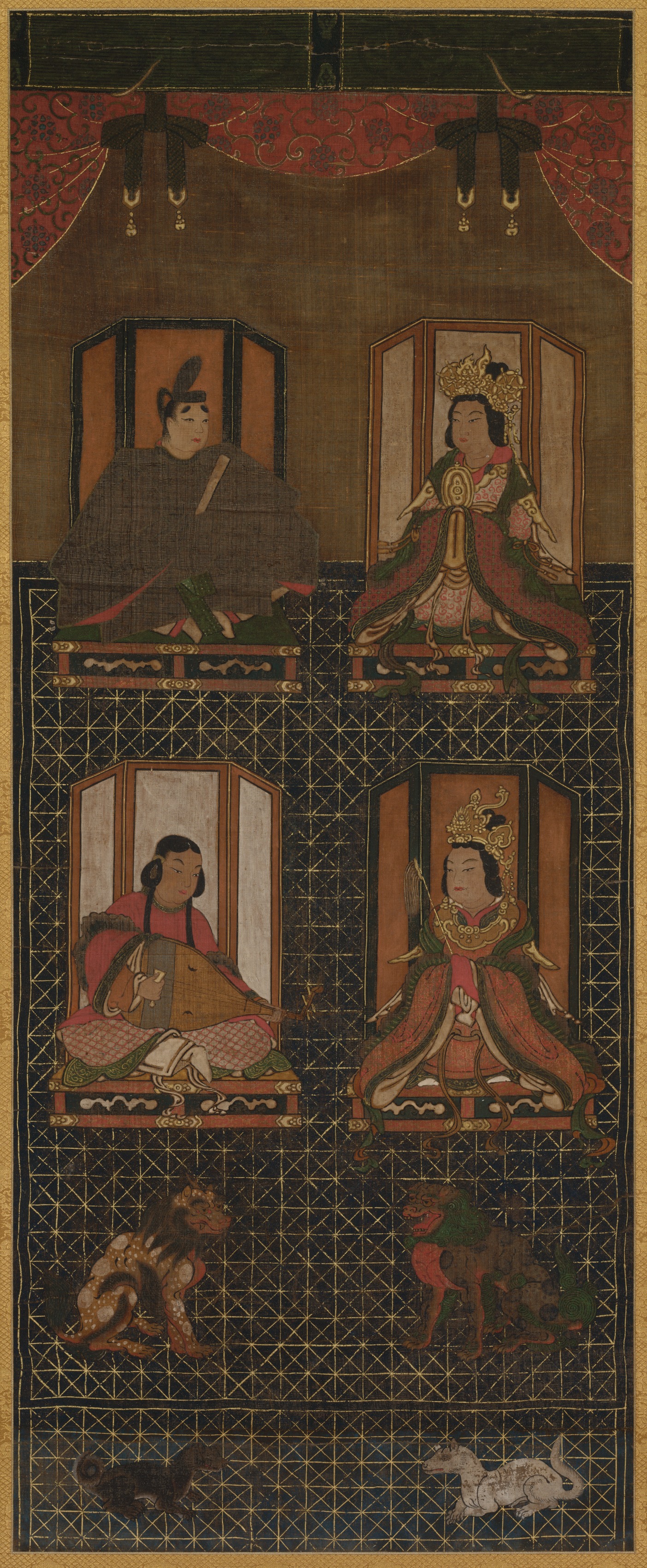
Cleveland 1999.262. The four tutelary kami of Mt. Kōya stacked on one scroll: Kariba and Niu Myōjin above (son and mother), Kehi Myōjin and the lute-playing Miyajima Myōjin below.
The Mandala of the Four Deities of Mt. Kōya (Cleveland 1999.262, Muromachi, 16th c., CC0) is Shingon’s own shrine mandala: the four tutelary kami who hold the mountain on which Kūkai built Kongōbu-ji, painted as a single vertical scroll. It is the Shingon counterpart to the Kasuga mandala of the Fujiwara, and it reads differently: a private mountain’s gods, not a clan shrine’s.
The work
Cleveland 1999.262 is a small painting on a tall mount. The painted field is only 97.5 by 39.3 cm; the full hanging scroll runs to 178.6 cm. That ratio matters. Most of the object is mounting silk, and the picture itself is a narrow vertical window, four figures stacked two-over-two, no landscape, no shrine buildings, no mountain. The Cleveland record dates it to the Muromachi 1500s and names the medium precisely: ink, color, and cut gold foil on silk. The gift is from Rosemarie and Leighton Longhi, 1999. The license is CC0.
The four figures are tutelary kami of Mt. Kōya. The Cleveland catalog identifies them in two registers. Above sit Kariba Myōjin and Niu Myōjin, described in the tradition as son and mother: Kariba in Japanese-style court robes, Niu in robes modelled on Tang-dynasty court dress. Below them sit Kehi Myōjin, a lady holding a whisk, and the youthful Miyajima Myōjin, his hair drawn up in loops, playing a biwa (lute). The catalog also records the tradition that Hōjō Masako (1157–1225), wife of the first Kamakura shōgun Minamoto Yoritomo, invited these deities to Mt. Kōya.
That Hōjō Masako attribution is the kind of detail worth pausing on rather than passing. It does not place the painting in the Kamakura period; the Cleveland scroll is Muromachi, three centuries later. It places the cult there: the four-deity set as a devotional grouping is being given a founding patron of the shogunal house, the same move the Kōya legend makes for the mountain itself with Kūkai. The scroll inherits a story about who first honoured these four together, and paints them as that story would want them seen, in court rank, at audience. The painting is late; the protocol it depicts is presented as old.
What the scroll does not show is as deliberate as what it does. There is no Dainichi disc in the sky, no register of honji buddhas above the kami, no path winding up a mountain. The Kasuga shrine mandalas the genre is usually read through put the buddhas in a band at the top and the shrine at the foot of Mt. Mikasa; this scroll refuses the diagram and gives only the gods, frontal, courtly, seated as if for an audience. The honji-suijaku doctrine is present, but it is held off the painted surface, which is itself a choice this article will come back to.
Reading the four deities
The two kami above are the ones the founding legend turns on. The Kōya tradition holds that Kūkai (774–835), seeking a mountain for his Shingon monastery, was granted the site by Niu Myōjin through an oracle, and was led to it by a hunter who was Niu’s son or emanation, Kariba Myōjin, also called Kōya Myōjin. Grapard records the legend in this form: Niu grants the land, Kariba the hunter shows the way, and Kongōbu-ji is founded around 816 on a mountain that was already the kami’s.1 The scroll’s upper register is that legend compressed into two seated figures. Kariba in Japanese court robes is the local hunter-god ennobled; Niu in Tang-style robes is the older, higher presence, her continental dress marking rank rather than foreign origin.
The lower register is less often explained. Kehi Myōjin appears as a court lady with a whisk; Miyajima Myōjin as a youth with a biwa, hair looped in the style that signals a divine child. These two complete the shisho myōjin, the “four luminous deities” of the title, drawing the Kōya pantheon together with kami imported from other sacred sites (the Kehi and Itsukushima/Miyajima associations) into a single tutelary set for the mountain. The scroll does not rank them by a buddha-correspondence grid. It ranks them by court protocol: elders above, attendants below, all four in the dress and posture of a Heian audience hall. The arrangement is bureaucratic rather than devotional, a seating chart for gods, and the kami are being shown the way the court would have shown its own. That is the visual logic the shrine-mandala genre runs on.
The cut gold foil is where the painter spent. Kirikane, gold leaf cut into fine lines and laid with adhesive, picks out the textile patterns and the haloes against an otherwise restrained ground. On a painting this small the technique is close work, and it concentrates on the upper pair: Niu’s Tang robes carry the densest gold, which reads, at the scale the scroll was made for, as rank made visible in light. The Cleveland medium line names cut gold foil explicitly, separating it from the brushed and powdered gold that a less careful painting of this date would have used. That is a connoisseurship point with consequences: kirikane at this fineness is a Kyoto-workshop competence, and its survival on a 16th-century provincial-cult subject says the four-deities scroll was not a cheap devotional object but a commissioned one, made by hands trained on higher-status work.
The composition also withholds the one thing the Esoteric mandala would foreground. There is no geometry. A Two-Worlds mandala is a grid before it is a picture; this scroll is a picture with no grid at all, the four kami floating on silk without architectural frame or cell. ten Grotenhuis’s organizing claim about the kami-site mandalas is that they are structured by sacred geography rather than by doctrinal diagram, and the Kōya scroll is almost a limit case of that claim: the geography has been abstracted away entirely, leaving only the gods who stand for the place.2 The mountain is not painted. The kami are the mountain, the way the besson icon’s held sutra is the wisdom it personifies. The scroll trusts the viewer to know that the four figures mean Mt. Kōya, and spends its silk on the figures rather than the slope.
What kind of mandala this is
The word “mandala” on this object is doing the looser of its two jobs. This is not a geometric Esoteric diagram of the Two Worlds. It is a miya mandara in the broad sense Tyler and ten Grotenhuis use for the kami-site mandalas: a devotional image of a sacred place’s gods, where the picture stands in for the place and the journey to it.32 ten Grotenhuis treats the kami-site mandalas (Kasuga, Kumano) as a third Japanese mandala tradition alongside the Esoteric and Pure Land lines, organized by sacred geography rather than by doctrinal grid.2 The Kōya scroll belongs to that third tradition. Its subject is a mountain’s gods, and owning or facing the scroll is a way of being present to Mt. Kōya without climbing it.
The honji-suijaku scaffolding is what holds the genre up: the kami are read as local traces (suijaku) of buddhas who are their original ground (honji). At Kōya the doctrinal endpoint is unusually tidy, because both Niu and Kariba were interpreted as manifestations of Dainichi (Mahāvairocana), the central buddha of Shingon and the deity of Kūkai’s lifelong attention. The mountain’s own gods resolve to the mountain’s own buddha. This is the leave-out point, taken once and then left: the full honji-suijaku theory, its Tendai and Shingon variants, and the buddha-to-kami correspondence tables belong to the concept page, not to a reading of this scroll. What the scroll needs from the doctrine is only this much: the four figures are gods of a place, and behind them, unpainted, stands Dainichi.
Kōya is not Kasuga
The genre’s center of gravity is Kasuga. The surviving shrine mandalas, the scholarship (Grapard’s Protocol of the Gods is a Kasuga study; Tyler’s book is a Kasuga study), and the museum holdings all lean toward the Fujiwara clan shrine at the foot of Mt. Mikasa. Reading the Kōya scroll through that literature is productive but needs one correction stated plainly. Kasuga is a clan shrine: the ancestral and tutelary shrine of the Fujiwara, the dominant aristocratic house, its mandalas tied to a lineage’s fortunes and its deities mapped onto the buddhas of a great Hossō temple, Kōfuku-ji. Kōya is not a clan’s shrine. It is a Shingon mountain’s own tutelary cult, the gods of the ground Kūkai negotiated for, with the doctrinal correspondence pointing inward to the school’s own central buddha rather than outward to a patron lineage’s temple.
That difference changes what the picture is for. A Kasuga deer mandala or shrine mandala carries the weight of a family’s relationship with its gods. The Kōya four-deities scroll carries a school’s relationship with the mountain that authorizes it: the founding legend made portable, the kami who said yes to Kūkai kept present to the institution they let exist. The iconography rhymes with Kasuga (court-dressed kami, vertical devotional format, honji-suijaku logic), and bodhi reads the Kōya scroll firmly inside the shrine-mandala genre Tyler and ten Grotenhuis define.
The comparandum hardens that placement. The Met holds an earlier treatment of exactly this four-deity subject (acc. 1994.309, object 44282), dated late 14th century, Nanbokuchō, ink, color, and gold on silk. Its painted field is 94 by 40.6 cm. The Cleveland field is 97.5 by 39.3 cm. Two scrolls, two collections, roughly two centuries apart, and almost the same painted dimensions: this is a stable, repeated devotional format, not an improvised one. The four-deities scroll was a known object that workshops made to a consistent size across the Nanbokuchō-to-Muromachi span, which is the strongest single argument that the Cleveland picture sits inside a genre rather than standing outside one.
The residual uncertainty is one of literature, not of type. The Kōya programme has nothing like the scholarly coverage Kasuga has. The Kōya-specific pages in the Kasuga-centered studies are thin, and the precise iconographic identification of Kehi and Miyajima rests here on the Cleveland catalog rather than on a dedicated monograph. The Cleveland dating (Muromachi, 1500s) is the museum’s catalog attribution, not an inscribed date; the Met comparandum confirms the type’s longevity but cannot fix this scroll’s year. bodhi commits to the genre placement and the honji-suijaku reading; what it does not claim is a tighter date or a named workshop, because the evidence for either is not in the object or the literature available here.
From in front of the scroll
The object asks to be read close and low. At under 40 cm wide, the painted field is roughly the span of two hands; the four kami are small, and the kirikane on Niu’s robes only resolves into ruled gold lines within arm’s reach. Step back to the distance the tall mount implies (a scroll hung in an alcove, viewed from the room) and the picture compresses into two gold-weighted figures above two quieter ones, a hierarchy legible before any single face is. There is no path to walk with the eye, the way a Kasuga shrine mandala asks the viewer to climb its silk. This scroll asks for the opposite: not a pilgrimage rendered as a picture, but an audience rendered as one, the mountain’s four gods seated and waiting, the buddha they resolve to deliberately left out of the room.
Related
- The Met’s two Kasuga shrine mandalas: the clan-shrine genre this scroll diverges from
- The Wakamiya Kasuga mandala: a single-deity honji-suijaku scroll for comparison
- Kūkai’s return from Tang, 806: the transmission that put Shingon on Mt. Kōya
- Honji-suijaku (entity)
- Kūkai (entity)
- Shingon (entity)
- Niu Myōjin (entity)
Footnotes
-
Grapard, The Protocol of the Gods (1992). The book is a study of the Kasuga cult; the Kōya founding legend (Niu Myōjin grants the site by oracle; Kariba Myōjin, her son or emanation, appears as a hunter and leads Kūkai to it; Kongōbu-ji founded c. 816) is used here at the contextual level. No Kōya-specific pages are cited: Kasuga is the volume’s subject, and the Kōya legend is drawn from the honji-suijaku framework rather than a Kōya monograph. ↩
-
ten Grotenhuis, Japanese Mandalas (1999). The kami-worshipping sites (Kasuga, Kumano) are treated as a third Japanese mandala tradition alongside the Esoteric and Pure Land lines, organized by sacred geography. Chapter-level citation; page numbers not verified. ↩ ↩2 ↩3
-
Tyler, The Cult of Kasuga Seen Through Its Art (1990). Used for the shrine-mandala (miya mandara) genre definition and the clan-shrine reading that the Kōya scroll is contrasted against. No Kōya-specific pages are cited; the book is Kasuga-centered and is cited for the genre, not for Kōya. ↩
Sources
-
Cleveland Open Access API (id 161027) verified: share_license_status CC0, Muromachi 1500–1573, painting 97.5×39.3 cm / overall 178.6×56.3 cm, Longhi gift. Catalog HTML retrieved 2026-05-16: identifies Kariba Myōjin + Niu Myōjin (son and mother) above, Kehi Myōjin (lady with whisk) + Miyajima Myōjin (youth with lute) below, and the Hōjō Masako (1157–1225) invitation tradition.
-
Principally a Kasuga study; used here for the honji-suijaku methodological framework and the Kūkai/Niu Myōjin oracle-and-hunter founding legend (Kariba as Niu's son/emanation leading Kūkai to the site, c. 816). No Kōya-specific pages are cited: Kasuga is the book's subject, and the Kōya legend is contextual.
-
The shrine-mandala genre and its honji-suijaku reading; used for the genre framing and the Kasuga contrast (clan shrine vs private mountain). No Kōya-specific pages are cited.
-
Treats kami-site mandalas (Kasuga, Kumano) as a third mandala tradition alongside Esoteric and Pure Land; used for the sacred-geography reading of shrine mandalas. Cited at chapter level.
-
Comparandum only. Met API object 44282 verified: accession 1994.309, public domain (CC0), late 14th c. (1367–92), image 94 × 40.6 cm — nearly identical painted dimensions to Cleveland 1999.262 (97.5 × 39.3 cm), establishing a stable repeated format across ~2 centuries. Not reproduced here; object facts from the Met API.